
The Impact of AI Chatbots on Learner Autonomy in Distance and Digital Education: A Systematic Literature Review
Article Sidebar
-
AI Chatbots, Learner Autonomy, Distance Education, Self-Regulated Learning, Artificial Intelligence in Education.
Abstract
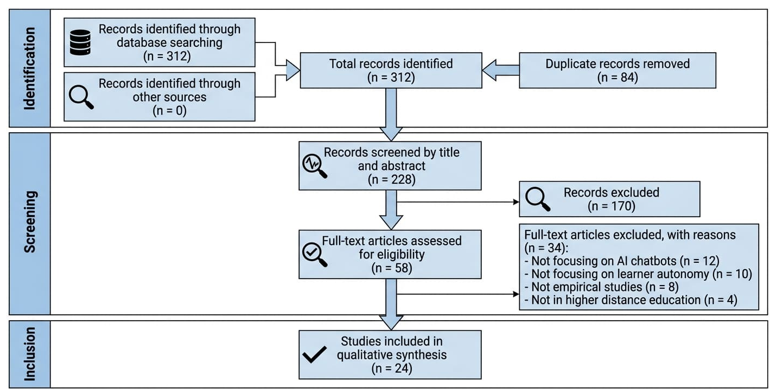
The rapid integration of Artificial Intelligence (AI) chatbots—such as ChatGPT, Claude, and specialized pedagogical agents—has significantly transformed distance and digital learning environments. However, their specific influence on learner autonomy remains a topic of ongoing scholarly investigation. This study presents a Systematic Literature Review (SLR) guided by the PRISMA framework to examine the impact of AI chatbots on learner autonomy in distance and higher education contexts. Synthesizing findings from peer-reviewed empirical studies published between 2021 and 2026 across major database repositories, this review investigates three core themes: self-regulated learning (SRL) strategies, motivational dynamics, and the risk of cognitive over-reliance. The results indicate that AI chatbots enhance cognitive and metacognitive self-regulation by providing personalized scaffolding, instant feedback, and goal-setting support. Nevertheless, negative side effects such as excessive dependency, reduced critical thinking, and reduced self-efficacy are observed when pedagogical scaffolding is insufficient. This paper concludes with a conceptual framework for balanced AI chatbot integration that fosters self-direction while mitigating cognitive passivity in distance education.
Full text article
References
Achuthan, K. (2025). Artificial intelligence and learner autonomy: A meta-analysis of self-regulated and self-directed learning. Frontiers in Education, 10, 1738751. https://doi.org/10.3389/feduc.2025.1738751
Al-kfairy, M., Mustafa, D., Kshetri, N., Insiew, M., & Alfandi, O. (2024). Ethical Challenges and Solutions of Generative AI: An Interdisciplinary Perspective. Informatics, 11(3), 58. https://doi.org/10.3390/informatics11030058
Alotaibi, J. O., & Alshahre, A. S. (2024). The role of conversational AI agents in providing support and social care for isolated individuals. Alexandria Engineering Journal, 108, 273–284. https://doi.org/10.1016/j.aej.2024.07.098
Arthur, F., Baba Yidana, M., & Yaw Sekyi Acquah, B. (2025). Self-regulated learning among higher education economics students: Does gender and academic level matter? Cogent Education, 12(1), 2579351. https://doi.org/10.1080/2331186X.2025.2579351
Aydemir, M. (2026). Online exams buffer the anxiety-procrastination-achievement pathway for distance learners with disabilities. Frontiers in Psychology, 17, 1806190. https://doi.org/10.3389/fpsyg.2026.1806190
Budhoo, T., & Roderique, M. J. (2026). AI-Enhanced Learning and Teacher Resilience in Guyana: A Self-Determination and Self-Regulated Learning Perspective. In AI and the Future of Learning—Psychological Perspectives on Student Success and Teacher Resilience [Working Title]. IntechOpen. https://doi.org/10.5772/intechopen.1016044
Ding, C., & Li, X. (2026). A mixed-methods study on the interplay between AI-assisted dynamic assessment, reading comprehension, and psychological adaptivity. Frontiers in Psychology, 17, 1798029. https://doi.org/10.3389/fpsyg.2026.1798029
Ding, D., & Muhyiddin B Yusof, A. (2025). Investigating the role of AI-powered conversation bots in enhancing L2 speaking skills and reducing speaking anxiety: A mixed methods study. Humanities and Social Sciences Communications, 12(1), 1223. https://doi.org/10.1057/s41599-025-05550-z
Engeness, I., Nohr, M., & Fossland, T. (2025). Investigating AI Chatbots’ Role in Online Learning and Digital Agency Development. Education Sciences, 15(6), 674. https://doi.org/10.3390/educsci15060674
Ganguly, A., Mehjabin, N., Malik, A., & Johri, A. (2026). Conversational AI agents in education: An umbrella review of current utilization, challenges, and future directions for ethical and responsible use. AI and Ethics, 6(1), 72. https://doi.org/10.1007/s43681-025-00916-0
Ghafar, Z. (2023). Teaching writing to Students of English as a foreign language: The Challenges Faced by Teachers. Journal Of Digital Learning And Distance Education, 2(2), 483–490. https://doi.org/10.56778/jdlde.v2i2.123
H. L. M. Mohideen. (2024). Exploring the Opportunities of Implementing Artificial Intelligence (AI) Technology for Teaching Arabic to Non-Native Speakers: A Theoretical Approach. Journal Of Digital Learning And Distance Education, 2(10), 760–767. https://doi.org/10.56778/jdlde.v2i9.225
Ilieva, G., Yankova, T., Ruseva, M., & Kabaivanov, S. (2025). A Framework for Generative AI-Driven Assessment in Higher Education. Information, 16(6), 472. https://doi.org/10.3390/info16060472
Khaenamkhaew, D. (2026). Procrastination in practice: Examining impacts and interventions for community development students in Thailand. Cogent Education, 13(1), 2678646. https://doi.org/10.1080/2331186X.2026.2678646
Klapproth, F. (2026). Redesigning Teaching, Learning, and Assessment in the Age of Generative AI: A Constructive Alignment Perspective for Higher Education. Education Sciences, 16(9), 1507. https://doi.org/10.3390/educsci16091507
Krakowski, S. (2025). Human-AI agency in the age of generative AI. Information and Organization, 35(1), 100560. https://doi.org/10.1016/j.infoandorg.2025.100560
Kuhail, M. A., Alturki, N., Alramlawi, S., & Alhejori, K. (2023). Interacting with educational chatbots: A systematic review. Education and Information Technologies, 28(1), 973–1018. https://doi.org/10.1007/s10639-022-11177-3
Kumar, A., Wongsirichot, T., & Nanthaamornphong, A. (2026). Generative AI in computing education: A systematic review and a framework for responsible integration. Computers and Education: Artificial Intelligence, 11, 100677. https://doi.org/10.1016/j.caeai.2026.100677
Lei, W., & Lei, Z. (2025). Exploring EFL teachers’ beliefs and practices of formative assessment in Chinese context. PLOS One, 20(9), e0333678. https://doi.org/10.1371/journal.pone.0333678
Li, Y., & Ritchie, T. (2026). Exploring University Students’ Experiences of Using Conversational Artificial Intelligence for Emotional and Relational Support in Experiences of Loneliness. Education Sciences, 16(10), 1640. https://doi.org/10.3390/educsci16101640
Lim, S., Yang, Q., Meng, J., & Rains, S. A. (2026). The role of communication in health-focused conversational AI: A review of systematic reviews examining conversational features, design characteristics, and interaction functions. Behaviour & Information Technology, 45(10), 2032–2059. https://doi.org/10.1080/0144929X.2025.2567989
Matz, S. C., Teeny, J. D., Vaid, S. S., Peters, H., Harari, G. M., & Cerf, M. (2024). The potential of generative AI for personalized persuasion at scale. Scientific Reports, 14(1), 4692. https://doi.org/10.1038/s41598-024-53755-0
Mithun Ramakrishnappa, Archana Manjegowda, Maltesh Shripadrao Kulkarni, & Varsha Tindlu Rajgopal. (2025). An Analytical Study of Augmented and Virtual Reality in Online Learning: Exploring Technological Advancements and Pedagogical Impacts. Journal Of Digital Learning And Distance Education, 4(7), 1791–1800. https://doi.org/10.56778/jdlde.v4i7.677
Mohamed, T. (2024). The Significance of the Language Laboratory for Arabic Non-Native Speakers in the Arabic Teaching Institutes of Sri Lanka. Journal Of Digital Learning And Distance Education, 3(1), 913–920. https://doi.org/10.56778/jdlde.v3i1.262
Mulaudzi, L. V., & Hamilton, J. (2025). Lecturer’s Perspective on the Role of AI in Personalized Learning: Benefits, Challenges, and Ethical Considerations in Higher Education. Journal of Academic Ethics, 23(4), 1571–1591. https://doi.org/10.1007/s10805-025-09615-1
Nazaretsky, T., Mejia-Domenzain, P., Swamy, V., Frej, J., & Käser, T. (2025). The critical role of trust in adopting AI-powered educational technology for learning: An instrument for measuring student perceptions. Computers and Education: Artificial Intelligence, 8, 100368. https://doi.org/10.1016/j.caeai.2025.100368
Nikolić, D., & Basta Nikolić, M. (2026). Designing AI-resilient assessment in higher education: A four-pillar conceptual framework. Frontiers in Artificial Intelligence, 9, 1841682. https://doi.org/10.3389/frai.2026.1841682
Novelo, R., Silva, R. R., & Bernardino, J. (2025). A Literature Review of Personalized Large Language Models for Email Generation and Automation. Future Internet, 17(12), 536. https://doi.org/10.3390/fi17120536
Peng, X., Qian, Y., & He, Y. (2026). When AI chatbots understand emotions: Exploring the mechanisms of self-disclosure from emotional arousal to psychological acceptance—a hybrid SEM–ANN–NCA analysis across multiple interaction configurations. Frontiers in Psychology, 16, 1724313. https://doi.org/10.3389/fpsyg.2025.1724313
Petrova, M. N. (2026). Strategies for developing AI competencies in higher education. Frontiers in Education, 10, 1683909. https://doi.org/10.3389/feduc.2025.1683909
Phung Tan, T., Tran Ngo Hanh, T., & Nguyen Hoang Huong, G. (2024). Learner Autonomy Through the Use of ChatGPT by Third-Year Students of English Faculty at University of Foreign Language Studies (UFLS). EDUKASIA: Jurnal Pendidikan Dan Pembelajaran, 5(2), 139–148. https://doi.org/10.62775/edukasia.v5i2.1159
Song, Y., Huang, L., Zheng, L., Fan, M., & Liu, Z. (2025). Interactions with generative AI chatbots: Unveiling dialogic dynamics, students’ perceptions, and practical competencies in creative problem-solving. International Journal of Educational Technology in Higher Education, 22(1), 12. https://doi.org/10.1186/s41239-025-00508-2
Tamaño, L. D. (2025). Utilizing TikTok in Enhancing Language Abilities: A Literature Review. Journal Of Digital Learning And Distance Education, 4(5), 1682–1688. https://doi.org/10.56778/jdlde.v4i5.586
Tripathi, T., Sharma, S. R., Singh, V., Bhargava, P., & Raj, C. (2025). Teaching and learning with AI: A qualitative study on K-12 teachers’ use and engagement with artificial intelligence. Frontiers in Education, 10, 1651217. https://doi.org/10.3389/feduc.2025.1651217
Tuna Pusa, E., & Dinçer, S. (2025). A Meta-synthesis Study on the Use of e-assessment Tools in Education. Sage Open, 15(3), 21582440251360495. https://doi.org/10.1177/21582440251360495
Vinci, V., Agrati, L. S., Berardi, P., & Beri, A. (2026). Artificial intelligence as a catalyst for transformative assessment: Designing teacher literacy at the crossroads of ethics, pedagogy, and human relationships. Frontiers in Education, 11, 1760626. https://doi.org/10.3389/feduc.2026.1760626
Wortha, F., Gerjets, P., Azevedo, R., Bernacki, M., Brucker, B., Bühler, B., Ehlis, A.-C., Kasneci, E., Miyake, A., Murayama, K., Nagengast, B., Roberts, B., Tibus, M., & Trautwein, U. (2026). A Conceptual Framework to Integrate Research Programs on Self-Regulation in Education. Educational Psychology Review, 38(1), 110. https://doi.org/10.1007/s10648-026-10196-7
Wu, E. (2026). Educational AI Auditing Across the Learning Lifespan: Concepts, Methods, Evidence, and Stage-Sensitive Governance. Encyclopedia, 6(9), 206. https://doi.org/10.3390/encyclopedia6090206
Xiaoyu, W., Zainuddin, Z., & Hai Leng, C. (2025). Generative artificial intelligence in pedagogical practices: A systematic review of empirical studies (2022–2024). Cogent Education, 12(1), 2485499. https://doi.org/10.1080/2331186X.2025.2485499
Yang, T.-C., Hsu, Y.-C., & Wu, J.-Y. (2025). The effectiveness of ChatGPT in assisting high school students in programming learning: Evidence from a quasi-experimental research. Interactive Learning Environments, 33(6), 3726–3743. https://doi.org/10.1080/10494820.2025.2450659
Authors
Copyright (c) 2026 JOURNAL OF DIGITAL LEARNING AND DISTANCE EDUCATION

This work is licensed under a Creative Commons Attribution 4.0 International License.
<a rel="license" href="http://creativecommons.org/licenses/by/4.0/"><img alt="Creative Commons License" style="border-width:0" src="https://i.creativecommons.org/l/by/4.0/88x31.png" /></a><br />This work is licensed under a <a rel="license" href="http://creativecommons.org/licenses/by/4.0/">Creative Commons Attribution 4.0 International License</a>.