
The Effectiveness of Interactive Learning Applications on Arabic Language Learning Outcomes: A Cognitive Perspective
Article Sidebar
-
Arabic Language Learning, Cognitive Theory, Interactive Learning Applications, Animaker Media, Sarf, Learning Outcomes
Abstract
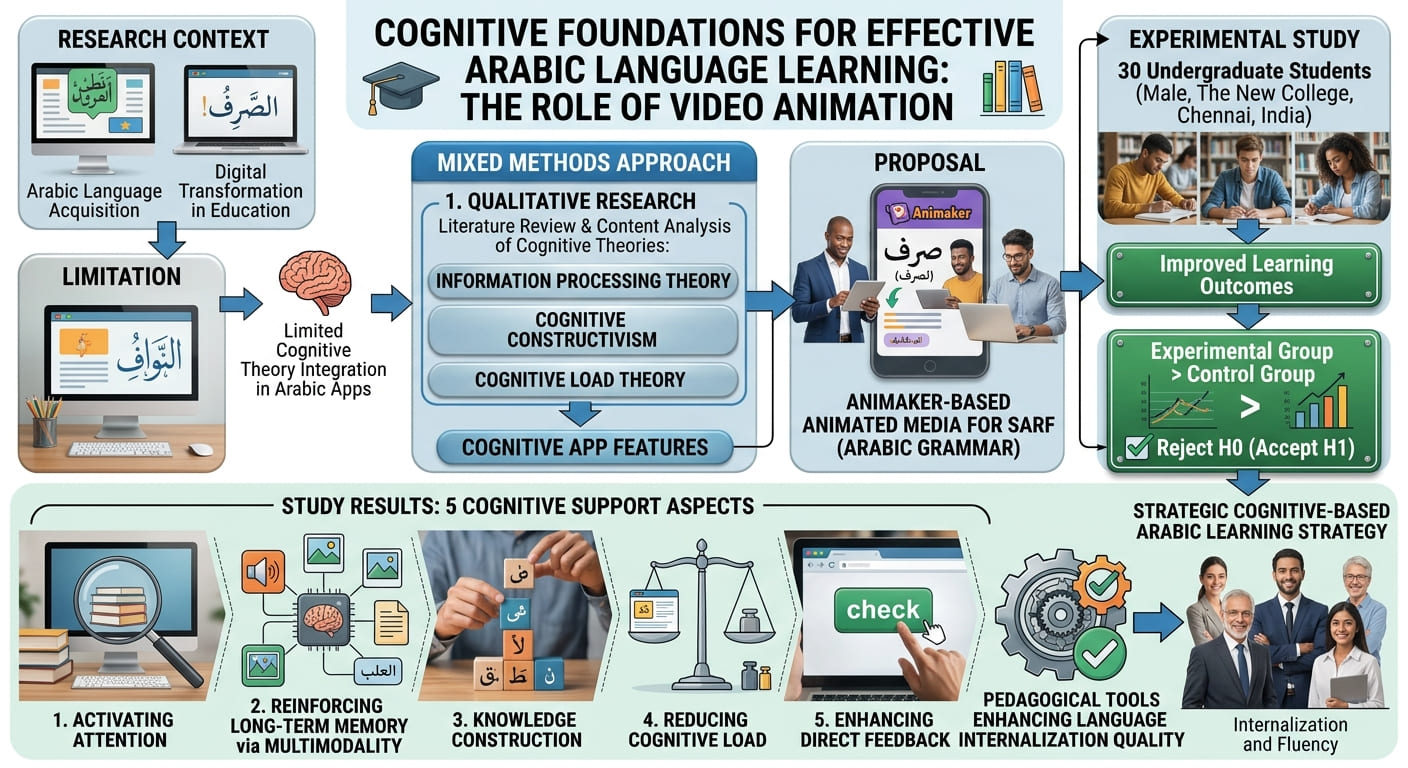
Digital transformation in education has promoted interactive learning applications as tools for foreign language acquisition, including Arabic. However, theoretical research integrating these applications from a cognitive perspective remains limited. This study examines how interactive learning applications support Arabic language learning based on cognitive learning theories: information processing theory, cognitive constructivism, and cognitive load theory. The research identifies cognitive features in applications, their relevance to Arabic learning, and potential for future development. A descriptive qualitative method was employed, using literature study and content analysis of academic sources. Additionally, an experimental study with 30 male undergraduate students at The New College, Chennai, India, measured the effectiveness of Animaker-based animated media in improving Arabic grammar (Sarf) learning outcomes. Results show that interactive applications support Arabic learning through five aspects: activating initial cognitive attention, reinforcing long-term memory via multimodality, knowledge construction, reducing cognitive load, and enhancing direct feedback. Experimental findings indicate Animaker media effectively improves Sarf learning outcomes, with a Mann-Whitney U-test significance value (2-tailed) of 0.004, less than 0.05, rejecting H0 and accepting H1. These findings confirm that learning applications are pedagogical tools enhancing language internalization quality. The study concludes that integrating interactive learning applications in Arabic language contexts is highly relevant and effective when based on cognitive principles, contributing scientifically to technology-based Arabic learning strategies adaptive to learners' mental processes.
Full text article
References
Akhmetzadina, Z. R., Mukhtarullina, A. R., Starodubtseva, E. A., Kozlova, M. N., & Pluzhnikova, Y. A. (2023). Review of effective methods of teaching a foreign language to university students in the framework of online distance learning: International experience. Frontiers in Education, 8, 1125458. https://doi.org/10.3389/feduc.2023.1125458
Amiruddin, M. (2023). User response of learning application Arabic language. International Journal of Language and Ubiquitous Learning, 1(2), 104–119. https://doi.org/10.70177/ijlul.v1i2.587
Andarwati, L. D., Erlina, Koderi, & Syahril, S. (2023). Learning Arabic Using Moodle Application Based E-Learning for Madrasah Aliyah│Pembelajaran Bahasa Arab dengan Menggunakan E-Learning Berbasis Aplikasi Moodle untuk Madrasah Aliyah. Mantiqu Tayr: Journal of Arabic Language, 3(2), 102–119. https://doi.org/10.25217/mantiqutayr.v3i2.3396
Ariska, D., Indrawati, N., & Zainuddin, A. (2022). Development of Stopmotion Video Animation Media in Qawa’Id Learning for Class XI Madrasah ’Aliyah Students | Pengembangan Media Animasi Stopmotion Video dalam Pembelajaran Qawa’Id pada Siswa Kelas XI Madrasah ‘Aliyah. Mantiqu Tayr: Journal of Arabic Language, 2(1), 1–12. https://doi.org/10.25217/mantiqutayr.v2i1.1670
Asmayawati, Yufiarti, & Yetti, E. (2024). Pedagogical innovation and curricular adaptation in enhancing digital literacy: A local wisdom approach for sustainable development in Indonesia context. Journal of Open Innovation: Technology, Market, and Complexity, 10(1), 100233. https://doi.org/10.1016/j.joitmc.2024.100233
Basori, B. (2018). Learning Foreign Languages Through Blended Learning. Scope : Journal of English Language Teaching, 2(02), 123. https://doi.org/10.30998/scope.v2i02.2313
Bautista-Vallejo, J. M., Hernández-Carrera, R. M., Moreno-Rodriguez, R., & Lopez-Bastias, J. L. (2020). Improvement of Memory and Motivation in Language Learning in Primary Education through the Interactive Digital Whiteboard (IDW): The Future in a Post-Pandemic Period. Sustainability, 12(19), 8109. https://doi.org/10.3390/su12198109
Damşa, C. I., & Ludvigsen, S. (2016). Learning through interaction and co-construction of knowledge objects in teacher education. Learning, Culture and Social Interaction, 11, 1–18. https://doi.org/10.1016/j.lcsi.2016.03.001
Deep, P. D., Chen, Y., Ghosh, N., & Rahaman, Md. S. (2024). The Influence of Student–Instructor Communication Methods on Student Engagement and Motivation in Higher Education Online Courses During and After the COVID-19 Pandemic. Education Sciences, 15(1), 33. https://doi.org/10.3390/educsci15010033
Fatmasari, R. K. (2025). The Effectiveness of Hybrid Learning Model with Emotional Design Approach in Improving Digital Literacy of Junior High School Students. Journal of English Language and Education, 10(3), 844–853. https://doi.org/10.31004/jele.v10i4.1026
Gazioğlu, M., & Karakuş, N. (2023). The impact of multisensory learning model-based tale-telling on listening skills and student opinions about it. Frontiers in Education, 8, 1137042. https://doi.org/10.3389/feduc.2023.1137042
Hady, R., Nasri, U., Hajras, M., Hasyim, M., & Rahmatullah, A. J. (2025). The Revolution of Arabic Language Learning: Integration of Digital Technology in 21st Century Education. Jurnal Ilmiah Profesi Pendidikan, 10(2), 1593–1599. https://doi.org/10.29303/jipp.v10i2.3444
Jamhuri, W., & Kasih, Bq. W. N. (2024). Development Quizizz Application As Instrument Evaluation in Arabic Language Learning for Class X at MAN 2 Mataram. IJ-ATL (International Journal of Arabic Teaching and Learning), 8(2). https://doi.org/10.33650/ijatl.v8i2.9696
Jihan Gina Fadila, A. N. M. (2026). The Use of Instructional Videos in Enhancing Arabic Language Comprehension: A Qualitative Study and Systematic Literature Review. Zenodo. https://doi.org/10.5281/ZENODO.20506397
Lin, Q., & He, L. (2026). How do individuals’ concerns about artificial intelligence affect their job crafting? Evidence from the Chinese hospitality sector. Journal of Innovation & Knowledge, 101167. https://doi.org/10.1016/j.jik.2026.101167
López-Meneses, E., Mellado-Moreno, P. C., Gallardo Herrerías, C., & Pelícano-Piris, N. (2025). Educational Data Mining and Predictive Modeling in the Age of Artificial Intelligence: An In-Depth Analysis of Research Dynamics. Computers, 14(2), 68. https://doi.org/10.3390/computers14020068
Mayer, R. E., & Moreno, R. (2003). Nine Ways to Reduce Cognitive Load in Multimedia Learning. Educational Psychologist, 38(1), 43–52. https://doi.org/10.1207/S15326985EP3801_6
Mudinillah, A. (2019). The Development of Interactive Multimedia Using Lectora Inspire Application in Arabic Language Learning. Jurnal Iqra’ : Kajian Ilmu Pendidikan, 4(2), 285–300. https://doi.org/10.25217/ji.v4i2.570
Mutasim, A. S. (2026). E-Learning Barriers and Opportunities in Higher Education in Saudi Arabian Universities: A Literature Review. Journal Of Digital Learning And Distance Education, 4(9), 1855–1863. https://doi.org/10.56778/jdlde.v4i9.648
Ndibalema, P. (2025). Digital literacy gaps in promoting 21st century skills among students in higher education institutions in Sub-Saharan Africa: A systematic review. Cogent Education, 12(1), 2452085. https://doi.org/10.1080/2331186X.2025.2452085
Novalina Indriyani, Yeni Erita, Mayrisa Undari, & Wiwit Sanjaya. (2022). Comparison of Civics and Social Studies Learning Design Models in Various Countries at the Elementary School Level. Journal Of Digital Learning And Distance Education, 1(7), 258–269. https://doi.org/10.56778/jdlde.v1i7.44
Pane, P. R., Pujiastuti, S., & Lubis, N. (2026). The Development of Interactive Learning Media to Improve Vocabulary Skills at the A1 Level: Penelitian. Jurnal Pengabdian Masyarakat Dan Riset Pendidikan, 4(4), 22594–22600. https://doi.org/10.31004/jerkin.v4i4.5982
Patras, Y. E., Naibaho, M. M., Karmila, N., Marini, A., & Hidayat, R. (2023). Development of Video Learning Media based on Filmora in Technology Topics for Elementary Students. Pedagonal : Jurnal Ilmiah Pendidikan, 7(2), 168–178. https://doi.org/10.55215/pedagonal.v7i2.8983
Pedroso, J. E., Notes, F. A., Ferrer, M. P., Jardeleza, L. C., Estuya, C. B., & Empil, B. D. (2024). Social Media as a Coping Tool Amongst Social Studies Pre-Service Teachers. Journal Of Digital Learning And Distance Education, 3(7), 1154–1167. https://doi.org/10.56778/jdlde.v3i7.367
Purba, R. A. (2022). Hybrid Models with Technology: Is it Effective for Learning in Abnormal Situations? Journal of Education Research and Evaluation, 6(1), 1–9. https://doi.org/10.23887/jere.v6i1.41546
Putri, A. S., Radandima, G. U. E., & Setiawan, A. (2024). Analysis of The Constructivist Approach in The Learning Process of Public Policy. Jejaring Administrasi Publik, 16(2), 115–130. https://doi.org/10.20473/jap.v16i2.53461
Robi’ah, S., Shodiq, M. J., Tukimin, T., & Astuti, H. (2023). Development of interactive multimedia for Arabic vocabulary learning through Android applications. International Journal of Arabic Language Teaching, 5(02), 301. https://doi.org/10.32332/ijalt.v5i02.7957
Sanusi, T. O. & Hameed Olalekan Bolaji. (2024). Awareness and Perceived Instructional Usefulness of Arabic Language Application Software among Junior Secondary School Students. Jurnal Pendidikan Multikultural Indonesia, 7(1), 88–95. https://doi.org/10.23887/jpmu.v7i1.67846
Skulmowski, A., & Xu, K. M. (2022). Understanding Cognitive Load in Digital and Online Learning: A New Perspective on Extraneous Cognitive Load. Educational Psychology Review, 34(1), 171–196. https://doi.org/10.1007/s10648-021-09624-7
Solis Trujillo, B. P., Velarde-Camaqui, D., Gonzales Nuñez, C. A., Castillo Silva, E. V., & Gonzalez Said De La Oliva, M. D. P. (2025). The current landscape of formative assessment and feedback in graduate studies: A systematic literature review. Frontiers in Education, 10, 1509983. https://doi.org/10.3389/feduc.2025.1509983
Strielkowski, W., Grebennikova, V., Lisovskiy, A., Rakhimova, G., & Vasileva, T. (2025). AI ‐driven adaptive learning for sustainable educational transformation. Sustainable Development, 33(2), 1921–1947. https://doi.org/10.1002/sd.3221
Sudika Puja, I. B. K., Wawan Sudatha, I. G., & Sudarma, I. K. (2026a). Development of Interactive Learning Multimedia Based on Krashen’s Second Language Acquisition Theory in Elementary School English Learning. International Journal of Elementary Education, 10(2), 351–363. https://doi.org/10.23887/ijee.v10i2.119453
Sudika Puja, I. B. K., Wawan Sudatha, I. G., & Sudarma, I. K. (2026b). Development of Interactive Learning Multimedia Based on Krashen’s Second Language Acquisition Theory in Elementary School English Learning. International Journal of Elementary Education, 10(2), 351–363. https://doi.org/10.23887/ijee.v10i2.119453
Sufianti, A. V. (2022). Hubungan Gaya Belajar Dengan Multiple Intellegences Terhadap Prestasi Peserta Didik. Indonesian Research Journal On Education, 2(1), 138–145. https://doi.org/10.31004/irje.v2i1.253
Sullivan, S., Gaydon, M., Panton, S., Nguyen, X. H., & Richardson, J. (2026). Perceptions of feedback: The use of self-reflection to improve student satisfaction. Assessment & Evaluation in Higher Education, 51(2), 301–314. https://doi.org/10.1080/02602938.2025.2572034
Teoh, S. H., Boon Zik Hong, J., Md Shamsudin, N., Singh, P., & Hartono, R. (2025). Students’ engagement in a hybrid classroom: A comparison between face-to-face and virtual environments. Cogent Education, 12(1), 2451497. https://doi.org/10.1080/2331186X.2025.2451497
Wahyuni, A. S., Arifin, Z., & Rahmawati, R. (2024). The Effectiveness of the Teams Games Tournament Cooperative Learning Strategies in Qira’ah Jahriyah | faʿāliyat istikhdām istirātījiyyat al-taʿallum al-taʿāwunī binawʿ jawlāt ʾalʿāb al-farīq fī tadrīs al-qirāʾah al-jahriyyah. Al-Ta’rib : Jurnal Ilmiah Program Studi Pendidikan Bahasa Arab IAIN Palangka Raya, 12(1), 147–158. https://doi.org/10.23971/altarib.v12i1.7931
Wu, Y. (2026). Optimizing cognitive load in Guzheng learning: A narrative review of demonstration, segmented practice, and feedback scaffolding. Frontiers in Psychology, 17, 1881131. https://doi.org/10.3389/fpsyg.2026.1881131
Yadav, H., & Dhar, R. L. (2026). A boon or a bane? Demystifying employee AI awareness (AIA): A systematic review and future research agenda. Acta Psychologica, 270, 107841. https://doi.org/10.1016/j.actpsy.2026.107841
Zou, Y., Kuek, F., Feng, W., & Cheng, X. (2025). Digital learning in the 21st century: Trends, challenges, and innovations in technology integration. Frontiers in Education, 10, 1562391. https://doi.org/10.3389/feduc.2025.1562391
Authors
Copyright (c) 2026 JOURNAL OF DIGITAL LEARNING AND DISTANCE EDUCATION

This work is licensed under a Creative Commons Attribution 4.0 International License.
<a rel="license" href="http://creativecommons.org/licenses/by/4.0/"><img alt="Creative Commons License" style="border-width:0" src="https://i.creativecommons.org/l/by/4.0/88x31.png" /></a><br />This work is licensed under a <a rel="license" href="http://creativecommons.org/licenses/by/4.0/">Creative Commons Attribution 4.0 International License</a>.