
The Use of Edmodo in Teaching Arabic as a Web-Based Learning Model: A Case Study at The New College, Chennai, India
Article Sidebar
-
Edmodo, web-based learning, Arabic teaching, e-learning, The New College Chennai
Abstract
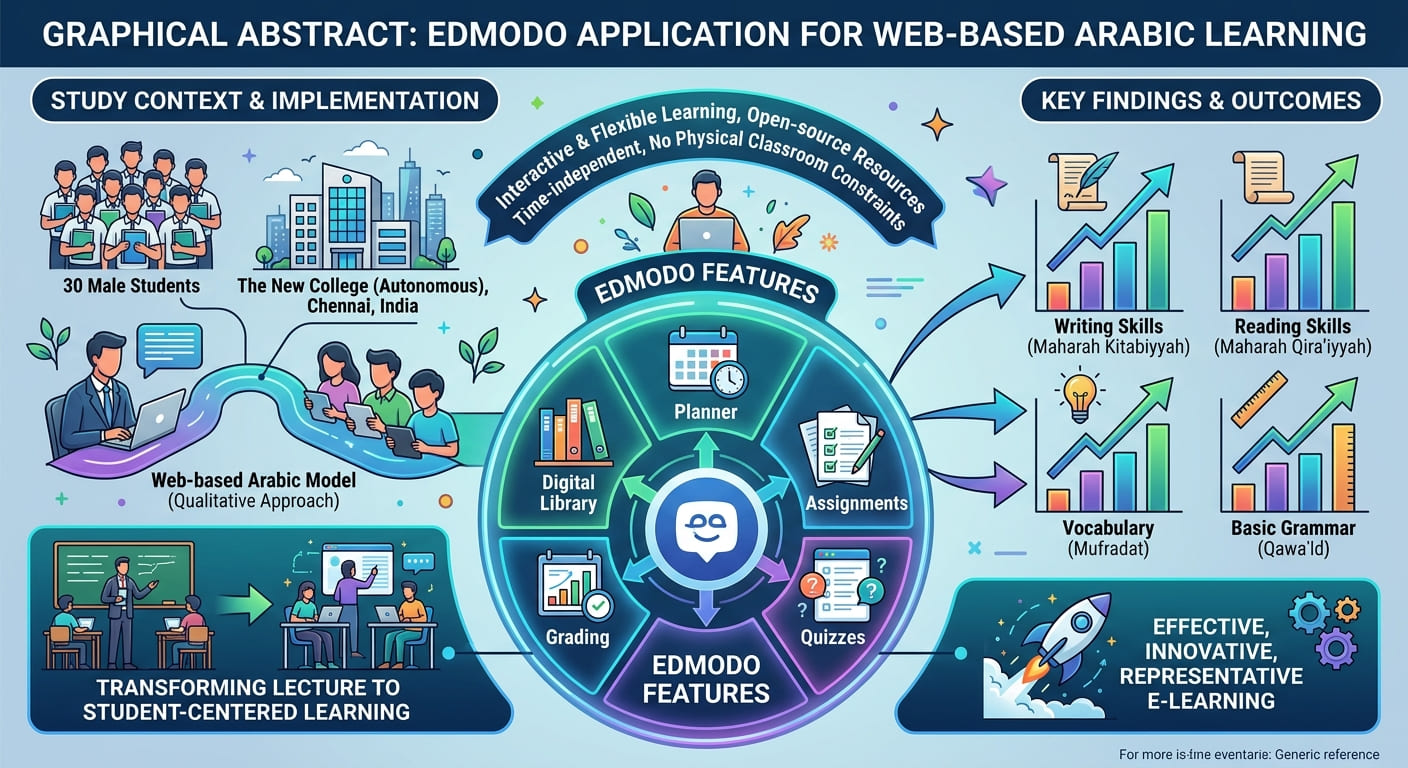
This study investigates the use of the Edmodo application as a web-based learning model for teaching Arabic to 30 male students in the Department of Arabic at The New College (Autonomous), Chennai, India. The primary purpose was to identify the characteristics, features, and implementation of Edmodo in enhancing the effectiveness of Arabic language instruction. Employing a qualitative approach, this research focused on how Edmodo facilitates an interactive and flexible learning atmosphere, allowing students and instructors to access extensive open-source resources, distribute assignments, and conduct assessments without the constraints of time and physical classroom presence. The results demonstrate that Edmodo possesses comprehensive features—including a digital library, planner, assignments, quizzes, and grading—that significantly improve the Arabic learning process. Key findings indicate an increase in students’ average performance in writing skills (maharah kitabiyyah), reading skills (maharah qira'iyyah), vocabulary (mufradat), and basic grammar (qawa'id). The study concludes that Edmodo is an effective, innovative, and representative medium for web-based Arabic instruction, capable of transforming traditional lecture-based methods into more student-centered, engaging, and accessible e-learning experiences. The implications suggest that similar digital platforms should be integrated into other courses to support technology-driven higher education.
Full text article
References
Alabdali, S. A., Pileggi, S. F., & Cetindamar, D. (2023). Influential Factors, Enablers, and Barriers to Adopting Smart Technology in Rural Regions: A Literature Review. Sustainability, 15(10), 7908. https://doi.org/10.3390/su15107908
AlRamamneh, Y. M., Ali, N., Kasasbeh, N. A., Hussien, A. M., Almajdoub, Z., & Alamoush, I. M. (2026). Teachers as designers of gamified pedagogical infrastructure: ClassPoint use in language classrooms. Frontiers in Education, 11, 1861576. https://doi.org/10.3389/feduc.2026.1861576
Alshammari, S. H., & Babu, E. (2025). The mediating role of satisfaction in the relationship between perceived usefulness, perceived ease of use and students’ behavioural intention to use ChatGPT. Scientific Reports, 15(1), 7169. https://doi.org/10.1038/s41598-025-91634-4
Alzahrani, B., Bahaitham, H., Andejany, M., & Elshennawy, A. (2021). How Ready Is Higher Education for Quality 4.0 Transformation according to the LNS Research Framework? Sustainability, 13(9), 5169. https://doi.org/10.3390/su13095169
Balakrishnan, V., Liew, T. K., & Pourgholaminejad, S. (2015). Fun learning with Edooware – A social media enabled tool. Computers & Education, 80, 39–47. https://doi.org/10.1016/j.compedu.2014.08.008
Bhat, A. R., & Ahmed, S. (2025). Artificial intelligence (AI) in drug design and discovery: A comprehensive review. In Silico Research in Biomedicine, 1, 100049. https://doi.org/10.1016/j.insi.2025.100049
Chen, J., Kolmos, A., & Du, X. (2021). Forms of implementation and challenges of PBL in engineering education: A review of literature. European Journal of Engineering Education, 46(1), 90–115. https://doi.org/10.1080/03043797.2020.1718615
Chorbwhan, R., Dueraman, B., Wasoh, F.-E., Pinaebango, H., & Boonsuk, Y. (2026). ‘ If we only focus on one model, it’s harder to survive outside the classroom’: Where should students stand when English is not only British and American? Language, Culture and Curriculum, 1–28. https://doi.org/10.1080/07908318.2026.2690203
Cocho-Bermejo, A. (2025). Adaptive Architectural Facades: Review 1985–2024. A Comparative Analysis of Media-TIC, the Arab Institute, and Al Bahar Towers Dynamic Facades Approaches. Nexus Network Journal, 27(4), 925–945. https://doi.org/10.1007/s00004-025-00831-1
Dang, T., Haapanen, M., & Suhonen, T. (2026). The long-term health consequences of expanding access to higher education. Economics of Education Review, 112, 102794. https://doi.org/10.1016/j.econedurev.2026.102794
Dr K M A Ahamed Zubair. (2026). Arabic Scrambled Card Games for Vocabulary Mastery: An Experimental Study at The New College, Chennai. Journal Of Digital Learning And Distance Education, 4(12), 2068–2075. https://doi.org/10.56778/jdlde.v4i12.683
E, E., Liu, W., & Li, Y. (2025). A qualitative study of question-posing anxiety in Chinese postgraduates in UK TESOL programs. Scientific Reports, 16(1), 2081. https://doi.org/10.1038/s41598-025-31915-0
Falade, A. A. (2023). Lecturers’ Awareness in the use of Edmodo for Teaching. Indonesian Journal Of Educational Research and Review, 6(1), 46–53. https://doi.org/10.23887/ijerr.v6i1.60365
H. L. M. Mohideen. (2024). Exploring the Opportunities of Implementing Artificial Intelligence (AI) Technology for Teaching Arabic to Non-Native Speakers: A Theoretical Approach. Journal Of Digital Learning And Distance Education, 2(10), 760–767. https://doi.org/10.56778/jdlde.v2i9.225
Hasanah, M., Halim, A., Safitri, R., & Yusrizal, Y. (2021). Pengaruh Model Pembelajaran Flipped Classroom Berbasis Edmodo Terhadap Hasil Belajar Peserta Didik Pada Topik Gelombang Bunyi. Jurnal Penelitian Pendidikan IPA, 7(SpecialIssue), 180–186. https://doi.org/10.29303/jppipa.v7iSpecialIssue.1061
Hassan Rakha, A., & Abdo Khalifa, M. (2024). Blended Learning Using Edmodo: Students’ Performance and Attitude in Boxing During COVID-19. Sage Open, 14(2), 21582440241253743. https://doi.org/10.1177/21582440241253743
H.L.M. Mohideen & A. Abdul Rasheed. (2024). Digitalizing Arabic Teaching for Non-Native Speakers in Sri Lanka: Challenges and Opportunities. Journal Of Digital Learning And Distance Education, 3(1), 902–912. https://doi.org/10.56778/jdlde.v3i1.263
K. M. A. Ahamed Zubair. (2025). Code-switching and Language-mixing among the AFL students of Chennai: Influence of Mother Tongue on the Use of Arabic as the Second Language. Journal Of Digital Learning And Distance Education, 3(8), 1228–1239. https://doi.org/10.56778/jdlde.v3i8.400
Karahan, A., Demircan, N., Özgeriş, M., Gökçe, O., & Karahan, F. (2025). Integration of Drones in Landscape Research: Technological Approaches and Applications. Drones, 9(9), 603. https://doi.org/10.3390/drones9090603
Kayanja, W., Kyambade, M., & Kiggundu, T. (2025). Exploring digital transformation in higher education setting: The shift to fully automated and paperless systems. Cogent Education, 12(1), 2489800. https://doi.org/10.1080/2331186X.2025.2489800
Kraus, S., Jones, P., Kailer, N., Weinmann, A., Chaparro-Banegas, N., & Roig-Tierno, N. (2021). Digital Transformation: An Overview of the Current State of the Art of Research. Sage Open, 11(3), 21582440211047576. https://doi.org/10.1177/21582440211047576
Lee, S. Y., & Kim, J. B. (2025). Toward optimal second language acquisition and proficiency: Addressing limited exposure and educational inequality in EFL contexts through home-based approaches and interdisciplinary insights. Ampersand, 15, 100226. https://doi.org/10.1016/j.amper.2025.100226
Lu, A., Liu, S., & Chen, W. (2024). Perceived usefulness of English (L2) learning apps and language mindset mediated by flow and motivation intensity: A serial mediation model and a network analysis. Interactive Learning Environments, 1–20. https://doi.org/10.1080/10494820.2024.2375637
Ma, Y., & Chen, M. (2025). The human touch in AI: Optimizing language learning through self-determination theory and teacher scaffolding. Frontiers in Psychology, 16, 1568239. https://doi.org/10.3389/fpsyg.2025.1568239
Mabotha, P. A. P., & Ngcamu, B. S. (2025). Digital Transformation in the Higher Education Sector: A Systematic Literature Review. Administrative Sciences, 16(1), 1. https://doi.org/10.3390/admsci16010001
Matan, P., & Velvizhy, P. (2025). A neuro-symbolic AI approach for translating children’s stories from English to Tamil with emotional paraphrasing. Scientific Reports, 15(1), 20348. https://doi.org/10.1038/s41598-025-03290-3
Mhlongo, S., Mbatha, K., Ramatsetse, B., & Dlamini, R. (2023). Challenges, opportunities, and prospects of adopting and using smart digital technologies in learning environments: An iterative review. Heliyon, 9(6), e16348. https://doi.org/10.1016/j.heliyon.2023.e16348
Mohamed, T. (2024). The Significance of the Language Laboratory for Arabic Non-Native Speakers in the Arabic Teaching Institutes of Sri Lanka. JOURNAL OF DIGITAL LEARNING AND DISTANCE EDUCATION, 3(1), 913–920. https://doi.org/10.56778/jdlde.v3i1.262
Nagoor Gani, S. H., Selvaraj, V., Md, S. I., Thalapathy, S., Abdulkadhar, M. J., & Kalimuthu, K. (2025). Revolutionising English language education:empowering teachers with BERT-LSTM-driven pedagogical tools. Humanities and Social Sciences Communications, 12(1), 1327. https://doi.org/10.1057/s41599-025-05699-7
Pan, L., Luo, H., He, X., & Ye, Y. (2025). Bridging foreign language classroom anxiety to Thai students’ Chinese language success. Acta Psychologica, 256, 105018. https://doi.org/10.1016/j.actpsy.2025.105018
Prinsloo, L. (2026). Digital transformation in higher education: A bibliometric analysis of global and South African trends (2013–2023)’. SN Social Sciences, 6(4), 151. https://doi.org/10.1007/s43545-026-01405-9
Rahman, Md. H., Bin Amin, M., Yusof, M. F., Islam, Md. A., & Afrin, S. (2024). Influence of teachers’ emotional intelligence on students’ motivation for academic learning: An empirical study on university students of Bangladesh. Cogent Education, 11(1), 2327752. https://doi.org/10.1080/2331186X.2024.2327752
Ravichandran, B., & Shanmugam, K. (2024). Adoption of EdTech products among college students: A conceptual study. Management Matters, 21(1), 1–19. https://doi.org/10.1108/MANM-07-2023-0026
Ross, P. M. (2026). Evolution of academic roles, the emergence of education focused roles, and the policy solutions needed for building resilience in education focused academic roles in higher education. Higher Education Research & Development, 45(3), 781–799. https://doi.org/10.1080/07294360.2025.2548280
Wochele-Thoma, T., Ijinu, T. P., Sasidharan, S. P., Manakkadan, A., Shine, L. S., Krishnakumar, N. M., Aruna, S. I., Pasupuleti, N., Aswany, T., Deepthi, D. C., Ma, Z., Hua, Y., Ławiński, M., Litvinova, O., Kletecka-Pulker, M., & Atanasov, A. G. (2026). Global English-language-dominated discourse on artificial intelligence in healthcare: A three-year longitudinal analysis of the #AIinHealthcare movement on X. Frontiers in Digital Health, 8, 1795488. https://doi.org/10.3389/fdgth.2026.1795488
Xia, Y., Shin, S.-Y., & Kim, J.-C. (2024). Cross-Cultural Intelligent Language Learning System (CILS): Leveraging AI to Facilitate Language Learning Strategies in Cross-Cultural Communication. Applied Sciences, 14(13), 5651. https://doi.org/10.3390/app14135651
Yang, F., Dantes, G. R., Suwastini, N. K. A., & Wahyuni, D. S. (2026). A Comprehensive Factors Framework for Digital Transformation in Basic Education: A Systematic Review. Education Sciences, 16(7), 1138. https://doi.org/10.3390/educsci16071138
Yeganeh, L. N., Fenty, N. S., Chen, Y., Simpson, A., & Hatami, M. (2025). The Future of Education: A Multi-Layered Metaverse Classroom Model for Immersive and Inclusive Learning. Future Internet, 17(2), 63. https://doi.org/10.3390/fi17020063
Zeyab, A., & M. Alayyar, G. (2023). Perspective Chapter: Education Technology (EdTech) and the Online Course Revolution. In L. Waller & S. Kay Waller (Eds.), Education and Human Development (Vol. 4). IntechOpen. https://doi.org/10.5772/intechopen.109227
Zou, Y., Kuek, F., Feng, W., & Cheng, X. (2025). Digital learning in the 21st century: Trends, challenges, and innovations in technology integration. Frontiers in Education, 10, 1562391. https://doi.org/10.3389/feduc.2025.1562391
Authors
Copyright (c) 2026 JOURNAL OF DIGITAL LEARNING AND DISTANCE EDUCATION

This work is licensed under a Creative Commons Attribution 4.0 International License.
<a rel="license" href="http://creativecommons.org/licenses/by/4.0/"><img alt="Creative Commons License" style="border-width:0" src="https://i.creativecommons.org/l/by/4.0/88x31.png" /></a><br />This work is licensed under a <a rel="license" href="http://creativecommons.org/licenses/by/4.0/">Creative Commons Attribution 4.0 International License</a>.