
AI in Action: Exploring Practice Teachers' Integration of Artificial Intelligence in Lesson Demonstrations
Article Sidebar
-
artificial intelligence, practice teachers, lesson demonstrations
Abstract
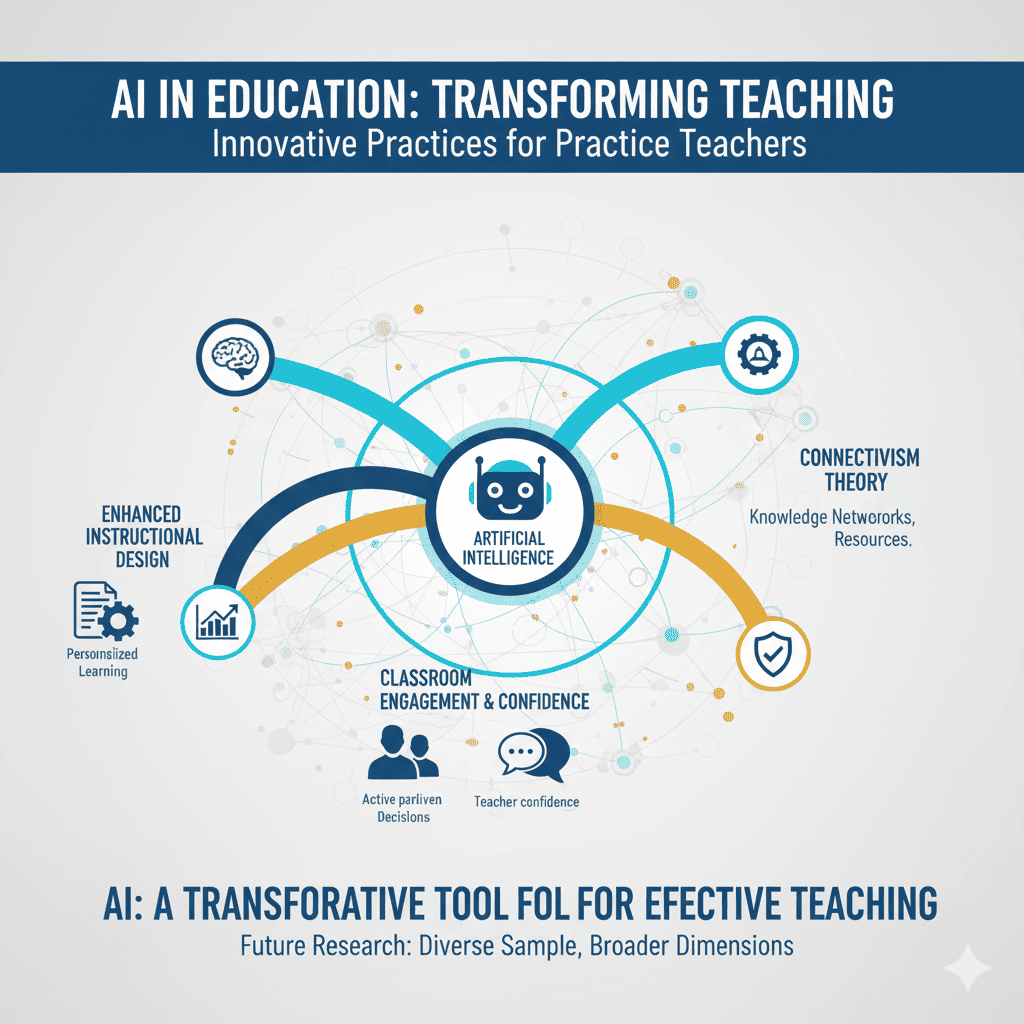
Artificial Intelligence (AI) plays a crucial role in our ever-evolving digital world. It benefits 21st-century citizens by offering a wide range of tools that drive technological advancements across various fields, including medicine, science, and, most importantly, the educational landscape. The integration of AI in education supports practice teachers by enabling innovative teaching practices, personalized learning experiences, and data-driven decision-making. Accordingly, this study explored the integration of artificial intelligence into the lesson demonstrations of practice teachers. It is anchored in George Siemens’ Connectivism Theory, which posits that knowledge is distributed across networks and that learning occurs through connections between people, ideas, and resources. Employing a descriptive qualitative approach, the study identified five major themes and fourteen subthemes. Findings conclude that AI serves as a transformative tool that enhances instructional design, classroom engagement, and teacher confidence when thoughtfully integrated into lesson demonstrations. It is recommended that future research involve a larger and more diverse sample and explore broader dimensions of AI in education to deepen understanding and support effective implementation.
Full text article
References
Abualrob, M. M. (2025). Innovative teaching: How pre-service teachers use artificial intelligence to teach science to fourth graders. Contemporary Educational Technology, 17(1), ep547. https://doi.org/10.30935/cedtech/15686
Alenezi, A. (2023). Teacher Perspectives On Ai-Driven Gamification: Impact On Student Motivation, Engagement, And Learning Outcomes. Information Technologies and Learning Tools, 97(5), 138–148. https://doi.org/10.33407/itlt.v97i5.5437
Al-Mansouri, J. O. (2024). The Impact of Real-Time Feedback on Optimizing Teachers’ Classroom Teaching Pace. Research and Advances in Education, 3(11), 45–48. https://doi.org/10.56397/RAE.2024.11.06
Apetorgbor, M., Narad, S., Akpabio, E., Dhawale, C., Konto, A., & Verma, P. (2024). Leveraging Artificial Intelligence for Effective Assessment and Evaluation in Education: A Comprehensive Review. 2024 2nd DMIHER International Conference on Artificial Intelligence in Healthcare, Education and Industry (IDICAIEI), 1–6. https://doi.org/10.1109/IDICAIEI61867.2024.10842940
Baque Guerra, V. E., Zavala O’Brien, M. I., Mendoza Bajaña, V. P., Recalde Villacrés, E. B., Nevares Pacheco, M. D. J., Castillo Rodríguez, N. E., & Barreto Zúñiga, W. W. (2024). Percepciones y experiencias de docentes universitarios sobre la inteligencia artificial: Transformación, ética y desafíos en el uso académico por estudiantes: Perceptions and experiences of university teachers on artificial intelligence: transformation, ethics and challenges in academic use by students. LATAM Revista Latinoamericana de Ciencias Sociales y Humanidades, 5(6). https://doi.org/10.56712/latam.v5i6.3204
Braun, V., & Clarke, V. (2006). Using thematic analysis in psychology. Qualitative Research in Psychology, 3(2), 77–101. https://doi.org/10.1191/1478088706qp063oa
Denston, A., Martin, R., Fickel, L., & O’Toole, V. (2022). Teachers’ perspectives of social-emotional learning: Informing the development of a linguistically and culturally responsive framework for social-emotional wellbeing in Aotearoa New Zealand. Teaching and Teacher Education, 117, 103813. https://doi.org/10.1016/j.tate.2022.103813
Ghimire, P. R., & Neupane, B. P. (2024). Teachers’ Perception and Experiences on Artificial Intelligence (AI) Integration in English Language Teaching and Learning. Lumbini Journal of Language and Literature, 4(1), 104–116. https://doi.org/10.3126/ljll.v4i1.73918
Gökçearslan, Ş., Tosun, C., & Erdemir, Z. G. (2024). Benefits, Challenges, and Methods of Artificial Intelligence (AI) Chatbots in Education: A Systematic Literature Review. International Journal of Technology in Education, 7(1), 19–39. https://doi.org/10.46328/ijte.600
Górriz, J. M., Ramírez, J., Ortíz, A., Martínez-Murcia, F. J., Segovia, F., Suckling, J., Leming, M., Zhang, Y.-D., Álvarez-Sánchez, J. R., Bologna, G., Bonomini, P., Casado, F. E., Charte, D., Charte, F., Contreras, R., Cuesta-Infante, A., Duro, R. J., Fernández-Caballero, A., Fernández-Jover, E., … Ferrández, J. M. (2020). Artificial intelligence within the interplay between natural and artificial computation: Advances in data science, trends and applications. Neurocomputing, 410, 237–270. https://doi.org/10.1016/j.neucom.2020.05.078
H. L. M. Mohideen. (2024). Exploring the Opportunities of Implementing Artificial Intelligence (AI) Technology for Teaching Arabic to Non-Native Speakers: A Theoretical Approach. Journal Of Digital Learning And Distance Education, 2(10), 760–767. https://doi.org/10.56778/jdlde.v2i9.225
Hwang, G.-J., Xie, H., Wah, B. W., & Gašević, D. (2020). Vision, challenges, roles and research issues of Artificial Intelligence in Education. Computers and Education: Artificial Intelligence, 1, 100001. https://doi.org/10.1016/j.caeai.2020.100001
Jose, J., & Jayaron Jose, B. (2024). Educators’ Academic Insights on Artificial Intelligence: Challenges and Opportunities. Electronic Journal of E-Learning, 00–00. https://doi.org/10.34190/ejel.21.5.3272
Kehoe, F. (2023). Leveraging Generative AI Tools for Enhanced Lesson Planning in Initial Teacher Education at Post Primary. Irish Journal of Technology Enhanced Learning, 7(2), 172–182. https://doi.org/10.22554/ijtel.v7i2.124
Kotsis, K. (2024). Integrating Artificial Intelligence in Science Education: Benefits and Challenges. International Journal Of Educational Innovation, 6(3), 39–49. https://doi.org/10.69685/ICAS1772
Le, N.-T., & Wartschinski, L. (2018). A Cognitive Assistant for improving human reasoning skills. International Journal of Human-Computer Studies, 117, 45–54. https://doi.org/10.1016/j.ijhcs.2018.02.005
Liang, J., Li, G., Zhang, F., Fan, D., & Luo, H. (2023). Benefits and Challenges of the Educational Metaverse: Evidence from Quantitative and Qualitative Data. Journal of Educational Technology Development and Exchange, 16(1), 71–91. https://doi.org/10.18785/jetde.1601.04
Luckin, R., & Cukurova, M. (2019). Designing educational technologies in the age of AI: A learning sciences‐driven approach. British Journal of Educational Technology, 50(6), 2824–2838. https://doi.org/10.1111/bjet.12861
Mohammad Rafee, S., Prasad, M., Sunil Kumar, M., & Easwaran, B. (2023). 2 AI technologies, tools, and industrial use cases. In V. H. C. De Albuquerque, P. Raj, & S. P. Yadav (Eds.), Toward Artificial General Intelligence (pp. 21–52). De Gruyter. https://doi.org/10.1515/9783111323749-002
Nanyang Polytechnic, Singapore, Chui, J., Foo, J., & Nanyang Polytechnic, Singapore. (2020). Real-Time Learning Analytics For Face-To-Face Lessons. Pupil: International Journal of Teaching, Education and Learning, 4(2), 121–131. https://doi.org/10.20319/pijtel.2020.42.121131
Perrotta, C., & Selwyn, N. (2020). Deep learning goes to school: Toward a relational understanding of AI in education. Learning, Media and Technology, 45(3), 251–269. https://doi.org/10.1080/17439884.2020.1686017
Plattner, M., Kosec, I., & Pejić Bach, M. (2024). The Impact of AI Tools on Education: Preliminary Research of HEIs’ Teachers’ Perspectives. ENTRENOVA - ENTerprise REsearch InNOVAtion, 10(1), 1–11. https://doi.org/10.54820/entrenova-2024-0001
Samur, Y., & Cömert, Z. (2024). Gamification in Education in the Age of Artificial Intelligence: In A. M. Güneş & E. Yünkül (Eds.), Advances in Educational Marketing, Administration, and Leadership (pp. 289–308). IGI Global. https://doi.org/10.4018/979-8-3693-4119-3.ch011
Smutny, P., & Schreiberova, P. (2020). Chatbots for learning: A review of educational chatbots for the Facebook Messenger. Computers & Education, 151, 103862. https://doi.org/10.1016/j.compedu.2020.103862
Sung, Y.-T., Chang, K.-E., & Liu, T.-C. (2016). The effects of integrating mobile devices with teaching and learning on students’ learning performance: A meta-analysis and research synthesis. Computers & Education, 94, 252–275. https://doi.org/10.1016/j.compedu.2015.11.008
T., P., Subbiah, P., T., P., Ojo, S., & S., V. (2024). Artificial Intelligence in Robotics: In T. Choudhury, A. Mary X., S. Chowdhury, C. Karthik, & C. S. Evangeline (Eds.), Advances in Computational Intelligence and Robotics (pp. 152–165). IGI Global. https://doi.org/10.4018/979-8-3693-1962-8.ch009
Talarico, D. (2023). Honing your AI prompts for more effective results. Disability Compliance for Higher Education, 29(4), 8–12. https://doi.org/10.1002/dhe.31614
Trust, T., & Whalen, J. (2020). Should Teachers be Trained in Emergency Remote Teaching? Lessons Learned from the COVID-19 Pandemic. Journal of Technology and Teacher Education, 28(2), 189–199. https://doi.org/10.70725/307718pkpjuu
Van Leeuwen, A., Teasley, S. D., & Wise, A. F. (2022). Teacher and Student Facing Learning Analytics. In C. Lang, G. Siemens, & A. F. Wise (Eds.), The Handbook of Learning Analytics (2nd ed., pp. 130–140). SOLAR. https://doi.org/10.18608/hla22.013
Wach, K., Duong, C. D., Ejdys, J., Kazlauskaitė, R., Korzynski, P., Mazurek, G., Paliszkiewicz, J., & Ziemba, E. (2023). The dark side of generative artificial intelligence: A critical analysis of controversies and risks of ChatGPT. Entrepreneurial Business and Economics Review, 11(2), 7–30. https://doi.org/10.15678/EBER.2023.110201
Wang, S., & Vásquez, C. (2012). Web 2.0 and Second Language Learning. CALICO Journal, 29(3), 412–430. https://doi.org/10.11139/cj.29.3.412-430
Williamson, B., & Eynon, R. (2020). Historical threads, missing links, and future directions in AI in education. Learning, Media and Technology, 45(3), 223–235. https://doi.org/10.1080/17439884.2020.1798995
Yang, Y.-F., Tseng, C. C., & Lai, S.-C. (2024). Enhancing teachers’ self-efficacy beliefs in AI-based technology integration into English speaking teaching through a professional development program. Teaching and Teacher Education, 144, 104582. https://doi.org/10.1016/j.tate.2024.104582
Zawacki-Richter, O., Marín, V. I., Bond, M., & Gouverneur, F. (2019). Systematic review of research on artificial intelligence applications in higher education – where are the educators? International Journal of Educational Technology in Higher Education, 16(1), 39. https://doi.org/10.1186/s41239-019-0171-0
Authors
Copyright (c) 2025 JOURNAL OF DIGITAL LEARNING AND DISTANCE EDUCATION

This work is licensed under a Creative Commons Attribution 4.0 International License.
<a rel="license" href="http://creativecommons.org/licenses/by/4.0/"><img alt="Creative Commons License" style="border-width:0" src="https://i.creativecommons.org/l/by/4.0/88x31.png" /></a><br />This work is licensed under a <a rel="license" href="http://creativecommons.org/licenses/by/4.0/">Creative Commons Attribution 4.0 International License</a>.