
WebEx and Socio-Technical Imaginaries in Greek Education: Between Infrastructural Continuity and Pedagogical Degradation
Article Sidebar
-
WEBEX, GREECE, EDUCATIONAL IMAGINARIES
Abstract
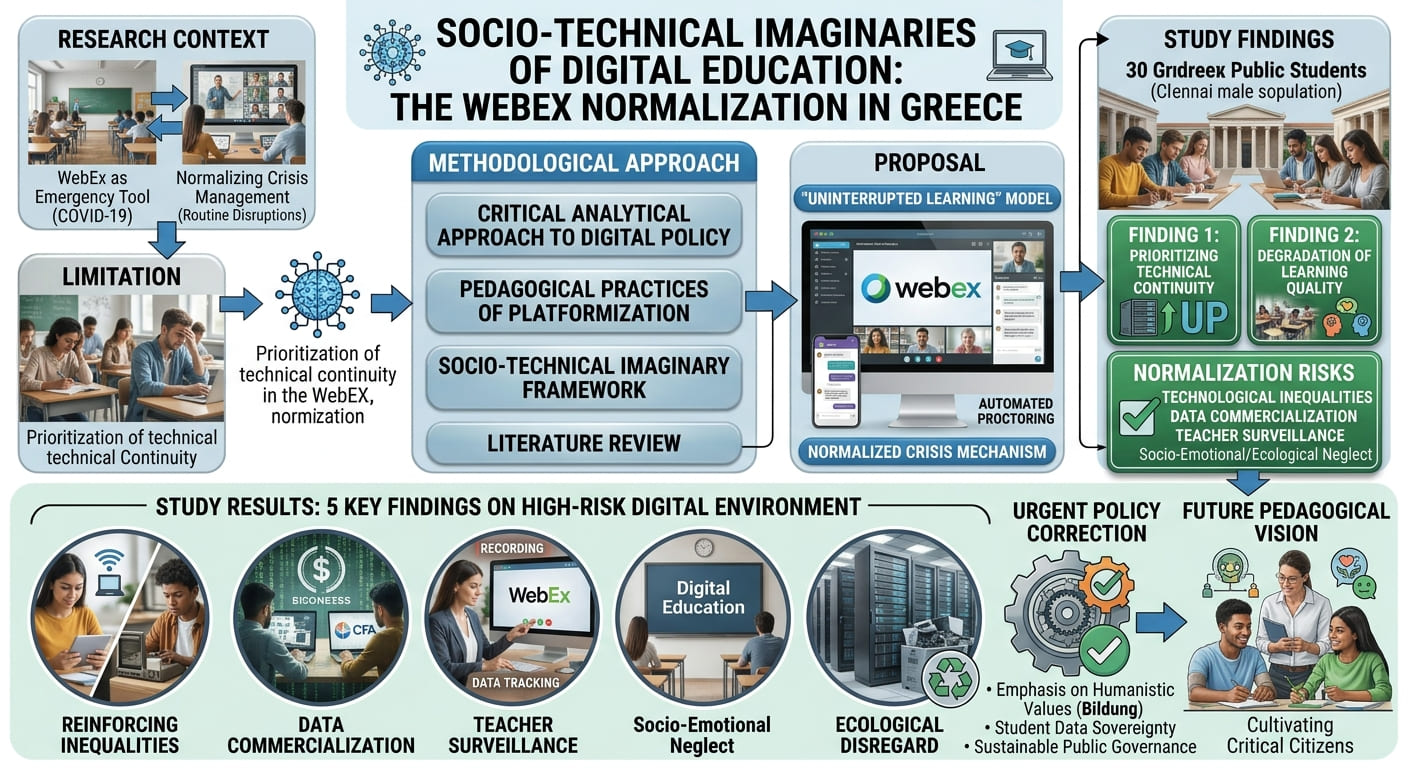
The aim of this paper is to study the WebEx platform in the context of digital pedagogy in the Greek educational system. Greece also followed the international imperatives for teaching through digital platforms. The WebEx platform was adopted, and the aim is to highlight not the problems faced by all those who used it, but how it is still used in emergency situations and crises today. Through the analysis, questions related to the digital initiative that was taken and is being taken will be answered. Its role in shaping the Imagined future will be determined, as well as the contribution of this Imaginary to shaping expectations for the future and how these expectations direct government policy in Greece. WebEx should not be understood merely as a technical instrument ensuring the continuity of education, but as a socio-technical mechanism that contributes to the formation of a particular educational future in which uninterrupted operation takes precedence over pedagogical experience. Through the normalization of continuous access, education is increasingly reframed as a system that must remain functional under all circumstances, shifting attention from learning quality towards institutional and technical continuity. In this context, alternative pedagogical possibilities become more difficult to imagine, as technological solutions are positioned as the default response to crisis situations. As a result, an educational future is being constructed that is continuous and stable in technical terms, yet increasingly dependent on platform infrastructures and progressively detached from meaningful pedagogical relations.
Full text article
References
Adiatma, T., Nopriawan Mahriadi, & Mega Suteki. (2022). Importance of International Accreditation for Global Recognition for Higher Education. Journal Of Digital Learning And Distance Education, 1(5), 195–199. https://doi.org/10.56778/jdlde.v1i5.53
Alieto, E., Abequibel-Encarnacion, B., Estigoy, E., Balasa, K., Eijansantos, A., & Torres-Toukoumidis, A. (2024). Teaching inside a digital classroom: A quantitative analysis of attitude, technological competence and access among teachers across subject disciplines. Heliyon, 10(2), e24282. https://doi.org/10.1016/j.heliyon.2024.e24282
Alizada, Z., Fatima Mohammadi, & Fatima Sahibzada. (2025). The Role of AI Technology in Advancing Education, Empowerment, and Entrepreneurship for Afghan Women. Journal Of Digital Learning And Distance Education, 4(6), 1718–1725. https://doi.org/10.56778/jdlde.v4i6.606
Amirbek, A., Torebek, Y., Abdualiyeva, M., Altynbekov, S., Tursynbayev, A., Abdraimov, R., & Omashova, G. (2026). Cloud-based learning and cognitive development among lower-secondary students (Grades 8–9): Evidence from schools in Kazakhstan. Frontiers in Education, 11, 1749929. https://doi.org/10.3389/feduc.2026.1749929
Autio, T. (2017). Curriculum Theory in Contestation? American Curriculum, European Didaktik, and Chinese Wisdom Traditions as Hybrid Platforms for Educational Leadership. In M. Uljens & R. M. Ylimaki (Eds.), Bridging Educational Leadership, Curriculum Theory and Didaktik (Vol. 5, pp. 257–280). Springer International Publishing. https://doi.org/10.1007/978-3-319-58650-2_7
Aviram, M., & Shoshana, A. (2024). “Each student is fitted with a customized suit”: Teacher identity, the burden of intensive educational work, and ethical transgressions among teachers at an elite high school. International Journal of Educational Research, 125, 102327. https://doi.org/10.1016/j.ijer.2024.102327
Criveanu, M. M. (2025). The Impact of Digital Technology on E-Commerce and Sustainable Performance in the EU. Economies, 14(1), 5. https://doi.org/10.3390/economies14010005
Díez-Gutiérrez, E.-J. (2026). Educational Digital Sovereignty and EdTech Platform Capitalism: Rethinking Innovation, Data Governance and Artificial Intelligence in Public Education. Journal of Innovation, 1(1), 5. https://doi.org/10.3390/joi1010005
Dong, X., & Xie, Y. (2025). Research on cloud computing network security mechanism and optimization in university education management informatization based on OpenFlow. Systems and Soft Computing, 7, 200225. https://doi.org/10.1016/j.sasc.2025.200225
Gouseti, A., & Shaw, P. (2026). When platformisation meets schooling: Exploring teachers, students and parents’ experiences of digital platform use. Learning, Media and Technology, 1–20. https://doi.org/10.1080/17439884.2026.2653746
Hazreeni Hamzah, N., Mahmud, M., Mohamed Zukri, S., Wan Yaacob, W. F., & Yacob, J. (2017). The Awareness and Challenges of Cloud Computing Adoption on Tertiary Education in Malaysia. Journal of Physics: Conference Series, 892, 012014. https://doi.org/10.1088/1742-6596/892/1/012014
Holl, A., Rama, R., & Hammond, H. (2024). COVID-19 and Business Digitalization: Unveiling the Effects of Concurrent Strategies. Journal of the Knowledge Economy, 16(4), 15456–15490. https://doi.org/10.1007/s13132-024-02374-1
Hönigsberg, S., Li, M. M., Korneeva, E., Wache, H., & Dinter, B. (2026). The impact of digital platform introduction on business models in SMEs—The interplay of efficiency and innovation orientation. The Journal of Strategic Information Systems, 35(2), 101967. https://doi.org/10.1016/j.jsis.2026.101967
Hooshyar, D., Tammets, K., Ley, T., Aus, K., & Kollom, K. (2023). Learning Analytics in Supporting Student Agency: A Systematic Review. Sustainability, 15(18), 13662. https://doi.org/10.3390/su151813662
Jemetz, M., & Motschnig, R. (2026). Self-regulated learning in the development of teachers’ digital competencies—A systematic literature review. Frontiers in Education, 11, 1893589. https://doi.org/10.3389/feduc.2026.1893589
Kosta, A. D., Keramitsoglou, K. M., & Tsagarakis, K. P. (2025). Circular economy and sustainable development in primary education. Frontiers in Sustainability, 6, 1414055. https://doi.org/10.3389/frsus.2025.1414055
Litchfield, I., Shukla, D., & Greenfield, S. (2021). Impact of COVID-19 on the digital divide: A rapid review. BMJ Open, 11(10), e053440. https://doi.org/10.1136/bmjopen-2021-053440
Löfving, C., Bergviken Rensfeldt, A., & Hillman, T. (2025). Platform bureaucratization as pedagogy in highly platformized classrooms. Learning, Media and Technology, 1–14. https://doi.org/10.1080/17439884.2025.2572619
Lousada, S., Jankauskienė, D., Virbalienė, A., & Šiurienė, A. (2026). Multidimensional Aspects of Teachers’ Well-Being Imbalance During Remote Teaching. Education Sciences, 16(2), 266. https://doi.org/10.3390/educsci16020266
M. Alshehri, S. (2024). Perspective Chapter: The Impact of Digital Education on Modern Educational Institutions. In S. Mohamed & S. Mohamed (Eds.), Social Media—Opportunities and Risks. IntechOpen. https://doi.org/10.5772/intechopen.108058
Mameli, C., Grazia, V., & Molinari, L. (2023). Student agency: Theoretical elaborations and implications for research and practice. International Journal of Educational Research, 122, 102258. https://doi.org/10.1016/j.ijer.2023.102258
Martini, E., & Sgambato, M. C. (2025). Digital Inequalities and Access to Technology: Analyzing How Digital Tools Exacerbate or Mitigate Social Inequalities. Societies, 15(11), 318. https://doi.org/10.3390/soc15110318
Mawgoud, A. A., Taha, M. H. N., Loey, M., Hussain Malik, M., & Khalifa, N. E. (2025). Enhancing Data Privacy and Trust in E‐Learning: A Blockchain‐Based Access Control Protocol for Cloud Educational Systems. Concurrency and Computation: Practice and Experience, 37(18–20), e70185. https://doi.org/10.1002/cpe.70185
McCarthy, A. M., Maor, D., McConney, A., & Cavanaugh, C. (2023). Digital transformation in education: Critical components for leaders of system change. Social Sciences & Humanities Open, 8(1), 100479. https://doi.org/10.1016/j.ssaho.2023.100479
Moreno-González, A., Calderón-Garrido, D., Rivera-Vargas, P., & Blanco-Navarro, M. (2026). Digital platforms in educational contexts: A scoping review of uses, perceptions and attitudes among educational communities. Discover Education, 5(1), 396. https://doi.org/10.1007/s44217-026-01299-y
Nichols, T. P., & Dixon-Román, E. (2024). Platform Governance and Education Policy: Power and Politics in Emerging Edtech Ecologies. Educational Evaluation and Policy Analysis, 46(2), 309–328. https://doi.org/10.3102/01623737231202469
Nieminen, J. H., Yan, Z., & Boud, D. (2025). Self-assessment design in a digital world: Centring student agency. Assessment & Evaluation in Higher Education, 50(5), 732–746. https://doi.org/10.1080/02602938.2025.2467647
Okai, S., Uddin, M., Arshad, A., Alsaqour, R., & Shah, A. (2014). Cloud Computing Adoption Model for Universities to Increase ICT Proficiency. Sage Open, 4(3), 2158244014546461. https://doi.org/10.1177/2158244014546461
Pedroso, J. E., Notes, F. A., Ferrer, M. P., Jardeleza, L. C., Estuya, C. B., & Empil, B. D. (2024). Social Media as a Coping Tool Amongst Social Studies Pre-Service Teachers. JOURNAL OF DIGITAL LEARNING AND DISTANCE EDUCATION, 3(7), 1154–1167. https://doi.org/10.56778/jdlde.v3i7.367
Pitorac, R. I., Hategan, C.-D., Imbrescu, C.-M., Pastiu, C. A., & Hategan, V.-P. (2025). The Impact of Covid-19 Pandemic on the Financial Performance of Romanian E-Commerce Companies. Eastern European Economics, 63(5), 828–843. https://doi.org/10.1080/00128775.2025.2516431
Sandoval-Ríos, F., Gajardo-Poblete, C., & López-Núñez, J. A. (2025). Role of data literacy training for decision-making in teaching practice: A systematic review. Frontiers in Education, 10, 1485821. https://doi.org/10.3389/feduc.2025.1485821
Sanova, A., Bakar, A., Afrida, A., Kurniawan, D. A., & Aldila, F. T. (2022). Digital Literacy on the Use of E-Module Towards Students’ Self-Directed Learning on Learning Process and Outcomes Evaluation Cources. JPI (Jurnal Pendidikan Indonesia), 11(1), 154–164. https://doi.org/10.23887/jpi-undiksha.v11i1.36509
Schultheiss, T., & Backes-Gellner, U. (2024). Does updating education curricula accelerate technology adoption in the workplace? Evidence from dual vocational education and training curricula in Switzerland. The Journal of Technology Transfer, 49(1), 191–235. https://doi.org/10.1007/s10961-022-09971-9
Shen, G., Wu, W., & Huang, W. (2025). Tackling the AI-Creativity paradox: How educational innovation and knowledge unlocks positive-sum dynamics? Journal of Innovation & Knowledge, 10(6), 100816. https://doi.org/10.1016/j.jik.2025.100816
Sjöström, J., Frerichs, N., Zuin, V. G., & Eilks, I. (2017). Use of the concept of Bildung in the international science education literature, its potential, and implications for teaching and learning. Studies in Science Education, 53(2), 165–192. https://doi.org/10.1080/03057267.2017.1384649
Szász, L., Bálint, C., Csíki, O., Nagy, B. Z., Rácz, B.-G., Csala, D., & Harris, L. C. (2022). The impact of COVID-19 on the evolution of online retail: The pandemic as a window of opportunity. Journal of Retailing and Consumer Services, 69, 103089. https://doi.org/10.1016/j.jretconser.2022.103089
Wang, M., Murphy, R., & Christie, I. (2025). Bringing Sustainable Practices, Fashion Shows, and Sociological Insights Together to Reinvigorate Sustainable Fashion Education. Sustainability, 17(2), 631. https://doi.org/10.3390/su17020631
Wieczorek, M., Utterberg Modén, M., Bergviken Rensfeldt, A., & Hillman, T. (2026). Beyond data extraction: Alternative models for the governance of educational data. Learning, Media and Technology, 1–17. https://doi.org/10.1080/17439884.2026.2678187
Wong, R., Chubb, L. A., & Bullen, P. (2026). The emotional burden of teaching: Navigating emotions in real-time in the school environment. Teachers and Teaching, 1–17. https://doi.org/10.1080/13540602.2026.2700740
Zhang, X., & Li, H. (2026). Teacher authority, responsibility, and platform governance in generative AI-supported classrooms. Discover Education, 5(1), 1040. https://doi.org/10.1007/s44217-026-02214-1
Authors
Copyright (c) 2026 JOURNAL OF DIGITAL LEARNING AND DISTANCE EDUCATION

This work is licensed under a Creative Commons Attribution 4.0 International License.
<a rel="license" href="http://creativecommons.org/licenses/by/4.0/"><img alt="Creative Commons License" style="border-width:0" src="https://i.creativecommons.org/l/by/4.0/88x31.png" /></a><br />This work is licensed under a <a rel="license" href="http://creativecommons.org/licenses/by/4.0/">Creative Commons Attribution 4.0 International License</a>.