
Digital Education in Greece: A Retrospective View
Article Sidebar
-
Digital education, Educational imaginaries, Sociotechnical futures
Abstract
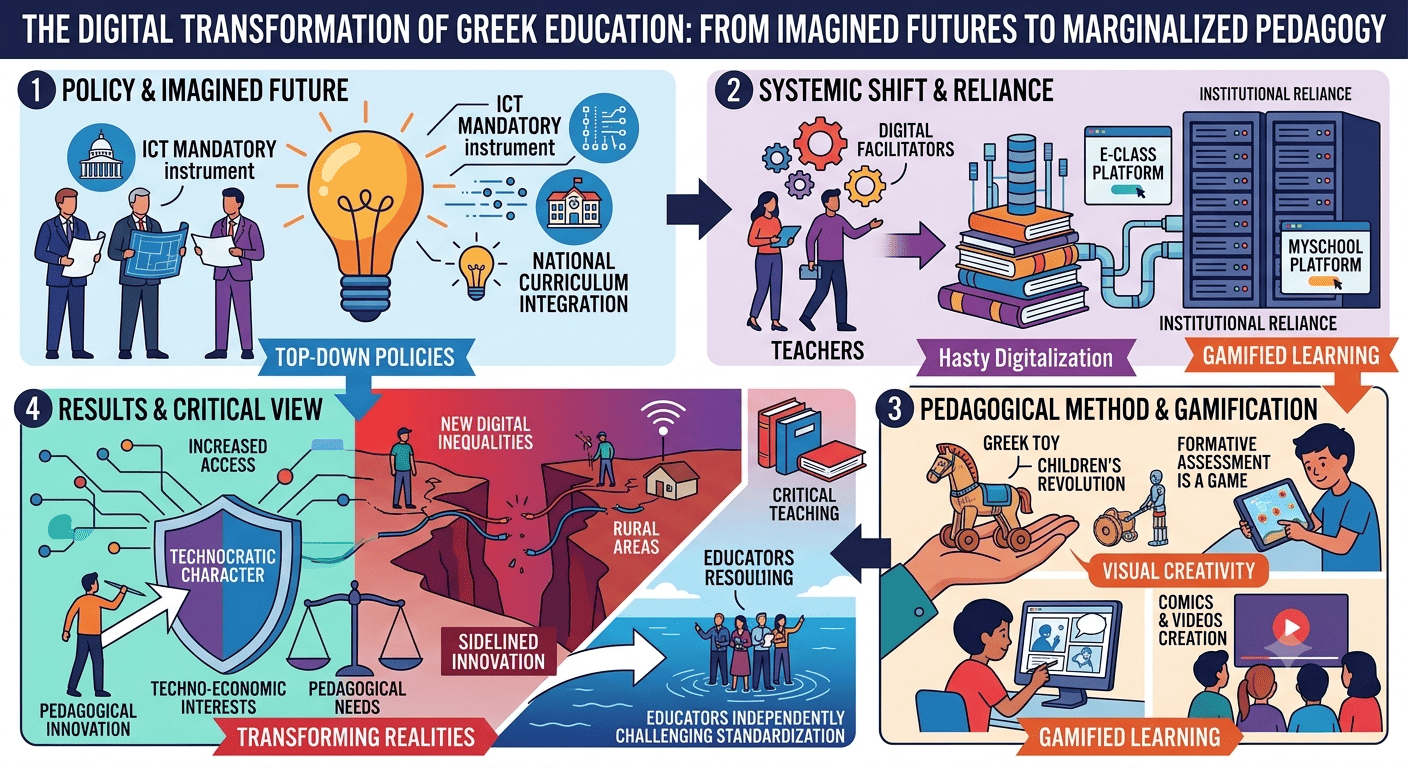
This study examines the digital transformation of the Greek education system since the early 2000s through the lens of imagined futures. ICT has shifted horizontally from being a mere computer subject to becoming a mandatory instrument integrated across the national curriculum. Using qualitative, descriptive-analytical methods, the study explores how top-down government policies reorganize pedagogical practices, transforming teachers into digital facilitators, and fueling institutional reliance on platforms such as e-class and MySchool. One concrete learning method analyzed is gamification through the "Greek toy children's revolution," which transforms formative assessments into interactive digital games and activates students' visual creativity through the creation of comics and videos. The results show that technological expectations promoted by political authorities often sideline pedagogical innovation in favor of techno-economic interests. Rather than reducing inequalities, this hasty digitalization without a space for collective dialogue reinforces the technocratic character of education, triggering new digital inequalities—particularly in rural areas—and marginalizing critical teaching approaches. However, some educators have begun to independently challenge this standardization in order to maintain the pedagogical essence of the classroom.
Full text article
References
Ahlin, A. (2025). From Traditional Leadership to Team Collaboration: Sense-Making by Principals in School Leadership Teams. Leadership and Policy in Schools, 1–16. https://doi.org/10.1080/15700763.2025.2549336
Aivazidi, M., & Michalakelis, C. (2023). Information and Communication Technologies in Primary Education: Teachers’ Perceptions in Greece. Informatics, 10(3), 57. https://doi.org/10.3390/informatics10030057
Becha, H., Kalai, M., Houidi, S., & Helali, K. (2025). Digital financial inclusion, environmental sustainability and regional economic growth in China: Insights from a panel threshold model. Journal of Economic Structures, 14(1), 4. https://doi.org/10.1186/s40008-025-00347-4
Blankesteijn, M. L., & Ghorbani, A. (2025). Embracing the digital horizon: Future scenarios for the Dutch higher education system. Futures, 174, 103702. https://doi.org/10.1016/j.futures.2025.103702
Bui, T. H. (2022). English teachers’ integration of digital technologies in the classroom. International Journal of Educational Research Open, 3, 100204. https://doi.org/10.1016/j.ijedro.2022.100204
Capolla, L. M. (2024). Shaping Educational Strategies: A Literature Review on Uncertainty and the Unexpected. Education Sciences, 14(3), 309. https://doi.org/10.3390/educsci14030309
Conway, M. (2022). An integrated frame for designing conversations about futures. Futures, 136, 102887. https://doi.org/10.1016/j.futures.2021.102887
Engel, L., Maxwell, C., & Yemini, M. (2022). The COVID-19 pandemic and the reconstitution of education. International Studies in Sociology of Education, 31(4), 397–400. https://doi.org/10.1080/09620214.2022.2138940
Esposito, E. (2024). Can we use the open future? Preparedness and innovation in times of self-generated uncertainty. European Journal of Social Theory, 27(2), 209–224. https://doi.org/10.1177/13684310231224546
Fadhli, R., Chang, S., & Mendoza, A. (2026). Charting the initial digital journeys of students in a new digital environment: A qualitative study. Higher Education. https://doi.org/10.1007/s10734-026-01657-7
Fernandes, G. W. R., Rodrigues, A. M., & Gomes, J. A. T. (2026). From reproduction to emancipation: Freire and Bernstein in dialogue for a counter-hegemonic science curriculum. Cultural Studies of Science Education. https://doi.org/10.1007/s11422-026-10285-7
Fritz, M., Koch, M., Johansson, H., & Emilsson, K. (2025). “What have future generations ever done for us?” Future expectations and present dispositions for social-ecological transformations. Futures, 169, 103593. https://doi.org/10.1016/j.futures.2025.103593
Gauttam, P., Singh, B., Singh, S., Bika, S. L., & Tiwari, R. P. (2024). Education as a soft power resource: A systematic review. Heliyon, 10(1), e23736. https://doi.org/10.1016/j.heliyon.2023.e23736
Glückler, J., Garschagen, M., & Panitz, R. (2025). Placing the Future: Understanding Space in the Making of Tomorrow. In J. Glückler, M. Garschagen, & R. Panitz (Eds.), Placing the Future (Vol. 20, pp. 1–18). Springer Nature Switzerland. https://doi.org/10.1007/978-3-031-76841-5_1
Haleem, A., Javaid, M., Qadri, M. A., & Suman, R. (2022). Understanding the role of digital technologies in education: A review. Sustainable Operations and Computers, 3, 275–285. https://doi.org/10.1016/j.susoc.2022.05.004
Hetmańczyk, P. (2024). Digitalization and its impact on labour market and education. Selected aspects. Education and Information Technologies, 29(9), 11119–11134. https://doi.org/10.1007/s10639-023-12203-8
Jatileni, C. N., Havu-Nuutinen, S., Pöntinen, S., & Kukkonen, J. (2024). Learning mathematics with personal mobile devices in school: A multigroup invariance analysis of acceptance among students and teachers. Frontiers in Education, 9, 1425779. https://doi.org/10.3389/feduc.2024.1425779
Kalkan, Ü., Altınay Aksal, F., Altınay Gazi, Z., Atasoy, R., & Dağlı, G. (2020). The Relationship Between School Administrators’ Leadership Styles, School Culture, and Organizational Image. Sage Open, 10(1), 2158244020902081. https://doi.org/10.1177/2158244020902081
Kougias, K., & Efstathopoulos, J. (2020). The Operational Framework of the Greek Educational System as an Obstacle to the Implementation of Sustainable School. Frontiers in Education, 5, 142. https://doi.org/10.3389/feduc.2020.00142
Li, H., Li, Q., Xu, Z., & Ye, X. (2024). Digital technologies. Journal of Digital Economy, 3, 240–248. https://doi.org/10.1016/j.jdec.2025.02.001
Li, X., Zhang, J., & Van Braak, J. (2022). Reflection on Value and Function of Information Technology Curriculum from the Reform of the British ICT Curriculum. Education Sciences, 13(1), 7. https://doi.org/10.3390/educsci13010007
Mena-Guacas, A. F., López-Catalán, L., Bernal-Bravo, C., & Ballesteros-Regaña, C. (2025). Educational Transformation Through Emerging Technologies: Critical Review of Scientific Impact on Learning. Education Sciences, 15(3), 368. https://doi.org/10.3390/educsci15030368
Moolkham, M. (2025). Digital transformation, financial performance and firm valuation: The moderating effect of environmental risk. Journal of Climate Finance, 13, 100075. https://doi.org/10.1016/j.jclimf.2025.100075
Mou, Y. (2024). The impact of digital finance on technological innovation across enterprise life cycles in China. Heliyon, 10(14), e33965. https://doi.org/10.1016/j.heliyon.2024.e33965
Moyson, S., Scholten, P., & Weible, C. M. (2017). Policy learning and policy change: Theorizing their relations from different perspectives. Policy and Society, 36(2), 161–177. https://doi.org/10.1080/14494035.2017.1331879
Msambwa, M. M., Daniel, K., & Lianyu, C. (2024). Integration of information and communication technology in secondary education for better learning: A systematic literature review. Social Sciences & Humanities Open, 10, 101203. https://doi.org/10.1016/j.ssaho.2024.101203
Muthanna, A., & Sang, G. (2023). A Conceptual Model of the Factors Affecting Education Policy Implementation. Education Sciences, 13(3), 260. https://doi.org/10.3390/educsci13030260
Norabuena-Figueroa, R. P., Deroncele-Acosta, A., Rodríguez-Orellana, H. M., Norabuena-Figueroa, E. D., Flores-Chinte, M. C., Huamán-Romero, L. L., Tarazona-Miranda, V. H., & Mollo-Flores, M. E. (2025). Digital Teaching Practices and Student Academic Stress in the Era of Digitalization in Higher Education. Applied Sciences, 15(3), 1487. https://doi.org/10.3390/app15031487
Nwafor, S. C., Kanu, M. O., Ekoyo, D. O., & Nwankwo, M. U. (2025). Teacher-Student Relationships: Understanding the Impact on Science Students’ Academic Performance from Both Sides of the Classroom. Journal Of Digital Learning And Distance Education, 3(12), 1395–1403. https://doi.org/10.56778/jdlde.v3i12.495
Pantazidis, S., & Bantiou, M. (2026). Commoning history education: Developing in-curriculum and beyond-curriculum thinking skills. Thinking Skills and Creativity, 61, 102151. https://doi.org/10.1016/j.tsc.2026.102151
Panxhi, M., Thanasi-Boçe, M., & Hoxha, J. (2025). Digital transformation, entrepreneurial competence, and future job prospects in engineering education. Cogent Education, 12(1), 2526429. https://doi.org/10.1080/2331186X.2025.2526429
Sak, T., Mylko, I., Ivashko, O., Chulipa, I., Wołowiec, T., & Sokołowska-Woźniak, J. (2025). How the Digital Economy Is Revolutionizing Marketing Management and Driving Sustainable Development. Sustainability, 17(3), 1130. https://doi.org/10.3390/su17031130
Sam-Kayode, C. O. (2025). Mathematics Teachers’ Perceptions of Difficulties Encountered by Students in Geometric Constructions in Egbeda Local Government Area, Oyo State, Nigeria. Journal Of Digital Learning And Distance Education, 3(9), 1262–1270. https://doi.org/10.56778/jdlde.v3i9.434
Sîrghi, N., Sinoi, E.-A., & Doroiman, M. M. (2026). The Impact of Digital Skills on Economic Growth in the European Union: A Bayesian Model Averaging Approach. Sustainability, 18(6), 2829. https://doi.org/10.3390/su18062829
Souza, A. S. C. D., & Debs, L. (2024). Concepts, innovative technologies, learning approaches and trend topics in education 4.0: A scoping literature review. Social Sciences & Humanities Open, 9, 100902. https://doi.org/10.1016/j.ssaho.2024.100902
Steiner-Khamsi, G. (2025). The Evolution of a Global Script: The Present, Future, and Sequence of Reforms. In G. Steiner-Khamsi, Time in Education Policy Transfer (pp. 91–152). Springer Nature Switzerland. https://doi.org/10.1007/978-3-031-82524-8_3
Suhada, S., Wulandari, N. D., Idries, F. A., Pratiwi, N., Oktariantra, I., Romandhani, A. O., & Riyadho, A. (2026). The role of digital skills, digital self-efficacy, and government support in enhancing digital work readiness. Asian Management and Business Review, 184–202. https://doi.org/10.20885/AMBR.vol6.iss1.art12
Suzer, E., & Koc, M. (2024). Teachers’ digital competency level according to various variables: A study based on the European DigCompEdu framework in a large Turkish city. Education and Information Technologies, 29(16), 22057–22083. https://doi.org/10.1007/s10639-024-12711-1
You, Y., & Morris, P. (2016). Imagining school autonomy in high-performing education systems: East Asia as a source of policy referencing in England. Compare: A Journal of Comparative and International Education, 46(6), 882–905. https://doi.org/10.1080/03057925.2015.1080115
Zou, Y., Kuek, F., Feng, W., & Cheng, X. (2025). Digital learning in the 21st century: Trends, challenges, and innovations in technology integration. Frontiers in Education, 10, 1562391. https://doi.org/10.3389/feduc.2025.1562391
Authors
Copyright (c) 2026 JOURNAL OF DIGITAL LEARNING AND DISTANCE EDUCATION

This work is licensed under a Creative Commons Attribution 4.0 International License.
<a rel="license" href="http://creativecommons.org/licenses/by/4.0/"><img alt="Creative Commons License" style="border-width:0" src="https://i.creativecommons.org/l/by/4.0/88x31.png" /></a><br />This work is licensed under a <a rel="license" href="http://creativecommons.org/licenses/by/4.0/">Creative Commons Attribution 4.0 International License</a>.