
Artificial Intelligence in the Study Habits of Students
Article Sidebar
-
Artificial Intelligence (AI), study habit of students, learning attitude, insights in the learning process, boost student motivation
Abstract
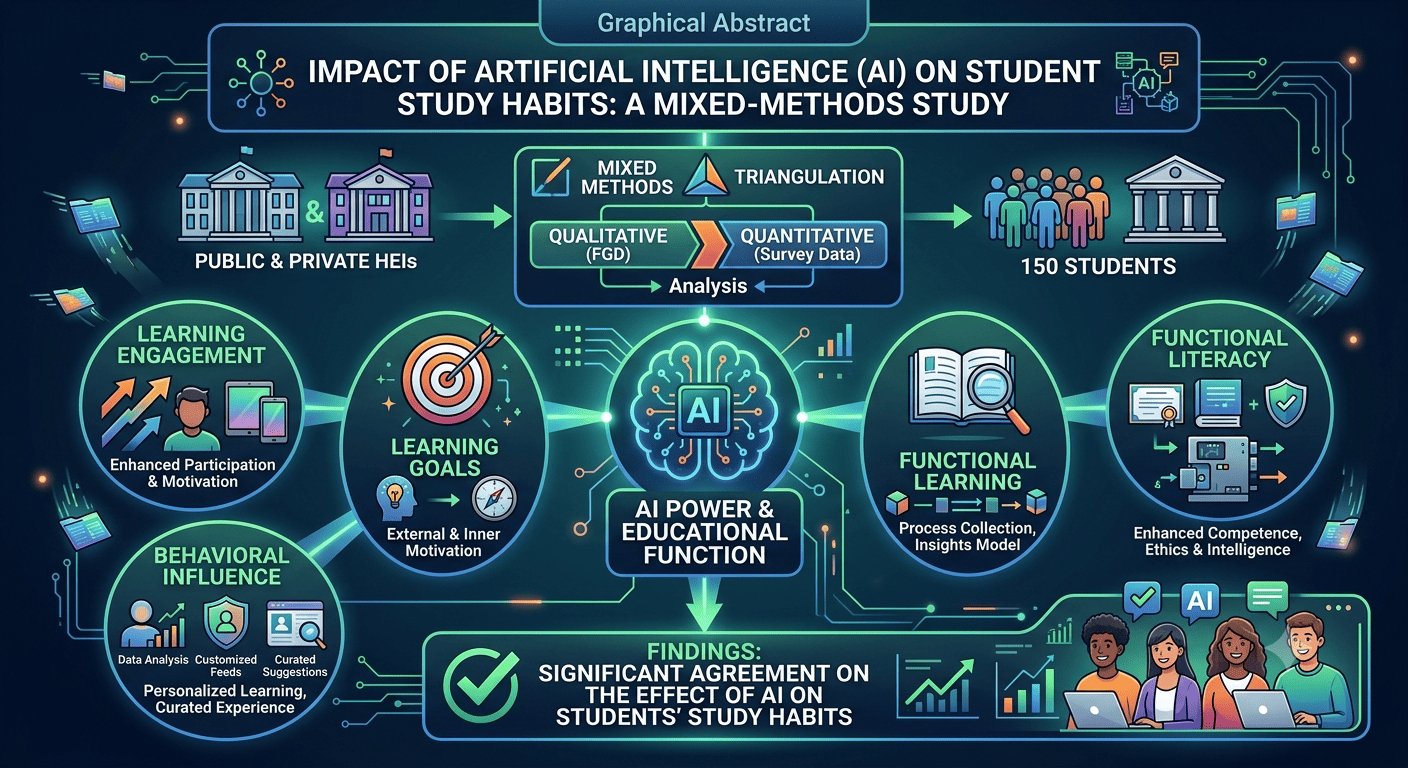
The study aims to evaluate and analyze the artificial intelligence in the study habits of students. Mixed methods are utilized in the study which deals on the Focus Group Discussion and triangulation for both quantitative and qualitative research design. The study comprised One Hundred Fifty (150) students from both private and public Higher Education Institutions. Results show that AI helps in the analysis of the platform AI educational power in enhancing learning engagement and motivation benefits of students, show that AI is an important factor toward learning of students in the goal setting towards learning belief problem solving abilities, and external and inner motivation in the academic performance of the students, show that AI focuses on the process of learning collection for the insights of specific function input and output model of learning, show that AI increases and enhances literacy for students to motivate learning process, confidence, purpose, and to promote learning intelligence and ethics, and show to influence the behavior of students in the learning process such as the algorithm for the AI power in the data analysis, preference, customized news feed, curated behavior, and significant recommendation. Findings show that there is a significant agreement on the effect of artificial intelligence in the study habits of students as observed among the respondents.
Full text article
References
Aballa Nkechi, A., O. Ojo, A., & A. Eneh, O. (2024). Impact of Artificial Intelligence in Achieving Quality Education. In S. Kadry (Ed.), Artificial Intelligence (Vol. 28). IntechOpen. https://doi.org/10.5772/intechopen.1004871
Acosta-Enriquez, B. G., Villena Zapata, L. I., Huamaní Jordan, O., López Roca, C., Cabrera Cipirán, B. M., Saavedra Villacrez, W., & Arbulu Perez Vargas, C. G. (2025). Acceptance of Artificial Intelligence as a Teaching Strategy Among University Professors: The Role of Habit, Hedonic Motivation, and Competence for Technology Integration. Human Behavior and Emerging Technologies, 2025(1), 5933157. https://doi.org/10.1155/hbe2/5933157
Al-Abyadh, M. H. A., & Abdel Azeem, H. A. H. (2022). Academic Achievement: Influences of University Students’ Self-Management and Perceived Self-Efficacy. Journal of Intelligence, 10(3), 55. https://doi.org/10.3390/jintelligence10030055
Alghamdi, A. A. (2025). University students’ perceptions of generative AI for critical thinking and creativity: The influence of self-efficacy and disciplinary differences. Innovations in Education and Teaching International, 1–15. https://doi.org/10.1080/14703297.2025.2600476
Alkhawaja, L., Idris, M., Al-Sayyed, S., & Al Jaber, A. M. (2025). Exploring the impact of Artificial Intelligence on students’ skills for sustainable development in education. Frontiers in Education, 10, 1691148. https://doi.org/10.3389/feduc.2025.1691148
Almoslamani, Y. (2022). The impact of learning strategies on the academic achievement of university students in Saudi Arabia. Learning and Teaching in Higher Education: Gulf Perspectives, 18(1), 4–18. https://doi.org/10.1108/LTHE-08-2020-0025
AL-Sayid, F., Alpago, H., & Kirkil, G. (2026). Exploring student motivations for AI usage in education: Nisantasi in Turkey, a case study. Acta Psychologica, 266, 106852. https://doi.org/10.1016/j.actpsy.2026.106852
Alseitova, A., Oliveira, W., Li, Z., & Hamari, J. (2025). Understanding Students’ Behavior in Learning Management Systems Through Their Personality Traits. Technology, Knowledge and Learning. https://doi.org/10.1007/s10758-025-09931-w
Alyahyan, E., & Düştegör, D. (2020). Predicting academic success in higher education: Literature review and best practices. International Journal of Educational Technology in Higher Education, 17(1), 3. https://doi.org/10.1186/s41239-020-0177-7
Ansari, S. R., & Qamari, I. N. (2025). Artificial intelligence and students’ cognitive learning outcomes with bibliometric and content analysis for future research agenda. Discover Education, 4(1), 441. https://doi.org/10.1007/s44217-025-00865-0
Bhardwaj, V., Zhang, S., Tan, Y. Q., & Pandey, V. (2025). Redefining learning: Student-centered strategies for academic and personal growth. Frontiers in Education, 10, 1518602. https://doi.org/10.3389/feduc.2025.1518602
Dickson, S. M., Idayana Alabere, & Ijeoma Peace Okechukwu. (2024). Web Technology Skills Acquisition by Computer Science Students at Polytechnics In Akwa Ibom State, Nigeria. JOURNAL OF DIGITAL LEARNING AND DISTANCE EDUCATION, 2(11), 809–818. https://doi.org/10.56778/jdlde.v2i11.229
Dogaru, M., Pisică, O., Popa, C.-Ștefan, Răgman, A.-A., & Tololoi, I.-R. (2025). The perceived impact of artificial intelligence on academic learning. Frontiers in Artificial Intelligence, 8, 1611183. https://doi.org/10.3389/frai.2025.1611183
Dong, L., Tang, X., & Wang, X. (2025). Examining the effect of artificial intelligence in relation to students’ academic achievement: A meta-analysis. Computers and Education: Artificial Intelligence, 8, 100400. https://doi.org/10.1016/j.caeai.2025.100400
Du, Z., Karabalaeva, G., Zhou, Z., Atakhanov, A., & Kozhomberdieva, Z. (2025). Investigation of Students’ Learning Behaviour Using Artificial Intelligence: A Qualitative Study. Premier Journal of Science. https://doi.org/10.70389/PJS.100160
Feng, Z., & Xiao, H. (2024). The impact of students’ lack of learning motivation and teachers’ teaching methods on innovation resistance in the context of big data. Learning and Motivation, 87, 102020. https://doi.org/10.1016/j.lmot.2024.102020
Fortuna, A., Prasetya, F., Samala, A. D., Rawas, S., Criollo-C, S., Kaya, D., Raihan, M., Andriani, W., Safitri, D., & Nabawi, R. A. (2025). Artificial intelligence in personalized learning: A global systematic review of current advancements and shaping future opportunities. Social Sciences & Humanities Open, 12, 102114. https://doi.org/10.1016/j.ssaho.2025.102114
Gouseti, A., James, F., Fallin, L., & Burden, K. (2025). The ethics of using AI in K-12 education: A systematic literature review. Technology, Pedagogy and Education, 34(2), 161–182. https://doi.org/10.1080/1475939X.2024.2428601
Klimova, B., & Pikhart, M. (2025). Exploring the effects of artificial intelligence on student and academic well-being in higher education: A mini-review. Frontiers in Psychology, 16, 1498132. https://doi.org/10.3389/fpsyg.2025.1498132
Kong, S. C., & Zhu, J. (2025). Developing and validating an artificial intelligence ethical awareness scale for secondary and university students: Cultivating ethical awareness through problem-solving with artificial intelligence tools. Computers and Education: Artificial Intelligence, 9, 100447. https://doi.org/10.1016/j.caeai.2025.100447
Levy-Feldman, I. (2025). The Role of Assessment in Improving Education and Promoting Educational Equity. Education Sciences, 15(2), 224. https://doi.org/10.3390/educsci15020224
Li, H., & Liu, Z. (2025). An Intelligent Educational System: Analyzing Student Behavior and Academic Performance Using Multi-Source Data. Electronics, 14(16), 3328. https://doi.org/10.3390/electronics14163328
Liu, B., & Yuan, D. (2024). Research on Personalized Teaching Strategies Based on Learner Profiles in a Blended Learning Environment: International Journal of Information and Communication Technology Education, 20(1), 1–25. https://doi.org/10.4018/IJICTE.346823
Luo, J., Zheng, C., Yin, J., & Teo, H. H. (2025). Design and assessment of AI-based learning tools in higher education: A systematic review. International Journal of Educational Technology in Higher Education, 22(1), 42. https://doi.org/10.1186/s41239-025-00540-2
Merino-Campos, C. (2025). The Impact of Artificial Intelligence on Personalized Learning in Higher Education: A Systematic Review. Trends in Higher Education, 4(2), 17. https://doi.org/10.3390/higheredu4020017
Mohamed, A. M., Shaaban, T. S., Bakry, S. H., Guillén-Gámez, F. D., & Strzelecki, A. (2025). Empowering the Faculty of Education Students: Applying AI’s Potential for Motivating and Enhancing Learning. Innovative Higher Education, 50(2), 587–609. https://doi.org/10.1007/s10755-024-09747-z
Nguyen, A., Ngo, H. N., Hong, Y., Dang, B., & Nguyen, B.-P. T. (2023). Ethical principles for artificial intelligence in education. Education and Information Technologies, 28(4), 4221–4241. https://doi.org/10.1007/s10639-022-11316-w
Ninghardjanti, P., Umam, M. C., Subarno, A., Winarno, W., Langgi, N. R., & Widodo, J. (2025). Evaluating the impact of AI on the critical thinking skills among the higher education students by combining the TAM model and critical thinking theory. Frontiers in Education, 10, 1719625. https://doi.org/10.3389/feduc.2025.1719625
Nwafor, S. C., Kanu, M. O., Ekoyo, D. O., & Nwankwo, M. U. (2025). Teacher-Student Relationships: Understanding the Impact on Science Students’ Academic Performance from Both Sides of the Classroom. Journal Of Digital Learning And Distance Education, 3(12), 1395–1403. https://doi.org/10.56778/jdlde.v3i12.495
Salido, A., Syarif, I., Sitepu, M. S., Suparjan, Wana, P. R., Taufika, R., & Melisa, R. (2025). Integrating critical thinking and artificial intelligence in higher education: A bibliometric and systematic review of skills and strategies. Social Sciences & Humanities Open, 12, 101924. https://doi.org/10.1016/j.ssaho.2025.101924
Song, H., & Cai, L. (2024). Interactive learning environment as a source of critical thinking skills for college students. BMC Medical Education, 24(1), 270. https://doi.org/10.1186/s12909-024-05247-y
Subandiyah, H., Nasrullah, R., Ramadhan, R., Supratno, H., Raharjo, R. P., & Lukman, F. (2025). The impact of differentiated instruction on student engagement and achievement in Indonesian language learning. Cogent Education, 12(1), 2516378. https://doi.org/10.1080/2331186X.2025.2516378
Sultana, A., Abdul Latheef, N., Siby, N., Sellami, A., Akber Abbasi, S., & Ahmad, Z. (2026). What shapes AI learning outcomes? Investigating the role of self-efficacy, institutional support and gender. Cogent Education, 13(1), 2625448. https://doi.org/10.1080/2331186X.2026.2625448
Usher, M., & Barak, M. (2024). Unpacking the role of AI ethics online education for science and engineering students. International Journal of STEM Education, 11(1), 35. https://doi.org/10.1186/s40594-024-00493-4
Vieriu, A. M., & Petrea, G. (2025). The Impact of Artificial Intelligence (AI) on Students’ Academic Development. Education Sciences, 15(3), 343. https://doi.org/10.3390/educsci15030343
Walter, Y. (2024). Embracing the future of Artificial Intelligence in the classroom: The relevance of AI literacy, prompt engineering, and critical thinking in modern education. International Journal of Educational Technology in Higher Education, 21(1), 15. https://doi.org/10.1186/s41239-024-00448-3
Wan, Y., Li, R., Li, W., & Du, H. (2025). Impact Pathways of AI-Supported Instruction on Learning Behaviors, Competence Development, and Academic Achievement in Engineering Education. Sustainability, 17(17), 8059. https://doi.org/10.3390/su17178059
Wang, Y. (2025). Artificial intelligence in student management systems to enhance academic performance monitoring and intervention. Scientific Reports, 15(1), 35122. https://doi.org/10.1038/s41598-025-19159-4
Wardani, I. S., & Fiorintina, E. (2023). Building Critical Thinking Skills of 21st Century Students through Problem Based Learning Model. JPI (Jurnal Pendidikan Indonesia), 12(3), 461–470. https://doi.org/10.23887/jpiundiksha.v12i3.58789
Yıldızhan Bora, B., & Şahin Kölemen, C. (2025). Integrating AI into instructional design: A case study on digital photography education in higher education. Contemporary Educational Technology, 17(3), ep583. https://doi.org/10.30935/cedtech/16433
Authors
Copyright (c) 2026 JOURNAL OF DIGITAL LEARNING AND DISTANCE EDUCATION

This work is licensed under a Creative Commons Attribution 4.0 International License.
<a rel="license" href="http://creativecommons.org/licenses/by/4.0/"><img alt="Creative Commons License" style="border-width:0" src="https://i.creativecommons.org/l/by/4.0/88x31.png" /></a><br />This work is licensed under a <a rel="license" href="http://creativecommons.org/licenses/by/4.0/">Creative Commons Attribution 4.0 International License</a>.