
Demystifying AI Hallucinations in Philippine Education: A Literature Review
Article Sidebar
-
AI Hallucinations, Philippine Education, Critical Literature Review
Abstract
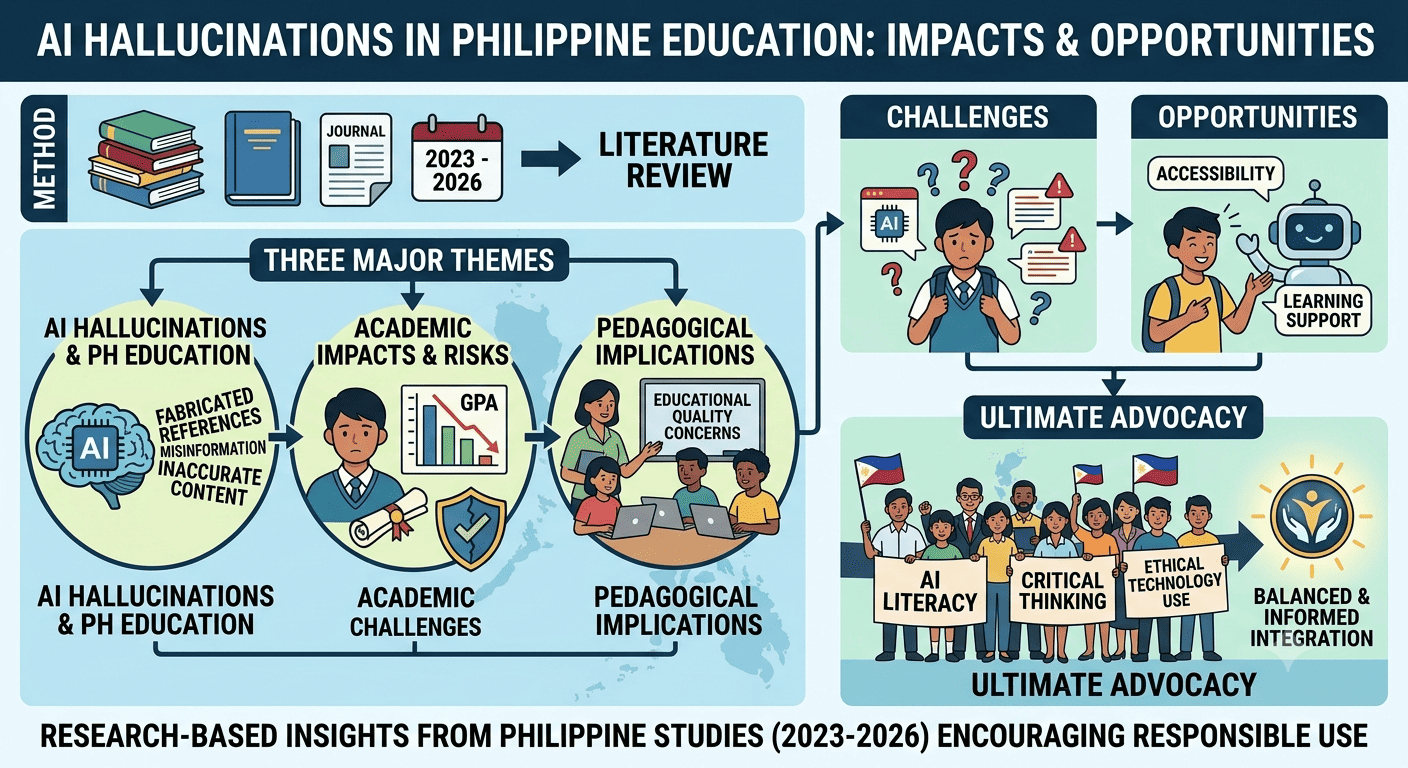
This literature review examines AI hallucinations in the context of Philippine education. Drawing from studies published between 2023 and 2026, it presents research-based insights into how AI-generated inaccuracies influence teaching, learning, and academic practices. The review explores three major themes: AI hallucinations and Philippine education, academic impacts and risks, and pedagogical implications. It highlights concerns regarding misinformation, fabricated references, inaccurate content generation, and the challenges these pose to educational quality and academic integrity. Overall, this paper aims to provide educators, students, and researchers with a clearer understanding of the opportunities and challenges associated with the growing use of artificial intelligence in educational settings. The findings suggest that while AI tools can enhance accessibility, efficiency, and learning support, their effectiveness depends on users’ ability to critically evaluate AI-generated outputs and use them responsibly. Ultimately, this review advocates for a balanced and informed integration of artificial intelligence in Philippine education through the promotion of AI literacy, critical thinking, and ethical technology use.
Full text article
References
Adejumo, A. A., Oyelere, S. S., Sanusi, I. T., & Suhonen, J. (2026). A systematic review of the impact of GenAI on learning performance, AI hallucinations, and problem-solving in computer science education. Computers and Education: Artificial Intelligence, 10, 100570. https://doi.org/10.1016/j.caeai.2026.100570
Aïmeur, E., Amri, S., & Brassard, G. (2023). Fake news, disinformation and misinformation in social media: A review. Social Network Analysis and Mining, 13(1), 30. https://doi.org/10.1007/s13278-023-01028-5
Ali Adeeb, R., & Mirhoseini, M. (2023). The Impact of Affect on the Perception of Fake News on Social Media: A Systematic Review. Social Sciences, 12(12), 674. https://doi.org/10.3390/socsci12120674
Ali, O., Murray, P. A., Momin, M., Dwivedi, Y. K., & Malik, T. (2024). The effects of artificial intelligence applications in educational settings: Challenges and strategies. Technological Forecasting and Social Change, 199, 123076. https://doi.org/10.1016/j.techfore.2023.123076
Bashar, M. A., & Nayak, R. (2025). Chatting with organisational data: A generative AI approach applied to scientific reports for information seeking. Knowledge and Information Systems, 67(11), 10657–10690. https://doi.org/10.1007/s10115-025-02551-x
Bittle, K., & El-Gayar, O. (2025). Generative AI and Academic Integrity in Higher Education: A Systematic Review and Research Agenda. Information, 16(4), 296. https://doi.org/10.3390/info16040296
Broda, E., & Strömbäck, J. (2024). Misinformation, disinformation, and fake news: Lessons from an interdisciplinary, systematic literature review. Annals of the International Communication Association, 48(2), 139–166. https://doi.org/10.1080/23808985.2024.2323736
Chen, S., Xiao, L., & Kumar, A. (2023). Spread of misinformation on social media: What contributes to it and how to combat it. Computers in Human Behavior, 141, 107643. https://doi.org/10.1016/j.chb.2022.107643
Deep, P. D., & Chen, Y. (2025). The Role of AI in Academic Writing: Impacts on Writing Skills, Critical Thinking, and Integrity in Higher Education. Societies, 15(9), 247. https://doi.org/10.3390/soc15090247
Del Vicario, M., Bessi, A., Zollo, F., Petroni, F., Scala, A., Caldarelli, G., Stanley, H. E., & Quattrociocchi, W. (2016). The spreading of misinformation online. Proceedings of the National Academy of Sciences, 113(3), 554–559. https://doi.org/10.1073/pnas.1517441113
Desitha Cahya, Putri Ramdani, Annajmi Rauf, Andi Baso Kaswar, & M Miftach Fakhri. (2026). AI Hallucinations in AI-Assisted Educational Decision-Making and Academic Honesty Intentions Among Undergraduates. Journal of Applied Artificial Intelligence in Education, 48–61. https://doi.org/10.66053/jaaie.v1i2.9
Dinç, E., Wherley, M. S., & Sankey, H. (2024). Student Perception of Journaling as an Assessment for an Engagement Experience. Journal of Experiential Education, 47(3), 484–503. https://doi.org/10.1177/10538259231203671
Ge, L. (2025). Spectral imaginings and sympoietic creativity: AI hallucinations and the ethics of posthuman creativity. Big Data & Society, 12(4), 20539517251400696. https://doi.org/10.1177/20539517251400696
Hadianti, S., Prakoso, T., Brillianing Pratiwi, Memet Casmat, Ucu Rahayu, Siti Aisyah, & Fitra Jaya. (2023). A Compatible Marketing Strategy for the Faculty of Distance Education Institution. Journal Of Digital Learning And Distance Education, 2(5), 589–599. https://doi.org/10.56778/jdlde.v2i5.161
Kamel, H. (2024). Understanding the impact of AI Hallucinations on the university community. Cybrarians Journal, (73), 111–134. https://doi.org/10.70000/cj.2024.73.622
Kuznetsova, E., Makhortykh, M., Vziatysheva, V., Stolze, M., Baghumyan, A., & Urman, A. (2025). In generative AI we trust: Can chatbots effectively verify political information? Journal of Computational Social Science, 8(1), 15. https://doi.org/10.1007/s42001-024-00338-8
Li, F., & Yang, Y. (2024). Impact of Artificial Intelligence–Generated Content Labels On Perceived Accuracy, Message Credibility, and Sharing Intentions for Misinformation: Web-Based, Randomized, Controlled Experiment. JMIR Formative Research, 8, e60024. https://doi.org/10.2196/60024
Lindo, M. R., & Panes, R. (2024). The Hallucination Effect: Correlating Generative AI Usage Frequency with Source Verification Habits among Grade 12 STEM Researchers. IMCC Journal of Science, 4(2), 9–11. https://doi.org/10.65931/d4n7x2h9
Mácha, J. (2026). Language Without Propositions: Why Large Language Models Hallucinate. Philosophies, 11(2), 42. https://doi.org/10.3390/philosophies11020042
Maleki, N., Padmanabhan, B., & Dutta, K. (2024). AI Hallucinations: A Misnomer Worth Clarifying. 2024 IEEE Conference on Artificial Intelligence (CAI), 133–138. https://doi.org/10.1109/CAI59869.2024.00033
Ncube, P. D. N., Dzvapatsva, G. P., Matobobo, C., & Ranga, M. M. (2026). Redefining student assessment in AI-infused learning environments: A systematic review of challenges and strategies for academic integrity. AI and Ethics, 6(1), 68. https://doi.org/10.1007/s43681-025-00871-w
Nguyen, D. C., & Welch, C. (2026). Generative Artificial Intelligence in Qualitative Data Analysis: Analyzing—Or Just Chatting? Organizational Research Methods, 29(1), 3–39. https://doi.org/10.1177/10944281251377154
Noorbehbahani, F., & Oyibo, K. (2026). AI-overdependence and human cognitive decline: Hazards, evidence, and mitigation strategies. Computers in Human Behavior Reports, 22, 101102. https://doi.org/10.1016/j.chbr.2026.101102
Osler, L. (2026). Hallucinating with AI: Distributed Delusions and “AI Psychosis.” Philosophy & Technology, 39(1), 30. https://doi.org/10.1007/s13347-026-01034-3
Pantao, J. G., Cahapay, M. B., Ulanday-Lozano, D. M. P., Pelones, M. T. P., Andang-Alaiden, E., Lañojan, R. S., Sales, A. M., & Bagayas, J. C. S. (2026). Examining Artificial Intelligence Literacy of Filipino College Students Using the Theory of Planned Behavior. European Journal of Educational Research, 15(3), 699–711. https://doi.org/10.12973/eu-jer.15.3.699
Park, S., & Nan, X. (2026). Generative AI and misinformation: A scoping review of the role of generative AI in the generation, detection, mitigation, and impact of misinformation. AI & SOCIETY, 41(2), 1501–1515. https://doi.org/10.1007/s00146-025-02620-3
Pedroso, J. E., Notes, F. A., Ferrer, M. P., Jardeleza, L. C., Estuya, C. B., & Empil, B. D. (2024). Social Media as a Coping Tool Amongst Social Studies Pre-Service Teachers. JOURNAL OF DIGITAL LEARNING AND DISTANCE EDUCATION, 3(7), 1154–1167. https://doi.org/10.56778/jdlde.v3i7.367
Rapp, A., Di Lodovico, C., & Di Caro, L. (2025). How do people react to ChatGPT’s unpredictable behavior? Anthropomorphism, uncanniness, and fear of AI: A qualitative study on individuals’ perceptions and understandings of LLMs’ nonsensical hallucinations. International Journal of Human-Computer Studies, 198, 103471. https://doi.org/10.1016/j.ijhcs.2025.103471
Santos, A., Cazzamatta, R., & Napolitano, C. J. (2025). Holding platforms accountable in the fight against misinformation: A cross-national analysis of state-established content moderation regulations. International Communication Gazette, 87(8), 729–750. https://doi.org/10.1177/17480485251348550
Shahrzadi, L., Mansouri, A., Alavi, M., & Shabani, A. (2024). Causes, consequences, and strategies to deal with information overload: A scoping review. International Journal of Information Management Data Insights, 4(2), 100261. https://doi.org/10.1016/j.jjimei.2024.100261
Singh, S. U., & Namin, A. S. (2025). A survey on chatbots and large language models: Testing and evaluation techniques. Natural Language Processing Journal, 10, 100128. https://doi.org/10.1016/j.nlp.2025.100128
Sosas, M. R. D., Fat, A. F. G., Dangculos, J. M. M., Anoba, H. R. P., Remiscal, C. G., & Aleguen, J. M. (2026). Use of ChatGPT as a supplemental learning tool in mathematics. Contemporary Mathematics and Science Education, 7(1), ep26004. https://doi.org/10.30935/conmaths/17989
Spiegler, S., Hoda, R., & Pant, A. (2026). Images of AI: How AI practitioners view the impact of Artificial Intelligence on society, now and in the future. Technology in Society, 84, 103109. https://doi.org/10.1016/j.techsoc.2025.103109
Sun, Y., Sheng, D., Zhou, Z., & Wu, Y. (2024). AI hallucination: Towards a comprehensive classification of distorted information in artificial intelligence-generated content. Humanities and Social Sciences Communications, 11(1), 1278. https://doi.org/10.1057/s41599-024-03811-x
Villarama, J. A. (2025). Demystifying Generative Artificial Intelligence in Academic Classrooms: Students’ Attitude and Critical Thinking. Pakistan Journal of Life and Social Sciences (PJLSS), 23(1). https://doi.org/10.57239/PJLSS-2025-23.1.00314
Wirtz, B. W., Weyerer, J. C., & Müller, T. F. (2026). AI-based digital disinformation: A theory-informed and integrated trilateral framework of digital disinformation for information systems research. International Journal of Information Management, 89, 103066. https://doi.org/10.1016/j.ijinfomgt.2026.103066
Xu, G., Qian, M., & Meng, L. (2025). Misinformation dissemination on social media: Key research themes and evolutionary paths between 2013 and 2023. Humanities and Social Sciences Communications, 12(1), 1775. https://doi.org/10.1057/s41599-025-06067-1
Yousaf, M. N. (2025). Practical Considerations and Ethical Implications of Using Artificial Intelligence in Writing Scientific Manuscripts. ACG Case Reports Journal, 12(2), e01629. https://doi.org/10.14309/crj.0000000000001629
Zhai, C., Wibowo, S., & Li, L. D. (2024). The effects of over-reliance on AI dialogue systems on students’ cognitive abilities: A systematic review. Smart Learning Environments, 11(1), 28. https://doi.org/10.1186/s40561-024-00316-7
Zhang, H., Wu, C., Xie, J., Lyu, Y., Cai, J., & Carroll, J. M. (2025). Harnessing the power of AI in qualitative research: Exploring, using and redesigning ChatGPT. Computers in Human Behavior: Artificial Humans, 4, 100144. https://doi.org/10.1016/j.chbah.2025.100144
Authors
Copyright (c) 2026 JOURNAL OF DIGITAL LEARNING AND DISTANCE EDUCATION

This work is licensed under a Creative Commons Attribution 4.0 International License.
<a rel="license" href="http://creativecommons.org/licenses/by/4.0/"><img alt="Creative Commons License" style="border-width:0" src="https://i.creativecommons.org/l/by/4.0/88x31.png" /></a><br />This work is licensed under a <a rel="license" href="http://creativecommons.org/licenses/by/4.0/">Creative Commons Attribution 4.0 International License</a>.