
Student Success Prediction in Digital Learning Environments
Article Sidebar
-
Fairness-aware machine learning, Student success prediction, educational data mining, Ethical AI, Digital learning
Abstract
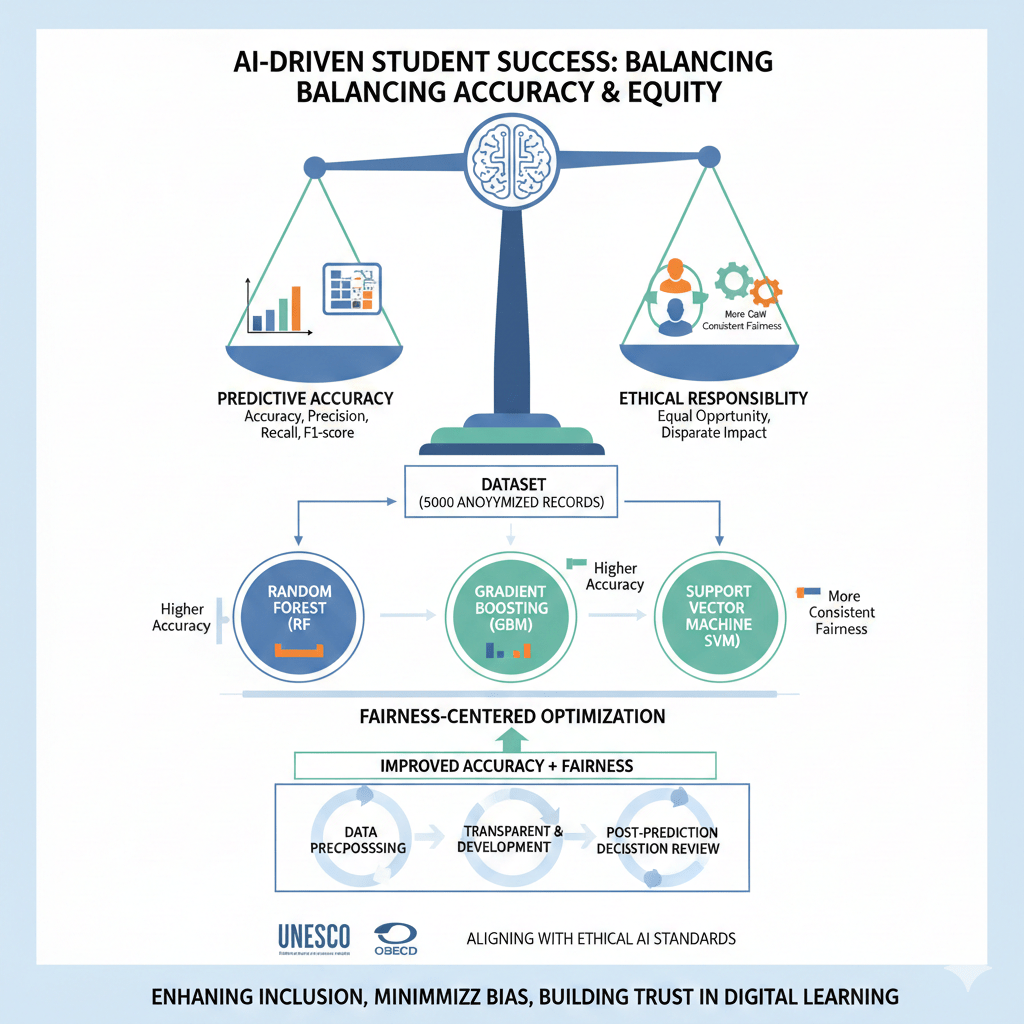
Acknowledging the risk of perpetuating bias in AI-driven student success prediction, this study introduces a fairness-conscious machine learning framework that aims to balance predictive accuracy with ethical responsibility in digital learning settings. Using a dataset of 5,000 anonymized student records, three models, Random Forest (RF), Gradient Boosting (GBM), and Support Vector Machine (SVM), were developed to forecast academic outcomes. Model evaluation combined standard metrics (accuracy, precision, recall, and F1-score) with fairness measures such as demographic parity, equal opportunity, and disparate impact ratio to explore trade-offs between accuracy and fairness. Results indicated that while RF and GBM had slightly higher accuracy, SVM demonstrated more consistent fairness across demographic groups, emphasizing its stronger balance between predictive power and equity. A fairness-centered optimization method was applied to embed fairness constraints directly into model training, showing that both accuracy and fairness can be improved simultaneously rather than being in opposition. The framework integrates fairness throughout data preprocessing, model development, and post-prediction review, promoting transparent and responsible decision-making. By aligning with international ethical AI standards from UNESCO and the OECD, this research provides a practical pathway for creating educational prediction systems that enhance inclusion, minimize bias, and build trust in digital learning environments.
Full text article
References
Bertolini, R., Finch, S. J., & Nehm, R. H. (2021). Testing the Impact of Novel Assessment Sources and Machine Learning Methods on Predictive Outcome Modeling in Undergraduate Biology. Journal of Science Education and Technology, 30(2), 193–209. https://doi.org/10.1007/S10956-020-09888-8
Bertolini, R., Finch, S. J., & Nehm, R. H. (2022). Quantifying variability in predictions of student performance: Examining the impact of bootstrap resampling in data pipelines. Computers and Education: Artificial Intelligence, 3, 100067. https://doi.org/10.1016/J.CAEAI.2022.100067
Bird, K. A., Castleman, B. L., Mabel, Z., & Song, Y. (2021). Bringing Transparency to Predictive Analytics: A Systematic Comparison of Predictive Modeling Methods in Higher Education. AERA Open, 7. https://doi.org/10.1177/23328584211037630
Bonnin, G., Bayer, V., Fernandez, M., Herodotou, C., Hlosta, M., & Mulholland, P. (2023). CERSEI: Cognitive Effort Based Recommender System for Enhancing Inclusiveness (pp. 692–697). https://doi.org/10.1007/978-3-031-42682-7_63
Hort, M., Chen, Z., Zhang, J. M., Harman, M., & Sarro, F. (2024). Bias Mitigation for Machine Learning Classifiers: A Comprehensive Survey. ACM Journal on Responsible Computing, 1(2), 1–52. https://doi.org/10.1145/3631326
James, G. G., P, O. G., G, C. E., A, M. N., F, E. W., & E, O. P. (2024). Optimizing Business Intelligence System Using Big Data and Machine Learning. Journal of Information Systems and Informatics, 6(2), 1215–1236. https://doi.org/10.51519/journalisi.v6i2.631
Khalil, M., Prinsloo, P., & Slade, S. (2023). Fairness, Trust, Transparency, Equity, and Responsibility in Learning Analytics. In Journal of Learning Analytics (Vol. 10, Issue 1, pp. 1–7). Society for Learning Analytics Research (SOLAR). https://doi.org/10.18608/jla.2023.7983
Li, C., Xing, W., & Leite, W. (2021). Yet Another Predictive Model? Fair Predictions of Students’ Learning Outcomes in an Online Math Learning Platform. LAK21: 11th International Learning Analytics and Knowledge Conference, 572–578. https://doi.org/10.1145/3448139.3448200
Li, H., Li, C., Xing, W., Baral, S., & Heffernan, N. (2024). Automated Feedback for Student Math Responses Based on Multi-Modality and Fine-Tuning. Proceedings of the 14th Learning Analytics and Knowledge Conference, 763–770. https://doi.org/10.1145/3636555.3636860
Liu, Z., Xing, W., Jiang, Y., Li, C., Kim, T., & Li, H. (2025). Leveraging contrastive learning to improve group and individual fairness in predictive analytics for online learning. Journal of Computing in Higher Education. https://doi.org/10.1007/s12528-025-09468-y
Malik, S., & Jothimani, K. (2024). Enhancing Student Success Prediction with FeatureX: A Fusion Voting Classifier Algorithm with Hybrid Feature Selection. Education and Information Technologies, 29(7), 8741–8791. https://doi.org/10.1007/s10639-023-12139-z
Oise, G., Cyprian C. KONYEHA, COMFORT, O. T., Konyeha, S., & Emmanueld, C. O. (2025). The Integration of Internet of Things (IoT) in Smart Classrooms: Opportunities, Challenges, and Future Trajectories. JOURNAL OF DIGITAL LEARNING AND DISTANCE EDUCATION, 4(3), 1554–1567. https://doi.org/10.56778/jdlde.v4i3.537
Oise, G., Ejenarhome Otega Prosper, Oyedotun Samuel ABIODUN, & Onwuzo Chioma JULIA. (2025). Evaluating the Impact of Blended Learning Models on Higher Education Outcomes: A Multidimensional Analysis. JOURNAL OF DIGITAL LEARNING AND DISTANCE EDUCATION, 4(2), 1507–1519. https://doi.org/10.56778/jdlde.v4i2.535
Oyedotun, S. A., Ejenarhome, O. P., & Oise, G. P. (2025). Learning Analytics and Predictive Modeling: Enhancing Student Success through Data-Driven Insights. Journal of Science Research and Reviews, 2(3), 42–51. https://doi.org/10.70882/josrar.2025.v2i3.77
Sha, L., Gašević, D., & Chen, G. (2023). Lessons from debiasing data for fair and accurate predictive modeling in education. Expert Systems with Applications, 228, 120323. https://doi.org/10.1016/j.eswa.2023.120323
Uddin, S., Lu, H., Rahman, A., & Gao, J. (2024). A novel approach for assessing fairness in deployed machine learning algorithms. Scientific Reports, 14(1), 17753. https://doi.org/10.1038/s41598-024-68651-w
Uttamchandani, S., & Quick, J. (2022). An Introduction to Fairness, Absence of Bias, and Equity in Learning Analytics. In The Handbook of Learning Analytics (pp. 205–212). SOLAR. https://doi.org/10.18608/hla22.020
Yan, H., Bao, W., Zhu, X., Wang, J., Wu, G., & Cao, J. (2023). Fairness-aware data offloading of IoT applications enabled by heterogeneous UAVs. Internet of Things, 22, 100745. https://doi.org/10.1016/J.IOT.2023.100745
Yu, R., Lee, H., & Kizilcec, R. F. (2021). Should College Dropout Prediction Models Include Protected Attributes? L@S 2021 - Proceedings of the 8th ACM Conference on Learning @ Scale, 91–100. https://doi.org/10.1145/3430895.3460139
Zhao, Z., & Ng, T. L. J. (2023). Fairness-Aware Processing Techniques in Survival Analysis: Promoting Equitable Predictions (pp. 460–476). https://doi.org/10.1007/978-3-031-43427-3_28
Authors
Copyright (c) 2025 JOURNAL OF DIGITAL LEARNING AND DISTANCE EDUCATION

This work is licensed under a Creative Commons Attribution 4.0 International License.
<a rel="license" href="http://creativecommons.org/licenses/by/4.0/"><img alt="Creative Commons License" style="border-width:0" src="https://i.creativecommons.org/l/by/4.0/88x31.png" /></a><br />This work is licensed under a <a rel="license" href="http://creativecommons.org/licenses/by/4.0/">Creative Commons Attribution 4.0 International License</a>.