
The Role of AI Technology in Advancing Education, Empowerment, and Entrepreneurship for Afghan Women
Article Sidebar
-
Artificial Intelligence (AI), Women’s Empowerment, Education Access, Digital Entrepreneurship, Afghanistan
Abstract
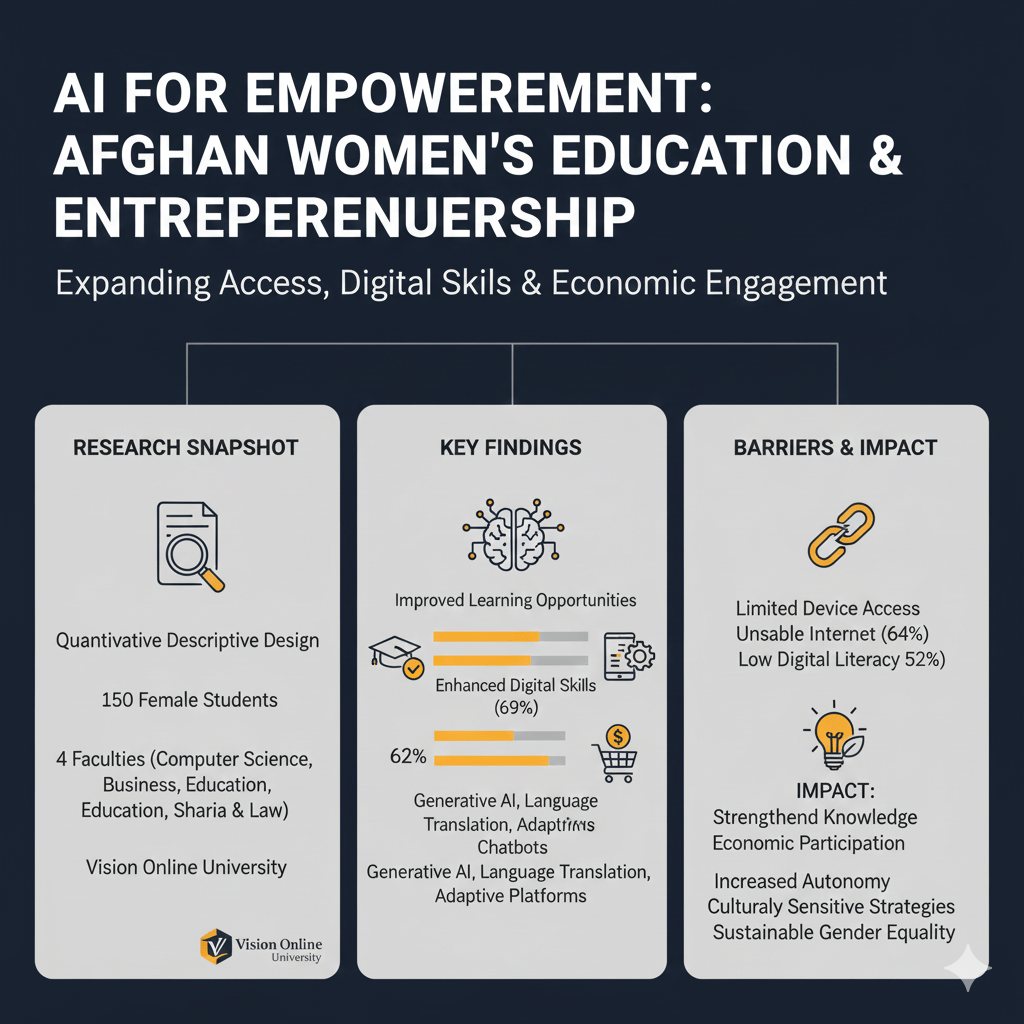
Artificial Intelligence (AI) has emerged as a transformative mechanism for expanding educational access, enhancing digital empowerment, and fostering entrepreneurial engagement among marginalized populations. This study investigates the specific role of AI technologies—such as generative AI tools, AI-powered language translation applications, adaptive learning platforms, and automated chatbots—in supporting Afghan women’s education and socio-economic participation. Employing a quantitative descriptive research design, data were collected from 150 female students across four faculties (Computer Science, Business Administration, Education, and Sharia & Law) at Vision Online University. Results show that 77% of participants perceive AI as significantly improving learning opportunities for women, particularly through personalized learning support and language-based assistance. Additionally, 69% reported that AI tools enhanced their digital skills, while 62% indicated that AI applications increased their interest in online business creation and entrepreneurial activities. Despite these benefits, respondents identified major barriers including limited access to digital devices (58%), unstable internet connectivity (64%), and low digital literacy (52%). The findings reveal AI’s multidimensional impact in strengthening knowledge, autonomy, and economic participation for Afghan women. The study underscores the need for inclusive digital infrastructure and culturally sensitive implementation strategies to fully leverage AI as a sustainable driver of gender equality and socio-economic development in Afghanistan.
Full text article
References
Abdul Azis, R., Mohamed, N. A., & Ashikin Ahmad, N. Z. (2025). Transforming Challenges into Opportunities: A Conceptual Exploration of AI’s Impact on Women Entrepreneurs in Malaysia. International Journal of Research and Innovation in Social Science, IX(V), 4509–4518. https://doi.org/10.47772/IJRISS.2025.905000347
Algur, S. M., & Mulla, Mr. M. (2025). AI-Driven Digitalization as a Catalyst for Women Entrepreneurship. International Journal of Research and Innovation in Applied Science, X(VII), 364–372. https://doi.org/10.51584/IJRIAS.2025.100700032
Barikzai, S., Bharathi S, V., & Perdana, A. (2025). Digital learning initiatives forging inclusive education in post-conflict nations. Cogent Education, 12(1), 2457904. https://doi.org/10.1080/2331186X.2025.2457904
Calzada, I. (2024). Artificial Intelligence for Social Innovation: Beyond the Noise of Algorithms and Datafication. Sustainability, 16(19), 8638. https://doi.org/10.3390/su16198638
Hakimi, M., Quchi, M. M., Hasas, A., & Fazil, A. W. (2024). The Transformative Power of Information and Communication Technology in Empowering Women in Afghanistan. Journal of Social Science Utilizing Technology, 2(1), 275–287. https://doi.org/10.70177/jssut.v2i1.702
Hakimi, M., Zarinkhail, S., & Sahnosh, F. A. (2025). Artificial Intelligence and Legal Reform in Developing Countries: Advancing Ethical, Rights-Based, and Accountable Digital Governance. Jurnal Ilmiah Telsinas Elektro, Sipil Dan Teknik Informasi, 8(2), 127–144. https://doi.org/10.38043/telsinas.v8i2.6934
Jawad Danish, Abdul Wahid Samadzai, Hakimi, M., & Mohammad Aziz Rastagari. (2025). Integrating IoT in Healthcare Systems: A Socio-Technical Approach to Improving Healthcare Delivery in Afghanistan. APLIKATIF: Journal of Research Trends in Social Sciences and Humanities, 4(1), 65–86. https://doi.org/10.59110/aplikatif.v4i1.566
Jia, X.-H., & Tu, J.-C. (2024). Towards a New Conceptual Model of AI-Enhanced Learning for College Students: The Roles of Artificial Intelligence Capabilities, General Self-Efficacy, Learning Motivation, and Critical Thinking Awareness. Systems, 12(3), 74. https://doi.org/10.3390/systems12030074
Kasinidou, M., Kleanthoys, S., & Otterbacher, J. (2025). Cypriot teachers’ digital skills and attitudes towards AI. Discover Education, 4(1), 1. https://doi.org/10.1007/s44217-024-00390-6
Marzia Ebrahimi, Behnaz Rahimi, Manizha Sharifi, Diba Sadat, Nahid Amiri, Sadaf Khalil, & Tamanna Quraishi. (2024). Empowering Women through Artificial Intelligence: Opportunities and Challenges. Journal Electrical and Computer Experiences, 2(2), 38–46. https://doi.org/10.59535/jece.v2i2.346
Moreira, L. F. R., Soares, L. S., & Martinhago, A. Z. (2024). Inspiring Women in Technology: Educational Pathways and Impact. Anais Do XVIII Women in Information Technology (WIT 2024), 325–330. https://doi.org/10.5753/wit.2024.1910
Nadry, Z., Hakimi, M., Sirat, A. W., & Popal, Z. (2025). Strengthening Cybersecurity Awareness Through Education: The Expanding Role of Cyber Law in Academic Institutions. Jurnal Analisis Hukum, 8(2), 193–209. https://doi.org/10.38043/jah.v8i2.7086
Nadry, Z., Sirat, A. W., Hakimi, M., & Quraishi, T. (2025). INTEGRATING BLOCKCHAIN IN EDUCATIONAL MANAGEMENT SYSTEMS: TRANSPARENCY AND ACCOUNTABILITY IN PUBLIC ADMINISTRATION. Jurnal Ilmiah Dinamika Sosial, 9(2), 286–309. https://doi.org/10.38043/jids.v9i2.7079
Nesari, N., Hosseini, M., Saberi, N., & Quraishi, T. (2025). Bright Future: The Role of Online Educational Technology in Empowering the Academic Advancement of Afghan Women. Gameology and Multimedia Expert, 2(4), 114–121. https://doi.org/10.29103/game.v2i4.23163
Retno, S., & Hakimi, M. (2025). Analysis of Clustering Results for Crime Incident Data in Indonesia Using Fuzzy C-Means. Journal of Advanced Computer Knowledge and Algorithms, 2(3), 73–79. https://doi.org/10.29103/jacka.v2i3.22565
Shahbazi, H., Hakimi, M., Ulusi, H., Rahimi, B., & Quraishi, T. (2024). Exploring the Impact of Artificial Intelligence on Women’s Empowerment: A Comprehensive Survey. Journal of Community Service and Society Empowerment, 2(03), 278–293. https://doi.org/10.59653/jcsse.v2i03.856
Shaikhzada, N., Mohammadi, L., Rahmani, L., Asghari, T., Hosseini, M., & Quraishi, T. (2025). Challenges and Opportunities for Afghan Women in the Digital World in Afghanistan. International Journal of Applied Research and Sustainable Sciences, 3(3), 261–272. https://doi.org/10.59890/ijarss.v3i3.5
Sirat, A. W., Hakimi, M., Himmat, B., & Enayat, W. (2025). Artificial Intelligence in Educational Leadership: Strategic, Analytical, Interactive, and Decision-Making Applications for the Digital Age. Jurnal Ilmiah Telsinas Elektro, Sipil Dan Teknik Informasi, 8(2), 210–224. https://doi.org/10.38043/telsinas.v8i2.7044
Sudestra, I. M. A., Agustini, N. W. E., Gunawan, I. M. A. O., Indrawan, G., & Hakimi, M. (2024). IMPROVING DIGITAL LEARNING: EVALUATING THE U LEARN LMS WITH THE SYSTEM USABILITY SCALE. JIPI (Jurnal Ilmiah Penelitian Dan Pembelajaran Informatika), 9(4), 2325–2332. https://doi.org/10.29100/jipi.v9i4.6910
Sustaningrum, R., & Haldaka, M. (2025). Student utilization and perceptions of AI technology for academic purposes: A mixed-method analysis. Cogent Education, 12(1), 2553835. https://doi.org/10.1080/2331186X.2025.2553835
Authors
Copyright (c) 2025 JOURNAL OF DIGITAL LEARNING AND DISTANCE EDUCATION

This work is licensed under a Creative Commons Attribution 4.0 International License.
<a rel="license" href="http://creativecommons.org/licenses/by/4.0/"><img alt="Creative Commons License" style="border-width:0" src="https://i.creativecommons.org/l/by/4.0/88x31.png" /></a><br />This work is licensed under a <a rel="license" href="http://creativecommons.org/licenses/by/4.0/">Creative Commons Attribution 4.0 International License</a>.