
The Impact of Using Youtube on Developing Kurdish EFL University Students’ Speaking Skills
Article Sidebar
-
YouTube, speaking skills, Kurdish EFL students, mixed methods, and digital pedagogy.
Abstract
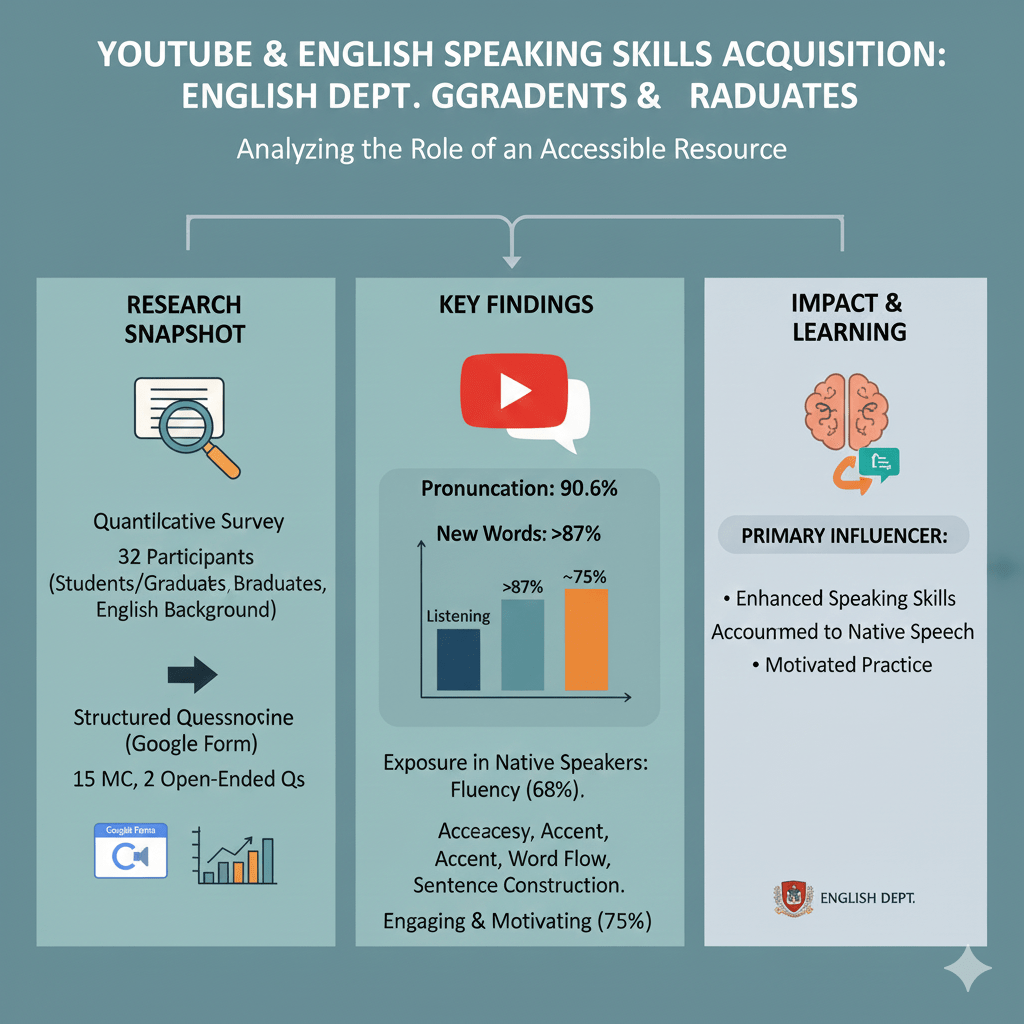
This study investigates the impact of YouTube on the development of English-speaking skills among Kurdish EFL university students and graduates. The research aimed to evaluate how YouTube's digital pedagogy influences oral proficiency, learner confidence, and autonomous learning strategies. Using a descriptive mixed-methods design, data were gathered from 32 participants via convenience sampling in the Kurdistan Region. The primary instrument was a 17-item online questionnaire analyzed through descriptive statistics and thematic content analysis. The findings indicate that YouTube functions as a potent catalyst for psychological and linguistic development, markedly increasing speaking confidence and diminishing language anxiety. The findings indicate that students effectively acquire skills incidentally through entertainment and strategically utilize subtitles as cognitive scaffolding. The study concludes that YouTube successfully bridges the gap between formal instruction and real-world communication, implying that integrating multimedia platforms into EFL curricula can foster greater learner autonomy and global intelligence.
Full text article
References
Abbas, F. N., & Qassim, A. T. (2020). Investigating the Effectiveness of YouTube as a Learning Tool among EFL Students at Baghdad University. Arab World English Journal, 6, 344–356. https://doi.org/10.24093/awej/call6.23
Al-Jarf, R. (2022). YouTube Videos as a Resource for Self-Regulated Pronunciation Practice in EFL Distance Learning Environments. Journal of English Language Teaching and Applied Linguistics, 4(2), 44–52. https://doi.org/10.32996/jeltal.2022.4.2.4
Alobaid, A. (2020). Smart multimedia learning of ICT: Role and impact on language learners’ writing fluency YouTube online English learning resources as an example. Smart Learning Environments, 7(1), 1-30. https://doi.org/10.1186/s40561-020-00134-7
Amal, M. I., Yamin, Moh., & Rosalina, E. (2025). The Effectiveness Of Using Youtube As A Medium For Teaching Efl In Improving Students’ Speaking Skills: A Systematic Review. Esteem Journal of English Education Study Programme, 8(2), 718–728. https://doi.org/10.31851/esteem.v8i2.18841
Apoko, T. W., & Waluyo, B. (2025). Social media for English language acquisition in Indonesian higher education: Constructivism and connectivism frameworks. Social Sciences & Humanities Open, 11, 101382. https://doi.org/10.1016/j.ssaho.2025.101382
Asary, M., Nadri, H. N., & Hassim, N. (2024). The Use of Youtube English Videos in Enhancing Fluency and Pronunciation in Speaking Skills. International Journal of Research and Innovation in Social Science, VIII(X), 5104–5111. https://doi.org/10.47772/IJRISS.2024.803379S
Ate, C. P., Da Conceição Anuno, A., & Muliani, M. (2025). Self-Directed Learning With Youtube: Enhancing Listening Skills On Students Of English Education Study Program. Journal of Innovative Technologies in Learning and Education, 2(2), 58–68. https://doi.org/10.37792/jitle.v2i2.1525
Baroroh, U., & Rizal, D. (2023). Using Youtube As A Learning Medium For Efl Students To Enhance Listening And Speaking Skills. Language Literacy: Journal of Linguistics, Literature, and Language Teaching, 7(2), 446–457. https://doi.org/10.30743/ll.v7i2.8349
Dominic, F. L., Yunus, M. M., & Ismail, H. H. (2025). YouTube as a Digital Learning Platform to Enhance Speaking Skills: A Study on the Perceptions and Challenges among Pre-University Students. International Journal of Research and Innovation in Social Science, IX(VIII), 5701–5712. https://doi.org/10.47772/IJRISS.2025.908000463
Elaoufy, H. (2025). Social media for vocabulary learning: Exploring YouTube’s effectiveness in EFL contexts A study of video-based language learning. International Journal of Science and Research Archive, 15(3), 1122–1136. https://doi.org/10.30574/ijsra.2025.15.3.1863
Fakhr, A. M., Farahani, B. D., & Farahani, K. A. A. (2021). Incidental Vocabulary Learning and Retention from Audiovisual Input and Factors Affecting Them. English Teaching & Learning, 45(2), 167–188. https://doi.org/10.1007/s42321-020-00066-y
Farchan, Z. R., Authar, N., Zaniar, S., Saputri, T., & Sarkawi, D. (2025). Social media-based learning: Jane Elisabet’s videos and their effect on learners’ speaking confidence. EnJourMe (English Journal of Merdeka): Culture, Language, and Teaching of English, 10(1), 93–100. https://doi.org/10.26905/enjourme.v10i1.15823
Ghafar, Z. N., & M. Amin, M. Y. (2022). Difficulties in Speaking English among the EFL students in Iraqi Kurdistan Region. World Journal of English Language, 12(6), 286-293. https://doi.org/10.5430/wjel.v12n6p286
Ghafor, O. F. (2020). Exploring the perceptions of Kurdish EFL university students towards culture as the fifth language skill. Studies in English Language and Education, 7(1), 70–82. https://doi.org/10.24815/siele.v7i1.15813
Gowhary, H., Pourhalashi, Z., Jamalinesari, A., & Azizifar, A. (2015). Investigating the Effect of Video Captioning on Iranian EFL Learners’ Listening Comprehension. Procedia - Social and Behavioral Sciences, 192, 205–212. https://doi.org/10.1016/j.sbspro.2015.06.029
Hanh, N. T. N. (2023). Investigating the Influence of YouTube on Speaking proficiency in English Major Students at Ho Chi Minh City University of Industry and Trade. Journal of Knowledge Learning and Science Technology ISSN: 2959-6386 (Online), 3(1), 1–18. https://doi.org/10.60087/jklst.vol3.n1.p18
Hasan, Md. M. (2025). Leveraging YouTube for EFL Learning: A Critical Review of Benefits, Challenges, and Pedagogical Potential. EDUCASIA: Jurnal Pendidikan, Pengajaran, Dan Pembelajaran, 10(3), 307–319. https://doi.org/10.21462/educasia.v10i3.379
Hasanah, M., & Wahono, S. S. (2022). Watching English Native Speakers’ Youtube Channel to Improve Students’ Pronunciation Ability. Journal of Language Intelligence and Culture, 4(1), 15–32. https://doi.org/10.35719/jlic.v4i1.77
Hudri, M., Iman, N. H., & Ilham, I. (2025). Students’ Perceptions of Youtube as A Learning Medium for Enhancing Speaking Skills in English Language Acquisition at Universitas Muhammadiyah Mataram. IJLECR - International Journal Of Language Education And Culture Review, 11(1), 79–88. https://doi.org/10.21009/ijlecr.v11i1.53584
Islam, Md. S., & Roy, S. (2024). Challenges in Developing Learners’ English-Speaking Skills at the Tertiary Level in the EFL Context: Teachers’ and Learners’ Perceptions. In Review. https://doi.org/10.21203/rs.3.rs-4491944/v1
Kern, R. (2024). Twenty‐first century technologies and language education: Charting a path forward. The Modern Language Journal, 108(2), 515–533. https://doi.org/10.1111/modl.12924
Khasanah, M., & Lestiyanawati, R. (2024). The Influence of Digital Literacy by Utilizing YouTube toward Students’ Speaking Ability. Journal of Language Intelligence and Culture, 6(2), 153–164. https://doi.org/10.35719/jlic.v6i2.136
Kristiani, P. E., & Pradnyadewi, D. A. M. (2021). Effectiveness of YouTube as Learning Media in Improving Learners’ Speaking Skills. The Art of Teaching English as a Foreign Language, 1(2), 8–12. https://doi.org/10.36663/tatefl.v1i2.97
Kusuma, S., Mardiana, W., & Iklil Saifulloh, A. (2024). Integrating Digital Media in Language Education: A Study on YouTube’s Effectiveness in Pronunciation Instruction. Fonologi: Jurnal Ilmuan Bahasa Dan Sastra Inggris, 2(2), 271–276. https://doi.org/10.61132/fonologi.v2i2.972
Meinawati, E., Harmoko, D. D., Rahmah, N. A., & Dewi, N.-. (2020). Increasing English Speaking Skills Using Youtube. Polyglot: Jurnal Ilmiah, 16(1), 1. https://doi.org/10.19166/pji.v16i1.1954
Mosully, A. (2024). The Effectiveness of YouTube in Developing and Improving English Foreign Language Learners’ Speaking Skills. International Journal of Linguistics, Literature and Translation, 7(1), 32–38. https://doi.org/10.32996/ijllt.2024.7.1.3
Mubarokah, E. N., & Rizal, D. (2025). EFL Students’ Perceptions on Watching English Movies as Audio-Visual Media to Improve Student’s Vocabulary Mastery. JETLEE: Journal of English Language Teaching, Linguistics, and Literature, 5(2), 169–180. https://doi.org/10.47766/jetlee.v5i2.5075
Mulyo, S., Rokhayati, T., & Setiyono, J. (2024). Investigating the Utilization of YouTube Videos for Improving Speaking Proficiency in English. Scripta: English Department Journal, 11(1), 57–67. https://doi.org/10.37729/scripta.v11i1.4958
Nasrullah, N. & Saifuddin Amin. (2024). A Systematic Literature Review: The Effectiveness of English Amusement Exposures to Acquire the Language for ESL Learners. International Journal of Education, Culture and Technology, 1(1), 13–29. https://doi.org/10.69747/edu-ij.v1i1.37
Oktapiani, I. U., Ilham, I., Humaira, H., Bafadal, F., Adebayo, M., & Fasih, P. (2024). The Effectiveness of English-Subtitled Videos in Enhancing Speaking, Listening and Vocabulary Skills: A Meta-Analysis. Journal of Languages and Language Teaching, 12(1), 56-65. https://doi.org/10.33394/jollt.v12i1.9501
Orhani, S. (2023). YouTube Platform in Teaching and Learning Constructions of Geometric Figures. Journal Of Digital Learning And Distance Education, 2(6), 608–621. https://doi.org/10.56778/jdlde.v2i6.173
Purwanti, N. K. R., Suwastini, N. K. A., Adnyani, N. L. P. S., & Kultsum, U. (2022). Youtube Videos For Improving Speaking Skills: The Benefits And Challenges According To Recent Research In Efl Context. Jurnal Pendidikan Teknologi Dan Kejuruan, 19(1), 66–75. https://doi.org/10.23887/jptk-undiksha.v19i1.41108
Qadir, S. M., & Bostanci, H. B. (2024). An analysis of English as a foreign language undergraduate students’ written errors. Forum for Linguistic Studies, 5(3),1-23. https://doi.org/10.59400/fls.v5i3.1881
Rahman, N. S., Rafii, Muh., & Epa, S. (2025). Students’ Perception Towards the Influence of YouTube Vlogs on Vocabulary Acquisition. English Education and Literature Journal, 5(02), 300–309. https://doi.org/10.53863/e-jou.v5i02.1770
Rustan, N. S., & Hamidi, F. (2024). The Use of Youtube in Facilitating Undergraduate Students’ Speaking Skills in the School of Education at Universiti Teknologi Malaysia. International Journal of Academic Research in Progressive Education and Development, 13(4), 2428-2442. https://doi.org/10.6007/IJARPED/v13-i4/23832
Saed, H. A., Haider, A. S., Al-Salman, S., & Hussein, R. F. (2021). The use of YouTube in developing the speaking skills of Jordanian EFL university students. Heliyon, 7(7), e07543. https://doi.org/10.1016/j.heliyon.2021.e07543
Shalini Roy, S., & Gandhimathi, S. N. S. (2025). Self-directed learning for optimizing sustainable language learning via mobile assisted language learning: A systematic review. Frontiers in Education, 9, 1463721. https://doi.org/10.3389/feduc.2024.1463721
Shiryaeva, T., Arakelova, A., Golubovskaya, E., & Mekeko, N. (2019). Shaping values with “YouTube freedoms”: Linguistic representation and axiological charge of the popular science IT-discourse. Heliyon, 5(12), e02988. https://doi.org/10.1016/j.heliyon.2019.e02988
Syaputra, A. Y., & Nurwita, S. (2024). Utilizing YouTube Videos to Improve Speaking Skills in Seventh-Grade Students at MTsN 2 Kota Bengkulu. PPSDP International Journal of Education, 3(2), 182–196. https://doi.org/10.59175/pijed.v3i2.298
Teng, M. F. (2025). Incidental vocabulary learning from captioned video genres: Vocabulary knowledge, comprehension, repetition, and working memory. Computer Assisted Language Learning, 38(5–6), 1301–1340. https://doi.org/10.1080/09588221.2023.2275158
Касимбекова, А. (2024). Acquisition of learning english through movies. Актуальные Вопросы Лингвистики и Преподавания Иностранных Языков: Достижения и Инновации, 1(1), 134–139. https://doi.org/10.47689/Topical-Tiltfl-vol1-iss1-2024-pp134-139
Authors
Copyright (c) 2025 JOURNAL OF DIGITAL LEARNING AND DISTANCE EDUCATION

This work is licensed under a Creative Commons Attribution 4.0 International License.
<a rel="license" href="http://creativecommons.org/licenses/by/4.0/"><img alt="Creative Commons License" style="border-width:0" src="https://i.creativecommons.org/l/by/4.0/88x31.png" /></a><br />This work is licensed under a <a rel="license" href="http://creativecommons.org/licenses/by/4.0/">Creative Commons Attribution 4.0 International License</a>.