
Effects of Artificial Intelligence on Cognitive Domain of Tertiary Institutions Students in Rivers State, Nigeria
Article Sidebar
-
Artificial Intelligence (AI), Cognitive Domain, Rivers State, Tertiary Institutions
Abstract
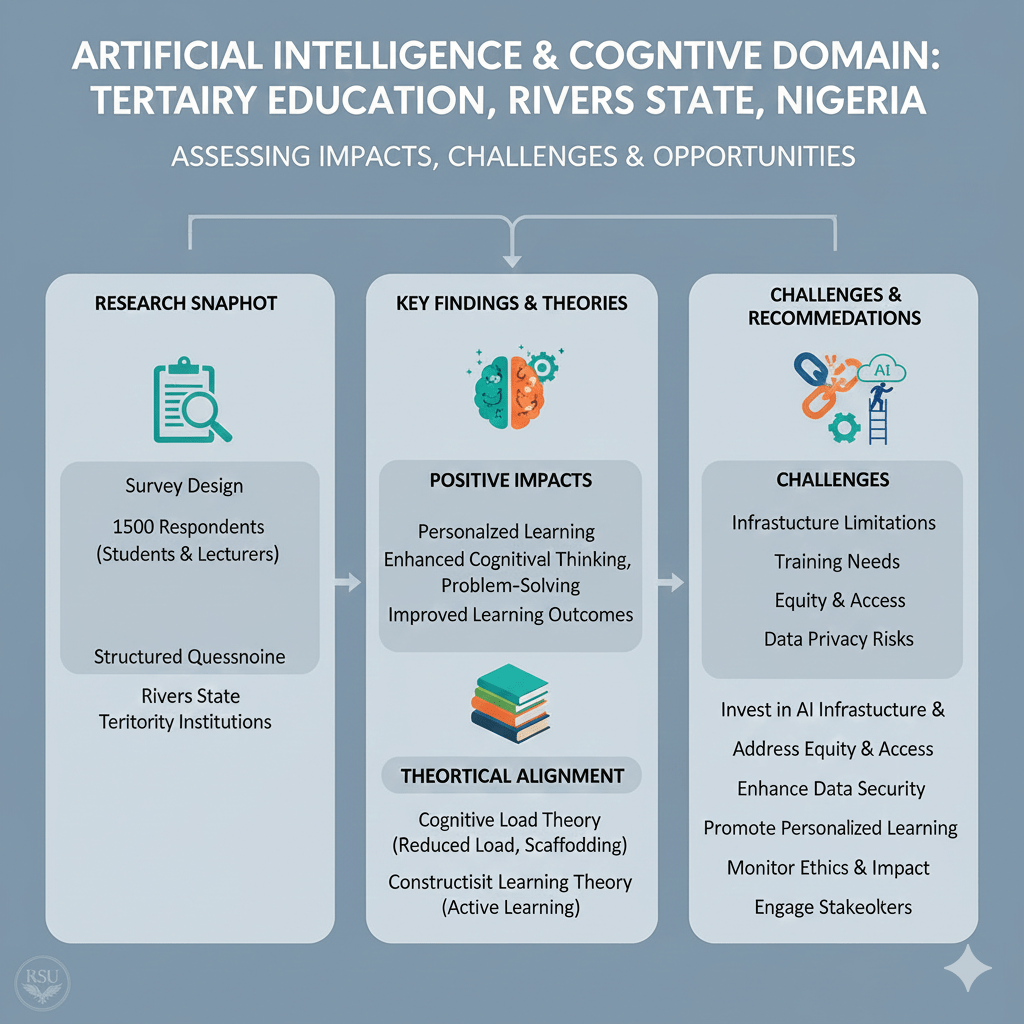
This study investigated the effects of artificial intelligence (AI) on the cognitive domain of tertiary institution students in Rivers State, Nigeria, aiming to assess AI tools' usage and impact on cognitive skills and learning outcomes and identify challenges and opportunities of AI adoption. Employing a survey research design, the study collected data from 1500 respondents (students and lecturers) across Rivers State's tertiary institutions using a structured questionnaire. Findings revealed significant AI integration, enhancing personalized learning, cognitive skills like analytical thinking and problem-solving, and learning outcomes. AI's management of cognitive load and scaffolding of learning aligned with Cognitive Load Theory and Constructivist Learning Theory. Challenges included infrastructure limitations, training needs, equity concerns, and data privacy risks, while opportunities encompassed enhanced personalization, efficiency, innovative learning tools, and future-ready skills. The study concluded that AI has potential in transforming Rivers State's tertiary institutions' students' education by emphasizing careful implementation and strategic investments. Thus, it is recommended that the government invest in AI infrastructure, teacher training, addressing equity and access concerns, enhancing data security, promoting personalized learning, monitoring AI impact and ethics, and engaging educational stakeholders for effective AI integration in Rivers State.
Full text article
References
Adewale, M. D., Azeta, A., Abayomi-Alli, A., & Sambo-Magaji, A. (2024). Impact of artificial intelligence adoption on students’ academic performance in open and distance learning: A systematic literature review. Heliyon, 10(22), e40025. https://doi.org/10.1016/j.heliyon.2024.e40025
Aksel Stenberdt, V., & Makransky, G. (2023). Mastery experiences in immersive virtual reality promote pro-environmental waste-sorting behavior. Computers & Education, 198, 104760. https://doi.org/10.1016/j.compedu.2023.104760
Al Nabhani, F., Hamzah, M. B., & Abuhassna, H. (2025). The role of artificial intelligence in personalizing educational content: Enhancing the learning experience and developing the teacher’s role in an integrated educational environment. Contemporary Educational Technology, 17(2), ep573. https://doi.org/10.30935/cedtech/16089
Bai, Y. (2025). Exploring the role and impact of artificial intelligence in personalized foreign language teaching. Discover Artificial Intelligence, 5(1), 318. https://doi.org/10.1007/s44163-025-00546-9
Du Plooy, E., Casteleijn, D., & Franzsen, D. (2024). Personalized adaptive learning in higher education: A scoping review of key characteristics and impact on academic performance and engagement. Heliyon, 10(21), e39630. https://doi.org/10.1016/j.heliyon.2024.e39630
Fitas, R. (2025). Inclusive education with AI: Supporting special needs and tackling language barriers. AI and Ethics, 5(6), 5729–5757. https://doi.org/10.1007/s43681-025-00824-3
Garzón, J., Patiño, E., & Marulanda, C. (2025). Systematic Review of Artificial Intelligence in Education: Trends, Benefits, and Challenges. Multimodal Technologies and Interaction, 9(8), 84. https://doi.org/10.3390/mti9080084
Guan, L., Liang, H., & Zhu, J. J. H. (2022). Predicting reposting latency of news content in social media: A focus on issue attention, temporal usage pattern, and information redundancy. Computers in Human Behavior, 127, 107080. https://doi.org/10.1016/j.chb.2021.107080
Haetami, H. (2025). AI-Driven Educational Transformation in Indonesia: From Learning Personalization to Institutional Management. AL-ISHLAH: Jurnal Pendidikan, 17(2), 1819–1832. https://doi.org/10.35445/alishlah.v17i2.7448
Herawati, A. A., Yusuf, S., Ilfiandra, I., Taufik, A., & Ya Habibi, A. S. (2024). Exploring the Role of Artificial Intelligence in Education, Students Preferences and Perceptions. AL-ISHLAH: Jurnal Pendidikan, 16(2), 1029–1040. https://doi.org/10.35445/alishlah.v16i2.4784
Hu, C., Li, F., Wang, S., Gao, Z., Pan, S., & Qing, M. (2025). The role of artificial intelligence in enhancing personalized learning pathways and clinical training in dental education. Cogent Education, 12(1), 2490425. https://doi.org/10.1080/2331186X.2025.2490425
Kerimbayev, N., Adamova, K., Shadiev, R., & Altinay, Z. (2025). Intelligent educational technologies in individual learning: A systematic literature review. Smart Learning Environments, 12(1), 1. https://doi.org/10.1186/s40561-024-00360-3
Mariyono, D., & Nur Alif Hd, A. (2025). AI’s role in transforming learning environments: A review of collaborative approaches and innovations. Quality Education for All, 2(1), 265–288. https://doi.org/10.1108/QEA-08-2024-0071
Mohamed, A. M., Shaaban, T. S., Bakry, S. H., Guillén-Gámez, F. D., & Strzelecki, A. (2025). Empowering the Faculty of Education Students: Applying AI’s Potential for Motivating and Enhancing Learning. Innovative Higher Education, 50(2), 587–609. https://doi.org/10.1007/s10755-024-09747-z
Mustafa, M. Y., Tlili, A., Lampropoulos, G., Huang, R., Jandrić, P., Zhao, J., Salha, S., Xu, L., Panda, S., Kinshuk, López-Pernas, S., & Saqr, M. (2024). A systematic review of literature reviews on artificial intelligence in education (AIED): A roadmap to a future research agenda. Smart Learning Environments, 11(1), 59. https://doi.org/10.1186/s40561-024-00350-5
Rahiman, H. U., & Kodikal, R. (2024). Revolutionizing education: Artificial intelligence empowered learning in higher education. Cogent Education, 11(1), 2293431. https://doi.org/10.1080/2331186X.2023.2293431
Schmidt, D. A., Alboloushi, B., Thomas, A., & Magalhaes, R. (2025). Integrating artificial intelligence in higher education: Perceptions, challenges, and strategies for academic innovation. Computers and Education Open, 9, 100274. https://doi.org/10.1016/j.caeo.2025.100274
Seo, K., Tang, J., Roll, I., Fels, S., & Yoon, D. (2021). The impact of artificial intelligence on learner–instructor interaction in online learning. International Journal of Educational Technology in Higher Education, 18(1), 54. https://doi.org/10.1186/s41239-021-00292-9
Vieriu, A. M., & Petrea, G. (2025). The Impact of Artificial Intelligence (AI) on Students’ Academic Development. Education Sciences, 15(3), 343. https://doi.org/10.3390/educsci15030343
Wang, S., Wang, F., Zhu, Z., Wang, J., Tran, T., & Du, Z. (2024). Artificial intelligence in education: A systematic literature review. Expert Systems with Applications, 252, 124167. https://doi.org/10.1016/j.eswa.2024.124167
Authors
Copyright (c) 2025 JOURNAL OF DIGITAL LEARNING AND DISTANCE EDUCATION

This work is licensed under a Creative Commons Attribution 4.0 International License.
<a rel="license" href="http://creativecommons.org/licenses/by/4.0/"><img alt="Creative Commons License" style="border-width:0" src="https://i.creativecommons.org/l/by/4.0/88x31.png" /></a><br />This work is licensed under a <a rel="license" href="http://creativecommons.org/licenses/by/4.0/">Creative Commons Attribution 4.0 International License</a>.