
Lecturers’ and Students’ Perceptions on Online Assessment in Offline Science Courses in Higher Education in South-East Geo -Political Zone, Nigeria
Article Sidebar
-
Online Assessment, Offline Science Courses, Higher Education, Lecturers’ and Students’ Perceptions
Abstract
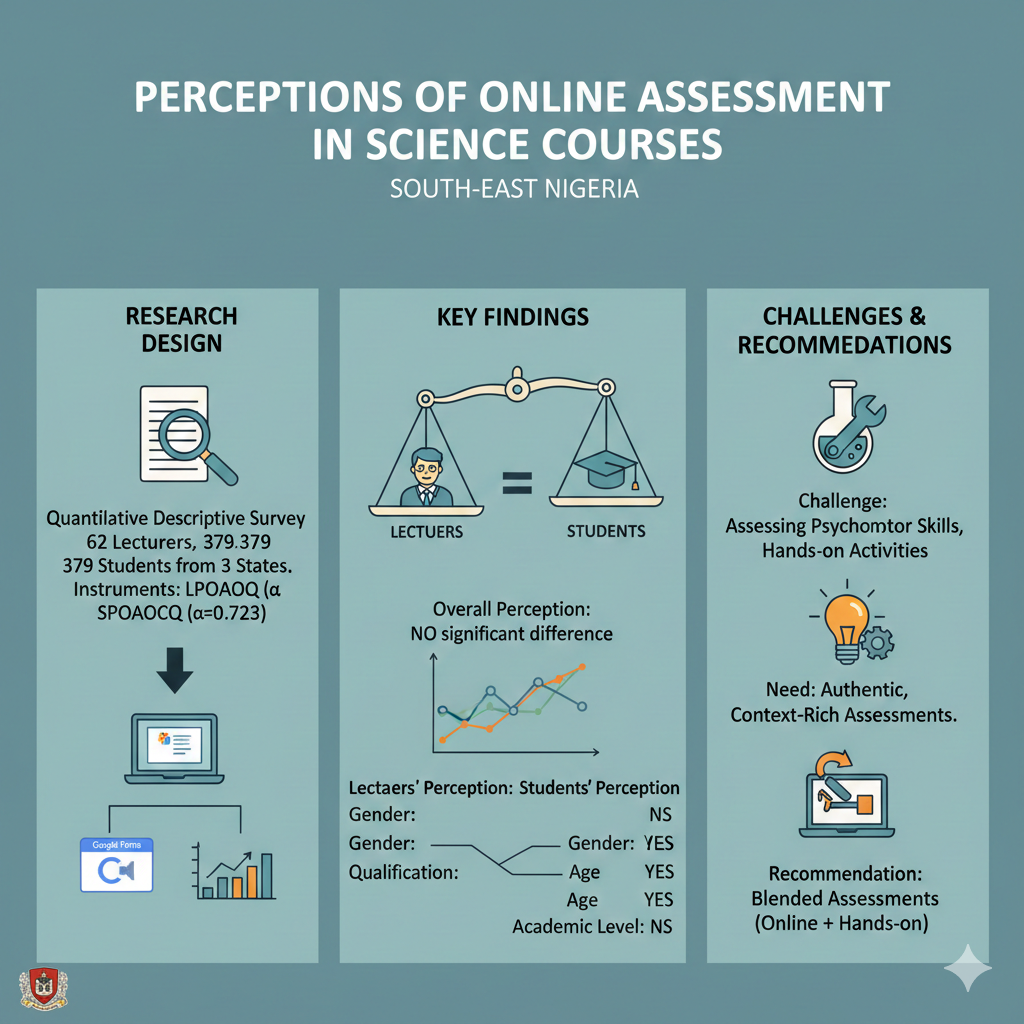
This study investigated lecturers’ and students’ perceptions of online assessment in science courses traditionally taught offline in higher institutions across South-East Nigeria. A quantitative descriptive survey design was adopted, guided by three research questions and three hypotheses. Using a multi-stage sampling technique, 62 lecturers and 379 students were selected from three states. Data were collected using two validated instruments, LPOAOCQ and SPOAOCQ, with reliability coefficients of 0.771 and 0.723 respectively, administered via Google Forms. Descriptive statistics, independent t-tests, and ANOVA were used for analysis at a 0.05 significance level. Results showed no significant difference between lecturers’ and students’ overall perceptions. However, while lecturers’ views did not vary significantly by gender or qualification, students’ perceptions differed significantly by gender and age, but not by academic level. The findings highlight challenges in assessing psychomotor skills through online formats, especially in science education where hands-on activities are essential. The study emphasizes the need for authentic, context-rich assessments that reflect real-world scientific practice. It was recommended among others that Institutions should adopt blended assessments that integrate online tools with hands-on evaluations to effectively measure student competencies.
Full text article
References
Akhtar, Z., & Perea-Borobio, E. (2025). Navigating the digital shift: Investigating the viability of digital assessments for electrical and electronic engineering students. European Journal of Engineering Education, 1–20. https://doi.org/10.1080/03043797.2025.2523549
Al-Barakat, A., AlAli, R., Alotaibi, S., Alrashood, J., Abdullatif, A., & Zaher, A. (2025). Science Education as a Pathway to Sustainable Awareness: Teachers’ Perceptions on Fostering Understanding of Humans and the Environment: A Qualitative Study. Sustainability, 17(15), 7136. https://doi.org/10.3390/su17157136
Bou Saad, R., Garcia, A. L., & Garcia, J. M. C. (2025). Mapping Constructivist Active Learning for STEM: Toward Sustainable Education. Sustainability, 17(13), 6225. https://doi.org/10.3390/su17136225
Chen, X., Jiang, L., Zhou, Z., & Li, D. (2025). Impact of perceived ease of use and perceived usefulness of humanoid robots on students’ intention to use. Acta Psychologica, 258, 105217. https://doi.org/10.1016/j.actpsy.2025.105217
Davis, F. D. (1989). Perceived Usefulness, Perceived Ease of Use, and User Acceptance of Information Technology. MIS Quarterly, 13(3), 319–340. https://doi.org/10.2307/249008
Denovan, R. F., & Marsasi, E. G. (2025). Perceived Ease Of Use, Perceived Usefulness And Satisfaction To Maximize Behavioral Intention With The Technology Acceptance Model In Generation Y And Z Consumers. Jurnal Pamator : Jurnal Ilmiah Universitas Trunojoyo, 18(1), 1–36. https://doi.org/10.21107/pamator.v18i1.29461
Ehiemere, F. I., & Chikezie, I. J. (2025). Exploring Motivation Variables as Predictors of Academic Assessment Outcomes Among Junior Secondary School Students in Aba Education Zone, Abia State. British Journal of Education, 13(4), 78–94. https://doi.org/10.37745/bje.2013/vol13n47894
García Doménech, N., Sanz Arjona, A., Prochukhan, N., Scully, N. P., & O’Donoghue, J. (2024). How to Write a Scientific Lab Report: A Short-Term Intervention for Improving Chemistry Writing Skills. Journal of Chemical Education, 101(3), 903–909. https://doi.org/10.1021/acs.jchemed.3c00651
Heil, J., & Ifenthaler, D. (2023). Online Assessment in Higher Education: A Systematic Review. Online Learning, 27(1). https://doi.org/10.24059/olj.v27i1.3398
Henderikx, M., Vrieling-Teunter, E., Molin, F., & Nadolski, R. (2025). Peer feedback modelling needs in online higher education: An exploratory study. Studies in Educational Evaluation, 86, 101464. https://doi.org/10.1016/j.stueduc.2025.101464
James, R. (2016). Tertiary student attitudes to invigilated, online summative examinations. International Journal of Educational Technology in Higher Education, 13(1), 19. https://doi.org/10.1186/s41239-016-0015-0
Karabacak, Ü., & Çelik, H. Y. (2025). Improving the psychomotor performance of student nurses using remote clinical skills practice: A mixed-methods study. BMC Nursing, 24(1), 338. https://doi.org/10.1186/s12912-025-03028-6
Newton, P. M., Furby, K. H., Campbell, J., Salvi, A., Santiago, G., & Chau, M. (2025). Negatively Marked Elimination-Format Multiple-Choice Questions Are Associated with High Cognitive Load and Poor Student Experience Compared to Single Best Answer. Medical Science Educator, 35(3), 1411–1422. https://doi.org/10.1007/s40670-025-02318-7
Osinakachukwu Jerik Okpaluba. (2025). Impact of Digital Education on The Academic Performance of Students: A Study of Selected Secondary Schools in Idemili North L.G.A, Anambra State. International Journal of Latest Technology in Engineering Management & Applied Science, 14(4), 975–1000. https://doi.org/10.51583/IJLTEMAS.2025.140400119
Ravi, M., & Besharat, M. (2025). A holistic consideration of authentic assessments: Student perception of assessment design, delivery, flexibility and creativity. European Journal of Engineering Education, 1–18. https://doi.org/10.1080/03043797.2025.2480116
Sarker, P. S., Banshal, S. K., Newton, M. A. H., Anika, S. I., Sumsee Sristy, Most. A., & Chakrobortty, A. (2025). Perceived key factors affecting online university classrooms. Education and Information Technologies. https://doi.org/10.1007/s10639-025-13744-w
Taconis, R., & Bekker, T. (2023). Challenge Based Learning as authentic learning environment for STEM identity construction. Frontiers in Education, 8, 1144702. https://doi.org/10.3389/feduc.2023.1144702
Yu, R., & Cai, X. (2022). Impact of Immediacy of Feedback on Continuous Intentions to Use Online Learning From the Student Perspective. Frontiers in Psychology, 13, 865680. https://doi.org/10.3389/fpsyg.2022.865680
Zahra Akbari Pordanjani & Keyvan Salehi. (2025). Limitations of Electronic Assessment: A Systematic Review. https://doi.org/10.15157/QR.2025.3.1.111-130
Žerovnik, A. (2024). Technology-Enhanced Feedback System Usability in the Context of Self-Regulation Promotion. Education Sciences, 14(9), 948. https://doi.org/10.3390/educsci14090948
Authors
Copyright (c) 2025 JOURNAL OF DIGITAL LEARNING AND DISTANCE EDUCATION

This work is licensed under a Creative Commons Attribution 4.0 International License.
<a rel="license" href="http://creativecommons.org/licenses/by/4.0/"><img alt="Creative Commons License" style="border-width:0" src="https://i.creativecommons.org/l/by/4.0/88x31.png" /></a><br />This work is licensed under a <a rel="license" href="http://creativecommons.org/licenses/by/4.0/">Creative Commons Attribution 4.0 International License</a>.