
Leveraging Artificial Intelligence for Transformative Religious Studies Education Curriculum in Nigeria: Teachers' Perspectives
Article Sidebar
-
Artificial Intelligence, Education curriculum, Nigeria, Religious studies, Teachers’ perspective
Abstract
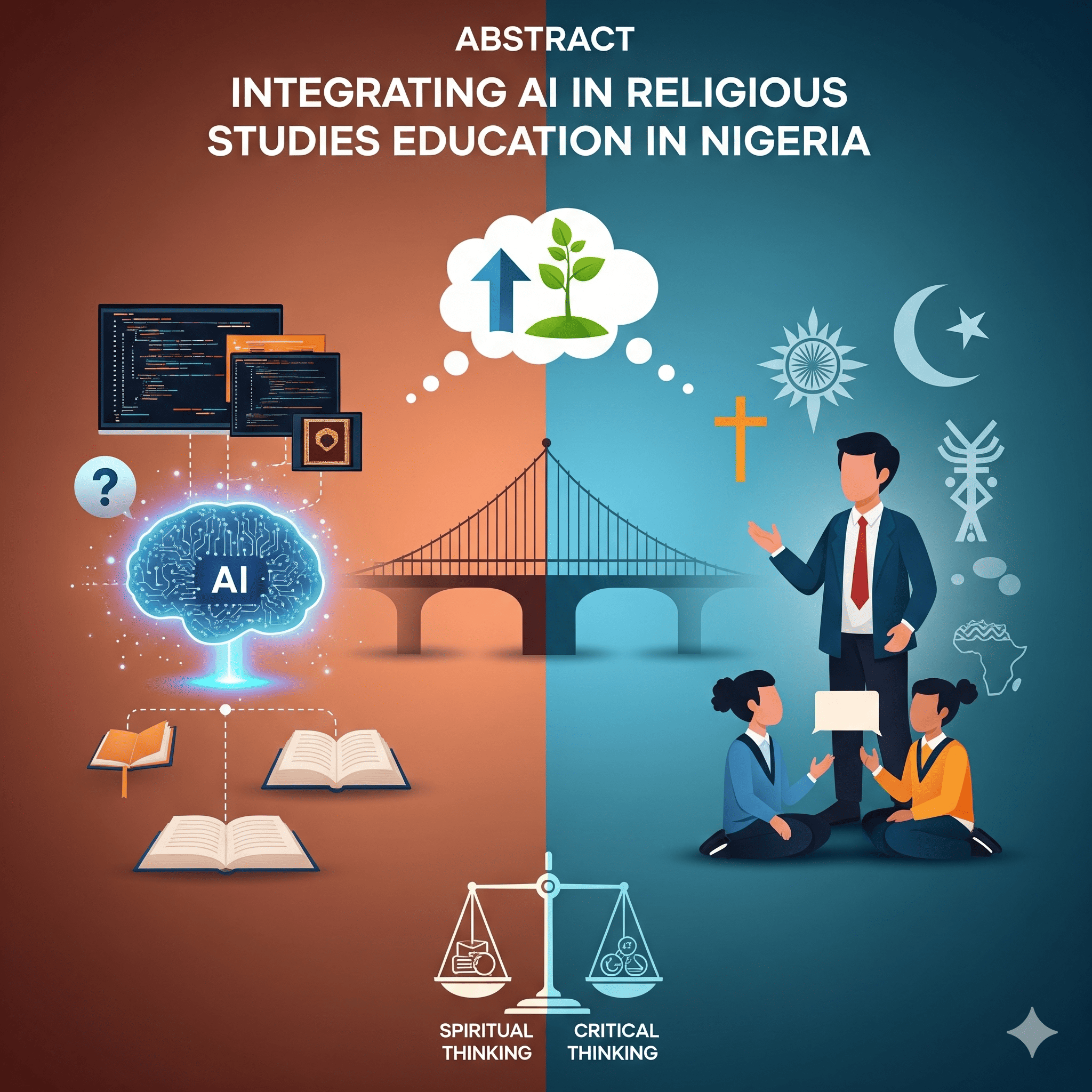
This study aimed to explore teachers' perspectives on the integration of Artificial Intelligence (AI) in Religious Studies Education Curriculum in Nigeria, with a focus on the potential benefits and challenges of AI integration. The study employed a survey research design, collecting data from 1000 teachers in Nigeria using a self-developed questionnaire.The study's conclusions show that while teachers view AI as a useful tool to enhance Religious Studies Education teaching methods, they also voice concerns about the lack of support and training for integrating AI, the possible dangers of relying too much on technology, and epistemic limitations. The report also suggests methods for integrating AI effectively, such as creating a comprehensive strategy that strikes a balance between the advantages of AI and the need for critical thinking, human contact, and spiritual development. The study comes to the conclusion that while AI has the potential to improve Religious Studies education, educators and policymakers must carefully weigh the advantages and disadvantages of integrating AI to make sure that it helps students develop their critical thinking, spiritual literacy, and problem-solving abilities.. Based on the findings, the study recommends that educators develop a holistic approach to AI integration, teach AI literacy, and ensure data privacy and security, while policymakers provide training and support for teachers and develop guidelines for AI integration. By understanding teachers' perspectives and developing effective strategies for AI integration, educators can promote deeper learning, spiritual growth, and critical thinking in students.
Full text article
References
Ahmad, S. F., Han, H., Alam, M. M., Rehmat, Mohd. K., Irshad, M., Arraño-Muñoz, M., & Ariza-Montes, A. (2023). Impact of artificial intelligence on human loss in decision making, laziness and safety in education. Humanities and Social Sciences Communications, 10(1), 311. https://doi.org/10.1057/s41599-023-01787-8
Alam, A., & Mohanty, A. (2023). Educational technology: Exploring the convergence of technology and pedagogy through mobility, interactivity, AI, and learning tools. Cogent Engineering, 10(2), 2283282. https://doi.org/10.1080/23311916.2023.2283282
Althoey, F., Waqar, A., Hamed Alsulamy, S., Khan, A. M., Alshehri, A., Idris Falqi, I., Abuhussain, M., & Awad Abuhussain, M. (2024). Influence of IoT implementation on Resource management in construction. Heliyon, 10(15), e32193. https://doi.org/10.1016/j.heliyon.2024.e32193
Alwaqdani, M. (2025). Investigating teachers’ perceptions of artificial intelligence tools in education: Potential and difficulties. Education and Information Technologies, 30(3), 2737–2755. https://doi.org/10.1007/s10639-024-12903-9
Bewersdorff, A., Zhai, X., Roberts, J., & Nerdel, C. (2023). Myths, mis- and preconceptions of artificial intelligence: A review of the literature. Computers and Education: Artificial Intelligence, 4, 100143. https://doi.org/10.1016/j.caeai.2023.100143
Çelik, F., & Baturay, M. H. (2024). Technology and innovation in shaping the future of education. Smart Learning Environments, 11(1), 54, s40561-024-00339–0. https://doi.org/10.1186/s40561-024-00339-0
Gu, L. (2025). How technology influences English learning attainment among Chinese students. Acta Psychologica, 253, 104740. https://doi.org/10.1016/j.actpsy.2025.104740
Holmes, W., & Tuomi, I. (2022). State of the art and practice in AI in education. European Journal of Education, 57(4), 542–570. https://doi.org/10.1111/ejed.12533
Kim, N. J., & Kim, M. K. (2022). Teacher’s Perceptions of Using an Artificial Intelligence-Based Educational Tool for Scientific Writing. Frontiers in Education, 7, 755914. https://doi.org/10.3389/feduc.2022.755914
Krishna, V. V. (2024). A I and contemporary challenges: The good, bad and the scary. Journal of Open Innovation: Technology, Market, and Complexity, 10(1), 100178. https://doi.org/10.1016/j.joitmc.2023.100178
Marrone, R., Zamecnik, A., Joksimovic, S., Johnson, J., & De Laat, M. (2024). Understanding Student Perceptions of Artificial Intelligence as a Teammate. Technology, Knowledge and Learning. https://doi.org/10.1007/s10758-024-09780-z
Marzuki, Widiati, U., Rusdin, D., Darwin, & Indrawati, I. (2023). The impact of AI writing tools on the content and organization of students’ writing: EFL teachers’ perspective. Cogent Education, 10(2), 2236469. https://doi.org/10.1080/2331186X.2023.2236469
Nyathi, M. (2023). Virtual campuses in developing countries: An evaluation of the “right connectors” for effective e-learning in higher education institutions in Zimbabwe. Journal of Research in Innovative Teaching & Learning, 16(2), 253–267. https://doi.org/10.1108/JRIT-06-2022-0040
Shabur, Md. A., Jahan, J., & Barua, P. (2025). Assessing the success of Education 4.0 in enhancing English proficiency for engineering students in Bangladesh. Discover Education, 4(1), 61. https://doi.org/10.1007/s44217-025-00453-2
Shi, L., Ding, A.-C. (Elisha), & Choi, I. (2024). Investigating Teachers’ Use of an AI-Enabled System and Their Perceptions of AI Integration in Science Classrooms: A Case Study. Education Sciences, 14(11), 1187. https://doi.org/10.3390/educsci14111187
Sihombing, O. R. (2024). Artificial Intelligence and Christian Religious Education Management: Finding the Balance between Technology and Spirituality. Indonesian Journal of Advanced Research, 3(12), 1959–1970. https://doi.org/10.55927/ijar.v3i12.12666
Sivakumar, A., Jayasingh, S., & Shaik, S. (2023). Social Media Influence on Students’ Knowledge Sharing and Learning: An Empirical Study. Education Sciences, 13(7), 745. https://doi.org/10.3390/educsci13070745
Vieriu, A. M., & Petrea, G. (2025). The Impact of Artificial Intelligence (AI) on Students’ Academic Development. Education Sciences, 15(3), 343. https://doi.org/10.3390/educsci15030343
Wang, T., Lund, B. D., Marengo, A., Pagano, A., Mannuru, N. R., Teel, Z. A., & Pange, J. (2023). Exploring the Potential Impact of Artificial Intelligence (AI) on International Students in Higher Education: Generative AI, Chatbots, Analytics, and International Student Success. Applied Sciences, 13(11), 6716. https://doi.org/10.3390/app13116716
Zhai, C., Wibowo, S., & Li, L. D. (2024). The effects of over-reliance on AI dialogue systems on students’ cognitive abilities: A systematic review. Smart Learning Environments, 11(1), 28. https://doi.org/10.1186/s40561-024-00316-7
Authors
Copyright (c) 2025 JOURNAL OF DIGITAL LEARNING AND DISTANCE EDUCATION

This work is licensed under a Creative Commons Attribution 4.0 International License.
<a rel="license" href="http://creativecommons.org/licenses/by/4.0/"><img alt="Creative Commons License" style="border-width:0" src="https://i.creativecommons.org/l/by/4.0/88x31.png" /></a><br />This work is licensed under a <a rel="license" href="http://creativecommons.org/licenses/by/4.0/">Creative Commons Attribution 4.0 International License</a>.