
Enhancing Arabic Speaking Skills: Pedagogical Strategies and Practical Approaches with special reference to Role-playing
Article Sidebar
-
role-playing, teaching speaking skills, teaching strategies, pedagogy, practice
Abstract
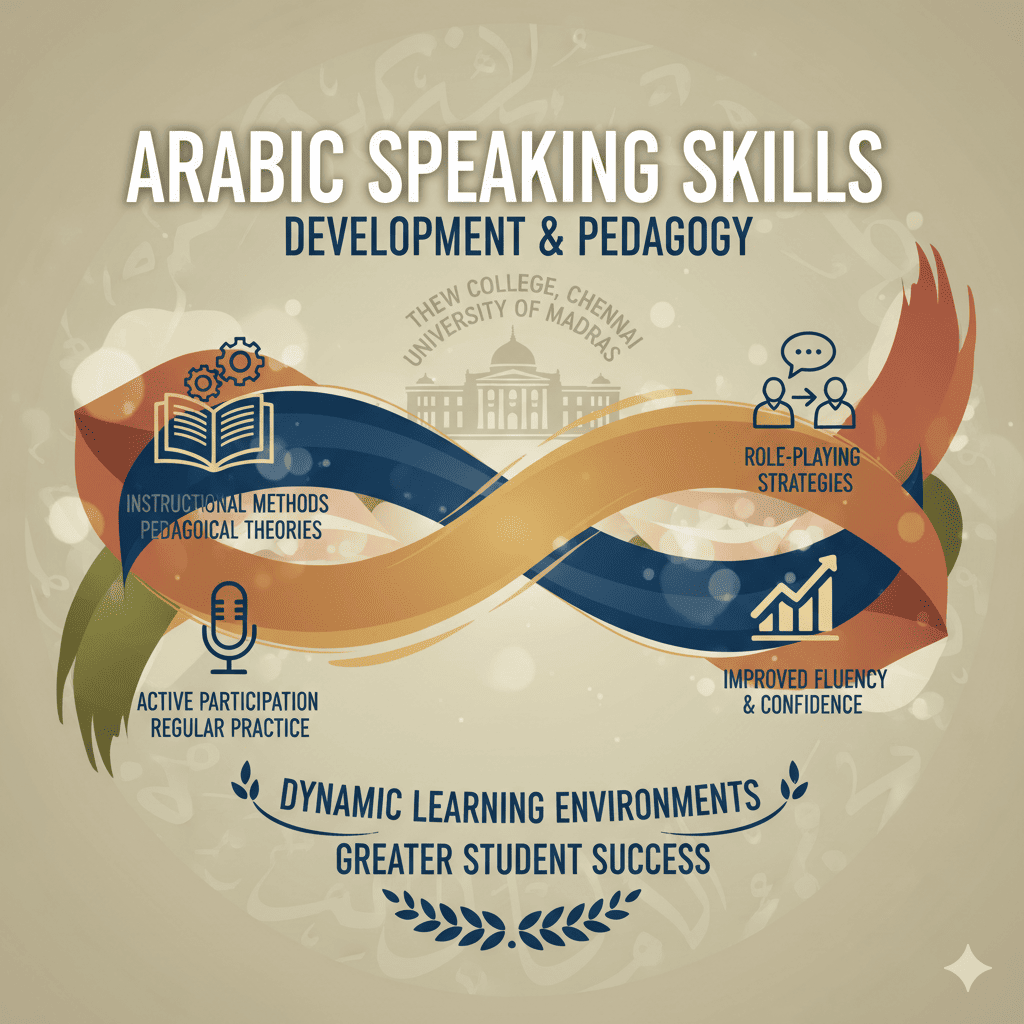
This research investigates the development and teaching of speaking skills in Arabic language education, emphasizing effective instructional methods and the importance of continuous practice beyond the classroom. It highlights that achieving proficiency in speaking requires dedicated effort from both teachers and students, utilizing tailored strategies to meet learners' needs. Drawing from extensive literature and pedagogical theories, the study underscores active participation, regular practice, and proper evaluation as key components for improving oral communication.
At the New College, Chennai, under the University of Madras, Arabic teaching aims to enhance students’ understanding of texts and their overall language skills—listening, speaking, reading, and writing. However, traditional teaching methods, primarily lecture-based, limit student engagement and reduce motivation to communicate. To address this issue, the study explores the implementation of role-playing strategies, which are highly effective for developing speaking skills by fostering active participation and confidence.
The research involved third-year Arabic students and followed two cycles, each with planning, implementation, observation, and reflection phases. Findings reveal that role-playing activities significantly boost students’ speaking abilities, helping them feel less embarrassed and more fluent. Students also work collaboratively, gaining confidence through acting and active engagement in class. Overall, the study demonstrates that incorporating interactive methods like role-playing can substantially improve Arabic speaking skills, encouraging more dynamic and motivated language learning environments. The results suggest that adopting such strategies can lead to more effective language instruction and greater student success in oral proficiency.
Full text article
References
Abdurrahman, S., Hasibuan, L. H., Idris, M., Hijriati, N., Lasterina, J., Puteri, S. A., Rosyadi, G. M., Firmansyah, A. S., & Hidayati, N. (2022). Pelatihan Pembuatan Penelitian Tindakan Kelas di SMPN 14 Banjarbaru. Jurnal Pengabdian Pada Masyarakat, 7(4), 972–978. https://doi.org/10.30653/002.202274.201
Ajiegoena, A. M. (2014). Peningkatan Hasil Belajar Matematika Melalui Metode Pemecahan Masalah. Tarbiya: Journal of Education in Muslim Society, 2(1), 83–94. https://doi.org/10.15408/tjems.v1i1.1116
Karmila, N. (2023). Penerapan Role Play untuk Meningkatkan Keterampilan Berbicara Siswa dalam Pembelajaran Bahasa Inggris di Kelas IX SMP Negeri 1 Bonjol. Pedagogika: Jurnal Ilmu-Ilmu Kependidikan, 3(2), 231–237. https://doi.org/10.57251/ped.v3i2.1290
Ly, C. K. (2024). Applying Role-Play Technique on Improving EFL Students’ Language Learning: A Case Study at a Vietnamese University. Journal of Knowledge Learning and Science Technology ISSN: 2959-6386 (Online), 3(4), 1–10. https://doi.org/10.60087/jklst.v3.n4.p1
Mabrurrosi, M., Aziz, L., & Ruji, R. (2023). Pendekatan Komunikatif David Nunan (Studi Kasus dalam Pembelajaran Bahasa Arab di Markas Bahasa Arab Pondok Pesantren Banyuanyar Pamekasan). Edu Journal Innovation in Learning and Education, 1(2), 152–161. https://doi.org/10.55352/edu.v1i2.772
Mariani, N., Arini, D. N., Nasrullah, N., & Hidayat, F. (2020). Teachers’ Perception on Classroom Action Research as One Of The TPD Strategies. English Education: Jurnal Tadris Bahasa Inggris, 13(1), 42–49. https://doi.org/10.24042/ee-jtbi.v13i1.5993
Moch. Fajarul Falah. (2023). Al-Usus al-Lughawwiyah Fī Ta`līm al-Lughah al-`Arabiyah Li Ghair an-Nāṭiqīn Bihā Baina an-Naẓariyah Wa at-Taṭbīq. EL-maqalah : Journal of Arabic Language Teaching and Linguistics, 4(1), 10–24. https://doi.org/10.22373/maqalah.v4i1.2895
Opesemowo, O. (2024). Artificial Intelligence in Education, Bridging Community Gap: A Phenomenological Approach. International Journal of New Education, 14. https://doi.org/10.24310/ijne.14.2024.20505
Palma Arzuaga, R. J. (2024). Fortalecimiento de la Enseñanza del Idioma Inglés como Lengua Extranjera a través de los principios del Enfoque Comunicativo de David Nunan. Ciencia Latina Revista Científica Multidisciplinar, 8(5), 13551–13563. https://doi.org/10.37811/cl_rcm.v8i5.14811
Putra, R. M., Solekhah, S., Agustina, D. D., & Sobirov, B. (2022). Action Learning Strategy to Enhance Students Speaking Skill: A Classroom Action Research. Anglophile Journal, 2(1), 37. https://doi.org/10.51278/anglophile.v2i1.269
Rafiqie, M., Shaleh, M., & Winarso, H. P. (2023). Classroom Action Research As A Solution For The Problems At Islamic Religious Education Study In Classrooms. Edupedia : Jurnal Studi Pendidikan Dan Pedagogi Islam, 8(1), 63–70. https://doi.org/10.35316/edupedia.v8i1.3322
Rahayu, W. (2019). Upaya Meningkatkan Kompetensi Guru Dalam Menyusun Rencana Pelaksanaan Pembelajaran Berbasis Learning Cycle 7e Melalui Supervisi Akademik. Jurnal Pajar (Pendidikan Dan Pengajaran), 3(6). https://doi.org/10.33578/pjr.v3i6.7862
Ramdhania, S., Nisa’, S., Istiqfaroh, N., & Syaria, S. (2022). Peningkatan Hasil Belajar dalam Pembelajaran Matematika Materi FPB & KPK melalui Media Pembelajaran Papan Musi pada Siswa Kelas IV di SDN Damarsih Sidoarjo. Jurnal Ilmu Pendidikan Sekolah Dasar, 9(3), 205. https://doi.org/10.19184/jipsd.v9i3.32444
Siddiqui, R. (2024). Using role-playing in the classroom to aid English conversation. Research Studies in English Language Teaching and Learning, 2(5), 269–281. https://doi.org/10.62583/rseltl.v2i5.58
Sudrajat, A., & Jaya, F. (2022). Penerapan Model Course Review Horay Pada Pembelajaran IPS di Kelas IV SDN Ciputat 04 Kota Tangerang Selatan. Eduka : Jurnal Pendidikan, Hukum, Dan Bisnis, 7(1), 63. https://doi.org/10.32493/eduka.v7i1.18549
Supriatnaningsih, R., Yulianto, A., & Diner, L. (2023). On improving Kaiwa (会話) assessment: Incorporating JF Standard descriptors and MFRM. Indonesian Journal of Applied Linguistics, 13(2), 407–417. https://doi.org/10.17509/ijal.v13i2.63075
Susilowati, D. (2018). Penelitian Tindakan Kelas (Ptk) Solusi Alternatif Problematika Pembelajaran. Jurnal Ilmiah Edunomika, 2(01). https://doi.org/10.29040/jie.v2i01.175
Tawil, H. (2018). Task-Based and Situated Language Learning and Its Impact on Language Teaching. International Journal of Language & Linguistics, 5(4). https://doi.org/10.30845/ijll.v5n4p26
Ulfah, Y. (2022). Peningkatan Kemampuan Bahasa Arab Bagi Mahasiswa Non Pendidikan Bahasa Arab Di Universitas Islam Zainul Hasan Genggong Probolinggo (Improving Arabic Language Skills for Non-Arabic Education Students at Zainul Hasan Genggong Islamic University, Probolinggo). Loghat Arabi: Jurnal Bahasa Arab Dan Pendidikan Bahasa Arab, 3(2), 157. https://doi.org/10.36915/la.v3i2.51
Wandira, S., & Efendi, M. A. (2023). The Improving Students’ English Speaking Skills by Using the Roll Play Method: English. JOEY: Journal of English Ibrahimy, 2(1), 27–32. https://doi.org/10.35316/joey.2023.v2i1.27-32
Wicaksono, A. (2019). Penerapan Pendekatan Keterampilan Proses Untuk Meningkatkan Hasil Belajar Siswa Pada Materi Keliling Dan Luas Lingkaran Di Kelas VIII Al Biruni Smp Islam Terpadu Al Fahmi Palu. Guru Tua : Jurnal Pendidikan Dan Pembelajaran, 2(1), 17–28. https://doi.org/10.31970/gurutua.v2i1.17
Zubair, K. M. A. A. (2024). Analyzing, Designing, Developing and Enriching the Arabic Language Environment (ALE) among the undergraduate AFL Learners. Radinka Journal of Science And Systematic Literature Review, 2(1), 249–261. https://doi.org/10.56778/rjslr.v2i1.241
Authors
Copyright (c) 2025 JOURNAL OF DIGITAL LEARNING AND DISTANCE EDUCATION

This work is licensed under a Creative Commons Attribution 4.0 International License.
<a rel="license" href="http://creativecommons.org/licenses/by/4.0/"><img alt="Creative Commons License" style="border-width:0" src="https://i.creativecommons.org/l/by/4.0/88x31.png" /></a><br />This work is licensed under a <a rel="license" href="http://creativecommons.org/licenses/by/4.0/">Creative Commons Attribution 4.0 International License</a>.