
The Integration of Internet of Things (IoT) in Smart Classrooms: Opportunities, Challenges, and Future Trajectories
Article Sidebar
-
Internet of Things (IoT), Smart Classrooms, Personalized Learning, Data Privacy, Teacher Training, Environmental Variables, Student Engagement, Machine Learning
Abstract
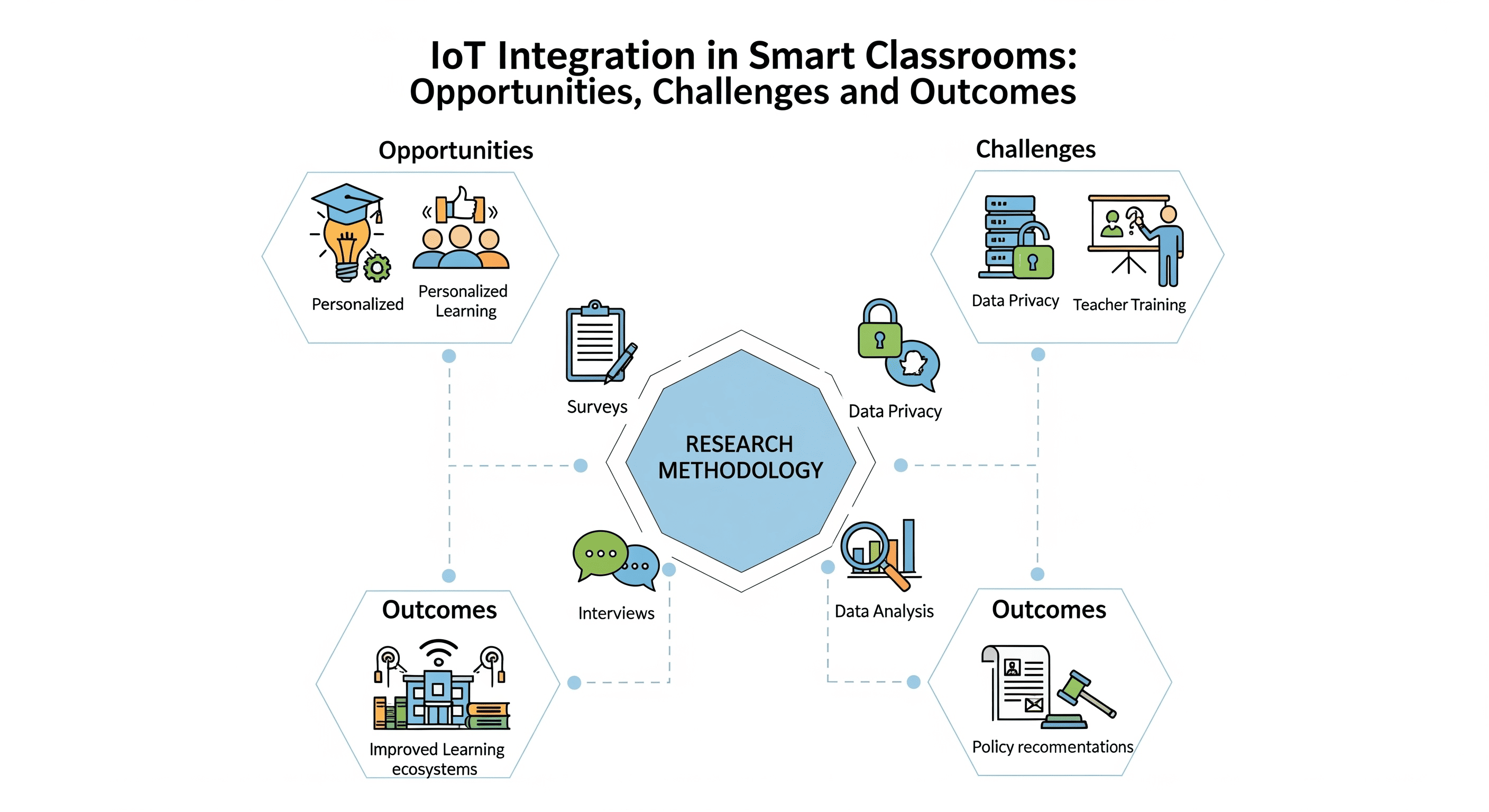
The integration of the Internet of Things (IoT) into educational environments signifies a transformative shift towards smart classrooms, enabling real-time data-driven instruction, environmental optimization, and personalized learning experiences. This study explores the opportunities, challenges, and future directions of IoT deployment in academic settings through a mixed-methods approach that combines quantitative analysis, qualitative interviews, and IoT-edge data assessment. Survey responses from 150 educators and interviews with 20 key stakeholders revealed significant adoption rates and pedagogical benefits, including enhanced engagement and individualized feedback. However, critical challenges such as data privacy, cybersecurity risks, limited teacher training, and infrastructure disparities hinder widespread implementation. A machine learning framework utilizing Random Forest classification was applied to a custom IoT-edge dataset, uncovering correlations between environmental variables and student behavior. High temperatures negatively affected classroom occupancy, while increased light intensity correlated with heightened engagement. Model evaluation yielded strong performance metrics, including an accuracy of 95% and an AUC of 0.99, highlighting the predictive power of features like learning outcomes and engagement scores. The findings emphasize the dual importance of technical readiness and pedagogical adaptation, advocating for policy support, ethical data governance, and teacher capacity-building to fully realize IoT’s potential in shaping adaptive, equitable, and intelligent learning ecosystems.
Full text article
References
Ababneh, K. I., Ahmed, K., & Dedousis, E. (2022). Predictors of cheating in online exams among business students during the Covid pandemic: Testing the theory of planned behavior. The International Journal of Management Education, 20(3), 100713. https://doi.org/10.1016/j.ijme.2022.100713
Abd-Alrazaq, A., Schneider, J., Alhuwail, D., Hamdi, M., Al-Kuwari, S., Al-Thani, D., & Househ, M. (2021). Artificial Intelligence in the Fight Against the COVID-19 Pandemic: Opportunities and Challenges. In M. Househ, E. Borycki, & A. Kushniruk (Eds.), Multiple Perspectives on Artificial Intelligence in Healthcare (pp. 185–196). Springer International Publishing. https://doi.org/10.1007/978-3-030-67303-1_15
Acosta-Gonzaga, E., & Ramirez-Arellano, A. (2021). The Influence of Motivation, Emotions, Cognition, and Metacognition on Students’ Learning Performance: A Comparative Study in Higher Education in Blended and Traditional Contexts. Sage Open, 11(2), 21582440211027561. https://doi.org/10.1177/21582440211027561
Al-Qatawneh, S., Eltahir, Mohd. E., & Alsalhi, N. R. (2020). The effect of blended learning on the achievement of HDE students in the methods of teaching Arabic language course and their attitudes towards its use at Ajman University: A case study. Education and Information Technologies, 25(3), 2101–2127. https://doi.org/10.1007/s10639-019-10046-w
Bertoletti, A., Soncin, M., Cannistrà, M., & Agasisti, T. (2023). The educational effects of emergency remote teaching practices—The case of covid-19 school closure in Italy. PLOS ONE, 18(1), e0280494. https://doi.org/10.1371/journal.pone.0280494
Bishop, P. A. (2021). Middle Grades Teacher Practices during the COVID-19 Pandemic. RMLE Online, 44(7), 1–18. https://doi.org/10.1080/19404476.2021.1959832
Bokolo, A., Kamaludin, A., Romli, A., Mat Raffei, A. F., A/L Eh Phon, D. N., Abdullah, A., Leong Ming, G., A. Shukor, N., Shukri Nordin, M., & Baba, S. (2020). A managerial perspective on institutions’ administration readiness to diffuse blended learning in higher education: Concept and evidence. Journal of Research on Technology in Education, 52(1), 37–64. https://doi.org/10.1080/15391523.2019.1675203
Bozkurt, A. (2022). A Retro Perspective on Blended/Hybrid Learning: Systematic Review, Mapping and Visualization of the Scholarly Landscape. Journal of Interactive Media in Education, 2022(1), 2. https://doi.org/10.5334/jime.751
Choi, H., Chung, S.-Y., & Ko, J. (2021). Rethinking Teacher Education Policy in ICT: Lessons from Emergency Remote Teaching (ERT) during the COVID-19 Pandemic Period in Korea. Sustainability, 13(10), 5480. https://doi.org/10.3390/su13105480
Dini, V., Sevian, H., Caushi, K., & Orduña Picón, R. (2020). Characterizing the formative assessment enactment of experienced science teachers. Science Education, 104(2), 290–325. https://doi.org/10.1002/sce.21559
Ferri, F., Grifoni, P., & Guzzo, T. (2020). Online Learning and Emergency Remote Teaching: Opportunities and Challenges in Emergency Situations. Societies, 10(4), 86. https://doi.org/10.3390/soc10040086
González-Betancor, S. M., López-Puig, A. J., & Cardenal, M. E. (2021). Digital inequality at home. The school as compensatory agent. Computers & Education, 168, 104195. https://doi.org/10.1016/j.compedu.2021.104195
Hassan Abuhassna, Nguyen Thuy Van, Noraffandy Yahaya, Megat Aman Zahiri Megat Zakaria, Fareed Awae, Diaya Ud Deen Al Zitawi, & Kawthar Bayoumi. (2022). Strategies for Successful Blended Learning—A Bibliometric Analysis and Reviews. International Journal of Interactive Mobile Technologies (iJIM), 16(13), 66–80. https://doi.org/10.3991/ijim.v16i13.30739
Kamruzzaman, M. M., Alanazi, S., Alruwaili, M., Alshammari, N., Elaiwat, S., Abu-Zanona, M., Innab, N., Mohammad Elzaghmouri, B., & Ahmed Alanazi, B. (2023). AI- and IoT-Assisted Sustainable Education Systems during Pandemics, such as COVID-19, for Smart Cities. Sustainability, 15(10), 8354. https://doi.org/10.3390/su15108354
Konuralp, H., & Topping, K. J. (2023). Underlying Factors Influencing the Quality of Online EFL Teaching in Higher Education: An Iranian Case Study. Interchange, 54(3), 353–377. https://doi.org/10.1007/s10780-023-09499-3
Ladendorf, K., Muehsler, H., Xie, Y., & Hinderliter, H. (2021). Teacher perspectives of self-efficacy and remote learning due to the emergency school closings of 2020. Educational Media International, 58(2), 124–144. https://doi.org/10.1080/09523987.2021.1930481
Li, K. C., & Wong, B. T.-M. (2022). Research landscape of smart education: A bibliometric analysis. Interactive Technology and Smart Education, 19(1), 3–19. https://doi.org/10.1108/ITSE-05-2021-0083
Lucas, M., & Vicente, P. N. (2023). A double-edged sword: Teachers’ perceptions of the benefits and challenges of online teaching and learning in higher education. Education and Information Technologies, 28(5), 5083–5103. https://doi.org/10.1007/s10639-022-11363-3
Platonova, R. I., Orekhovskaya, N. A., Dautova, S. B., Martynenko, E. V., Kryukova, N. I., & Demir, S. (2022). Blended Learning in Higher Education: Diversifying Models and Practical Recommendations for Researchers. Frontiers in Education, 7, 957199. https://doi.org/10.3389/feduc.2022.957199
Shah, H., Shah, S., Tanwar, S., Gupta, R., & Kumar, N. (2022). Fusion of AI techniques to tackle COVID-19 pandemic: Models, incidence rates, and future trends. Multimedia Systems, 28(4), 1189–1222. https://doi.org/10.1007/s00530-021-00818-1
Vo, X. M., Do-Hong, C., Ha, T. M. T., & Vu, C. T. (2024). An Examination of Blended Learning in Higher Education Over a Two-Decade Period (2003-2022): Insights Derived From Scopus Database. European Journal of Educational Research, 13(4), 1821–1840. https://doi.org/10.12973/eu-jer.13.4.1821
Zeeshan, K., Hämäläinen, T., & Neittaanmäki, P. (2022). Internet of Things for Sustainable Smart Education: An Overview. Sustainability, 14(7), 4293. https://doi.org/10.3390/su14074293
Ziya. (2025). Smart Classroom IoT-Edge Dataset [Dataset]. Kaggle. https://www.kaggle.com/datasets/ziya07/smart-classroom-iot-edge-dataset
Authors
Copyright (c) 2025 JOURNAL OF DIGITAL LEARNING AND DISTANCE EDUCATION

This work is licensed under a Creative Commons Attribution 4.0 International License.
<a rel="license" href="http://creativecommons.org/licenses/by/4.0/"><img alt="Creative Commons License" style="border-width:0" src="https://i.creativecommons.org/l/by/4.0/88x31.png" /></a><br />This work is licensed under a <a rel="license" href="http://creativecommons.org/licenses/by/4.0/">Creative Commons Attribution 4.0 International License</a>.