
From Chalkboards to Keyboards: Exploring the Digital Competence of Educators Rural in Classrooms
Article Sidebar
-
Digital competence, rural teachers, knowledge application, professional development, educational technology
Abstract
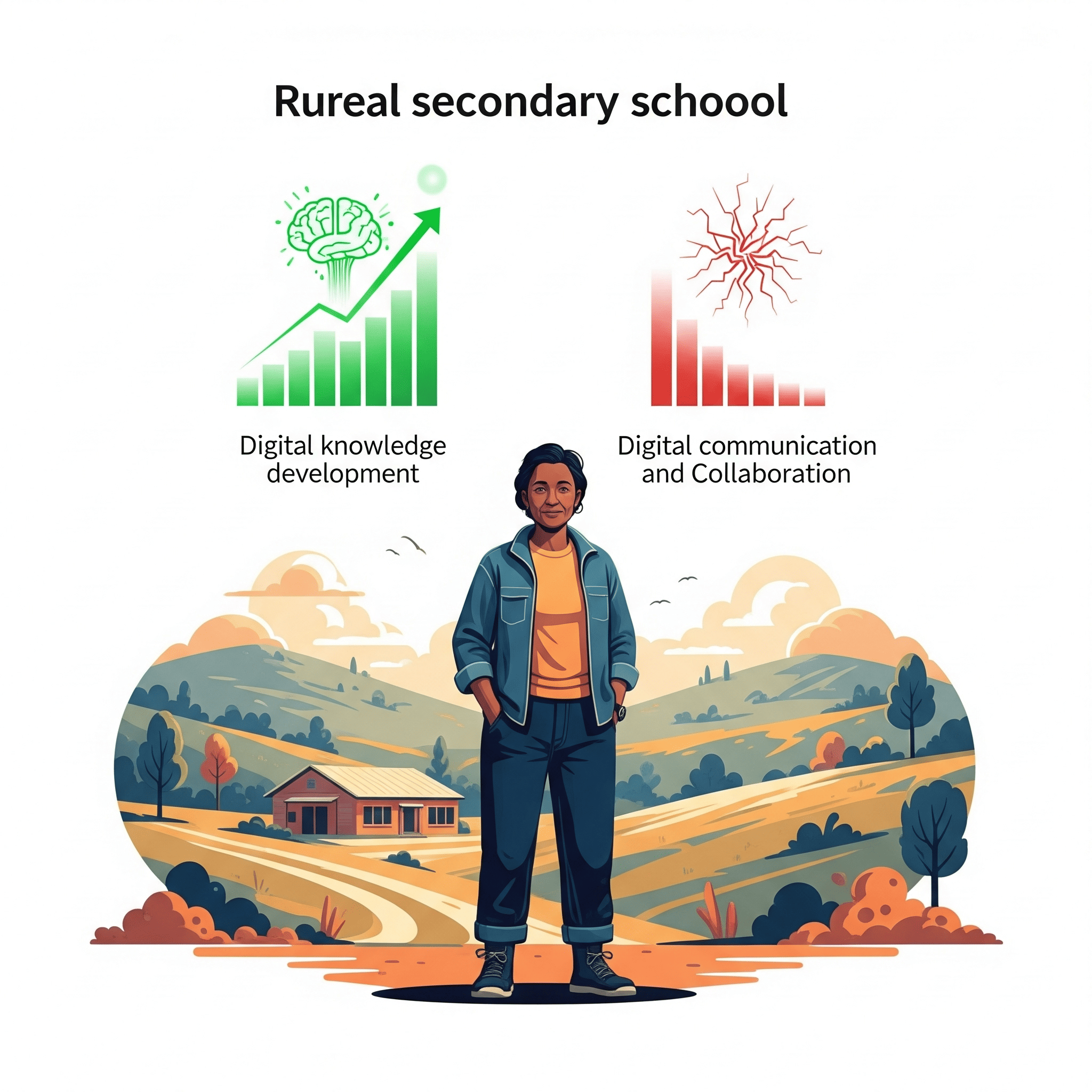
This research explored the digital competence of secondary school teachers working in rural areas within the New Lucena District, Iloilo Province, focusing on how they acquire, apply, share, and communicate digital knowledge. A descriptive research design was used, involving 82 teachers with both permanent and contractual employment status. Data were gathered using an online survey administered through Google Forms. The tool assessed four key areas of digital competence: Development, Application, Sharing, Knowledge and Communication. Results indicated that these teachers generally possess a moderate level of digital skills. Many expressed confidence in using digital tools for basic tasks, though some aspects, particularly those involving interactive or collaborative applications, remain challenging for them. Descriptive statistics like mean and standard deviation were used to measure both overall digital competence and performance in each specific area. The data suggested that teachers performed best in acquiring and developing digital knowledge, while their weakest point involved using digital platforms for effective communication and teamwork. To check if the differences across these four areas were meaningful, the study made use of the Friedman test, which revealed notable variations. This points to the need for better support in certain aspects of digital skills. In view of these results, the study recommends that professional development initiatives be designed to provide teachers with more practical and hands- on opportunities for digital skills enhancement. Programs that promote peer mentoring, encourage collaborative digital projects, and improve access to up-to-date technological tools and resources could significantly help in bridging the competence gaps.
Full text article
References
Abella, J. L., & Rosa, E. D. (2023). Digital Literacy and Digital Competence of Selected Filipino
Teachers: Basis for a Post-Pandemic Pedagogy. IJORER : International Journal of Recent
Educational Research, 4(5), 548–569. https://doi.org/10.46245/ijorer.v4i5.378
American Psychological Association. (2017). Ethical principles of psychologists and code of conduct.
https://Www.apa.org. https://www.apa.org/ethics/code
Cabiles, R. C. (2024). Life Skills of Junior High School Teachers in Coastal, Rural and Urban Areas in
Albay, Philippines. International Journal of Multidisciplinary Applied Business and Education
Research, 5(11), 4556–4563. https://doi.org/10.11594/ijmaber.05.11.22
Dacer, G., Magana, M., Asis, A., & Volante, D. (2023). Barriers, Strategies and Interventions of Digital
Governance in the Schools Division Office of Camarines Norte Philippines: A Case Study -
International Journal of Research and Innovation in Social Science. International Journal of
Research and Innovation in Social Science.
https://dx.doi.org/10.47772/IJRISS.2025.9010101
Graciano, J., & Benablo, C. I. (2023). Digital Literacy Skills and Online Information Searching
Strategies as Determinants of Academic Performance of BSIT Students. Psychology and
Education: A Multidisciplinary Journal, 12(10), 1–1.
https://ejournals.ph/article.php?id=21647
Kormos, E., & Wisdom, K. (2021). Rural Schools and the Digital Divide. Theory & Practice in Rural
Education, 11(1). https://doi.org/10.3776/tpre.2021.v11n1p25-39
Kunjiapu, S., Sinnappan, P., Akmar, F., & Kunasegaran, M. (2025). Challenges and Dilemmas of
Digitalization in Philippine Education: A Grassroots Perspective. Journal of Public
Administration and Governance, 14(2), 232–232. https://doi.org/10.5296/jpag.v14i2.22325
Kus, Z., & Mert, H. (2023). Digital Competence of Educators in Turkey According to European Digital
Competence Framework. Journal of Learning and Teaching in Digital Age.
https://doi.org/10.53850/joltida.1301592
Liu, J., & Xu, Y. (2022). T-Friedman Test: A New Statistical Test for Multiple Comparison with an
Adjustable Conservativeness Measure. International Journal of Computational Intelligence
Systems, 15(1). https://doi.org/10.1007/s44196-022-00083-8
Lucas, M., Bem-Haja, P., Siddiq, F., Moreira, A., & Redecker, C. (2020). The relation between in-service
teachers’ digital competence and personal and contextual factors: What matters most?
Computers & Education, 160, 104052–104052. https://doi.org/10.1016/j.compedu.2020.104052
Noor, S., Tajik, O., & Golzar, J. (2022). Simple Random Sampling. International Journal of Education &
Language Studies, 1(2), 78–82. https://doi.org/10.22034/ijels.2022.162982
Schmidt, R. A. (2021). Using Technology to Overcome the Challenge of Place and Space in Rural
Education. Ed.gov. http://ies.ed.gov/ncee/edlabs/regions/appalachia/index.asp
Shinija, A. (2024). Descriptive Research Design. ResearchGate.
https://doi.org/10.13140/RG.2.2.19205.36325
Temirkhanova, M., Abildinova, G., & Karaca, C. (2024). Enhancing digital literacy skills among
teachers for effective integration of computer science and design education: a case study at
Astana International School, Kazakhstan. Frontiers in Education, 9.
https://doi.org/10.3389/feduc.2024.1408512
UNICEF. (2022, October 9). Educators’ Digital Competence Framework. Unicef.org.
https://www.unicef.org/eca/reports/educators-digital-competence-framework
Authors
Copyright (c) 2025 JOURNAL OF DIGITAL LEARNING AND DISTANCE EDUCATION

This work is licensed under a Creative Commons Attribution 4.0 International License.
<a rel="license" href="http://creativecommons.org/licenses/by/4.0/"><img alt="Creative Commons License" style="border-width:0" src="https://i.creativecommons.org/l/by/4.0/88x31.png" /></a><br />This work is licensed under a <a rel="license" href="http://creativecommons.org/licenses/by/4.0/">Creative Commons Attribution 4.0 International License</a>.