
Utilization of AI Language Learning Tools By Undergraduate Students in Selected Universities in Delta State, Nigeria
Article Sidebar
-
AI, Learning language tools, uLesson, Undergraduate students, Chatbots
Abstract
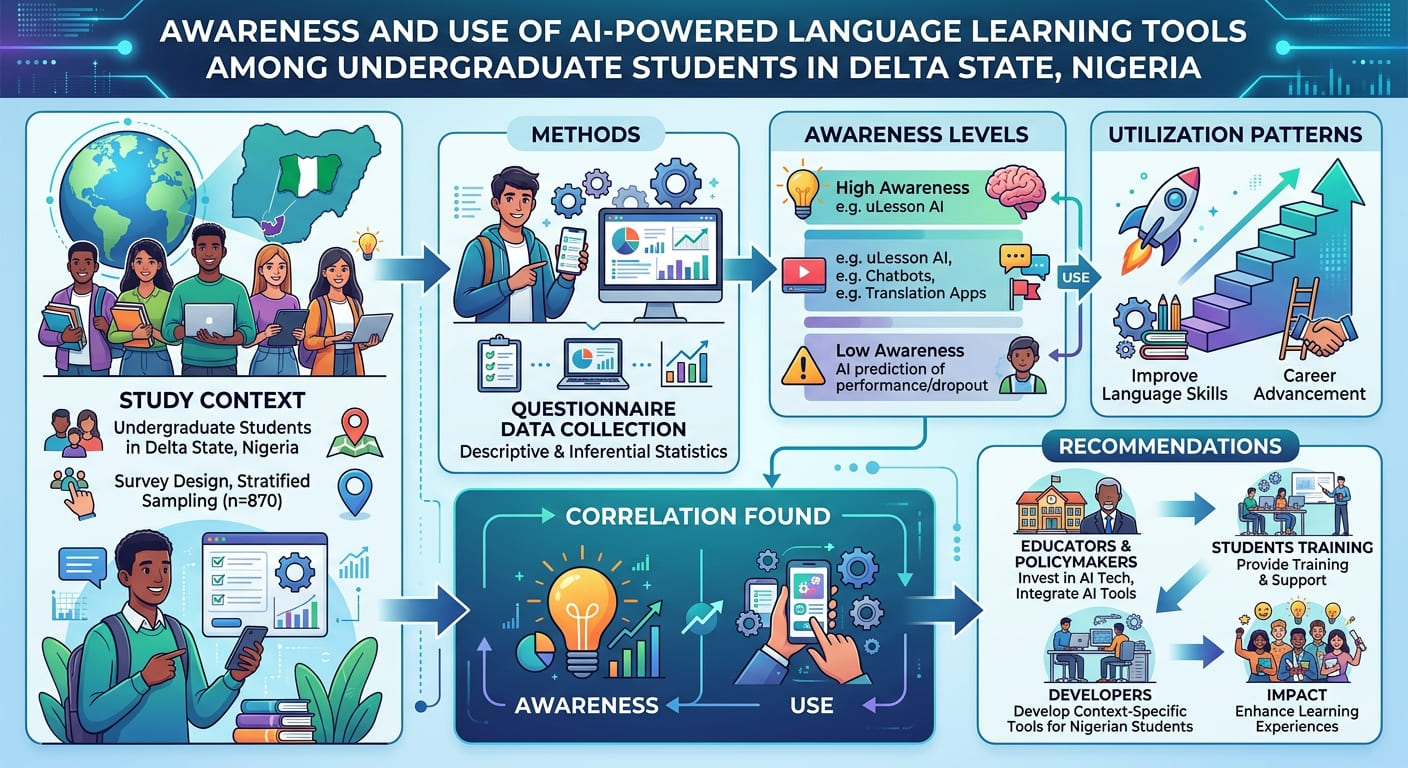
This study investigated the awareness and use of artificial intelligence-powered language learning tools among undergraduate students in Delta State, Nigeria. Survey research design was used and a sample size of 870 students was selected by stratified random sampling technique. A questionnaire was used to collect data on the awareness and use of AI-powered language learning tools. Descriptive and inferential statistics were used to analyze the data. Undergraduate students in Delta State have varying levels of awareness and use of different AI language learning tools, and the levels of awareness and use are positively correlated. The study found, in particular, that students are aware of uLesson’s AI-powered video lessons, chatbots for learning and AI-powered language translation apps, but less aware of AI being used to predict student performance and dropout rates. The study also found that students use AI-enabled learning platforms to improve their skills and advance their careers, and that awareness and use of AI language learning tools are related. The study concluded that educators and policymakers should invest in AI technology and integrate AI-powered language learning tools into language learning programs to enhance student learning experiences and recommended that students should be provided with training and support to enhance their awareness and utilization of AI language learning tools, and that developers of AI language learning tools should develop context-specific tools that meet the needs of Nigerian students.
Full text article
References
Ahmed, A., & Sultan, A. (2026). Examining the impact of generative AI on student motivation and engagement: The mediating role of autonomy-support and autonomous motivation in education. Frontiers in Psychology, 17, 1852265. https://doi.org/10.3389/fpsyg.2026.1852265
Akhter, S., & Shaheen, M. (2026). AI adoption and student success among EFL learners: Examining the effects of peer support and motivation on well-being. Frontiers in Psychology, 17, 1739395. https://doi.org/10.3389/fpsyg.2026.1739395
Al-Adwan, A. S., Li, N., Al-Adwan, A., Abbasi, G. A., Albelbisi, N. A., & Habibi, A. (2023). “Extending the Technology Acceptance Model (TAM) to Predict University Students’ Intentions to Use Metaverse-Based Learning Platforms”. Education and Information Technologies, 28(11), 15381–15413. https://doi.org/10.1007/s10639-023-11816-3
Alam, M. N., Islam, M. A., Babiker, M. O. A., Siddiqui, M. S., Amin, M. B., & Oláh, J. (2026). AI-assisted learning tools and student learning outcomes: A cognitive load theory perspective. Computers in Human Behavior Reports, 21, 100986. https://doi.org/10.1016/j.chbr.2026.100986
Alexandropoulos, G. (2025). Exploring the Views of Secondary School Teachers in Greece on Interactive Educational Tools. Journal Of Digital Learning And Distance Education, 4(3), 1527–1545. https://doi.org/10.56778/jdlde.v4i3.540
Alharbi, N., Ud Din, F., Paul, D., & Sadgrove, E. (2025). Driving AI chatbot adoption: A systematic review of factors, barriers, and future research directions. Journal of Open Innovation: Technology, Market, and Complexity, 11(3), 100590. https://doi.org/10.1016/j.joitmc.2025.100590
Alizada, Z., Fatima Mohammadi, & Fatima Sahibzada. (2025). The Role of AI Technology in Advancing Education, Empowerment, and Entrepreneurship for Afghan Women. Journal Of Digital Learning And Distance Education, 4(6), 1718–1725. https://doi.org/10.56778/jdlde.v4i6.606
Alsyouf, A., Lutfi, A., Alsubahi, N., Alhazmi, F. N., Al-Mugheed, K., Anshasi, R. J., Alharbi, N. I., & Albugami, M. (2023). The Use of a Technology Acceptance Model (TAM) to Predict Patients’ Usage of a Personal Health Record System: The Role of Security, Privacy, and Usability. International Journal of Environmental Research and Public Health, 20(2), 1347. https://doi.org/10.3390/ijerph20021347
Chen, B., Chang, Y., Wang, B., Zou, J., & Tu, S. (2024). Technology acceptance model perspective on the intention to participate in medical talents training in China. Heliyon, 10(4), e26206. https://doi.org/10.1016/j.heliyon.2024.e26206
Chen, D.-L., Aaltonen, K., Lampela, H., & Kujala, J. (2025). The Design and Implementation of an Educational Chatbot with Personalized Adaptive Learning Features for Project Management Training. Technology, Knowledge and Learning, 30(2), 1047–1072. https://doi.org/10.1007/s10758-024-09807-5
Chen, X., Jiang, L., Zhou, Z., & Li, D. (2025). Impact of perceived ease of use and perceived usefulness of humanoid robots on students’ intention to use. Acta Psychologica, 258, 105217. https://doi.org/10.1016/j.actpsy.2025.105217
Du, J., & Daniel, B. K. (2024). Transforming language education: A systematic review of AI-powered chatbots for English as a foreign language speaking practice. Computers and Education: Artificial Intelligence, 6, 100230. https://doi.org/10.1016/j.caeai.2024.100230
Ekizer, F. N. (2025). Exploring the impact of artificial intelligence on English language teaching: A meta-analysis. Acta Psychologica, 260, 105649. https://doi.org/10.1016/j.actpsy.2025.105649
Eze, P., Alabi, A., & Osunbunmi, I. (2025). AI-driven career guidance: Comparing Nigerian undergraduate and postgraduate perceptions. Discover Education, 4(1), 543. https://doi.org/10.1007/s44217-025-00900-0
Ganguly, A., Mehjabin, N., Malik, A., & Johri, A. (2026). Conversational AI agents in education: An umbrella review of current utilization, challenges, and future directions for ethical and responsible use. AI and Ethics, 6(1), 72. https://doi.org/10.1007/s43681-025-00916-0
Hassan, A. (2026). Leveraging artificial intelligence (AI) to enhance student engagement and academic performance in higher education. Education and Information Technologies, 31(11), 3835–3861. https://doi.org/10.1007/s10639-026-13946-w
Im, R., Umasugi, M., Umasugi, H., Adam, A., Lumbessy, S., & Juliadarma, M. (2025). Analysis of the Influence of AI on Student Learning Motivation in the Digital Era. Electronic Journal of Education, Social Economics and Technology, 6(1), 196–201. https://doi.org/10.33122/ejeset.v6i1.384
Jara, A., & Pedroso, J. E. P. (2025). From Chalkboards to Keyboards: Exploring the Digital Competence of Educators Rural in Classrooms. Journal Of Digital Learning And Distance Education, 4(3), 1546–1553. https://doi.org/10.56778/jdlde.v4i3.536
Kelly, A. E., & Palaniappan, S. (2023). Using a technology acceptance model to determine factors influencing continued usage of mobile money service transactions in Ghana. Journal of Innovation and Entrepreneurship, 12(1), 34. https://doi.org/10.1186/s13731-023-00301-3
Kılıçkaya, F., & Kic-Drgas, J. (2025). Enhancing Collaborative Learning Practices via Chatbots: Insights from an EFL context. Sage Open, 15(3), 21582440251369189. https://doi.org/10.1177/21582440251369189
Liu, Q., Osman, L. H., Lian, Z., Wel, C. A. C., & Hamid, S. N. Ab. (2025). From Perception to Purchase: How AI Literacy Shapes Consumer Decisions in AI-Generated Sponsored Vlogs Across Products and Services. Journal of Theoretical and Applied Electronic Commerce Research, 20(4), 302. https://doi.org/10.3390/jtaer20040302
Liu, Z., & Wang, Q. (2026). The Application of AI Chatbot System Based on CLIL Concept in the Teaching of Artificial Intelligence Courses. Applied Sciences, 16(3), 1633. https://doi.org/10.3390/app16031633
Llanes, N. P., Talamor, M. A., Jaspe, S. M., & Pedroso, J. E. (2025). Generation Z’s Views on the Ethical Use of Artificial Intelligence Tools in Accomplishing Academic Outputs. Journal Of Digital Learning And Distance Education, 4(4), 1641–1655. https://doi.org/10.56778/jdlde.v4i4.557
Marian, A.-L., Apostolache, R., & Ceobanu, C. M. (2025). Toward Sustainable Technology Use in Education: Psychological Pathways and Professional Status Effects in the TAM Framework. Sustainability, 17(15), 7025. https://doi.org/10.3390/su17157025
Musa, H. G., Fatmawati, I., Nuryakin, N., & Suyanto, M. (2024). Marketing research trends using technology acceptance model (TAM): A comprehensive review of researches (2002–2022). Cogent Business & Management, 11(1), 2329375. https://doi.org/10.1080/23311975.2024.2329375
Nwachukwu, E. L., Nwamaka Goodness Egbue, & Ijeoma Victor-Nwakaku. (2025). Adaptive Learning Systems: Bridging Instructional Technology and Personalized Pedagogy through Design Thinking. Journal Of Digital Learning And Distance Education, 4(5), 1689–1703. https://doi.org/10.56778/jdlde.v4i5.588
Ocado, Ma. K. G. (2025). More than skills: How AI literacy shapes student motivation in the age of education 4.0. Journal of Technology and Science Education, 15(3), 679. https://doi.org/10.3926/jotse.3748
Pedroso, J. E., Rv S. Sulleza, Keith Hae Moon C. Francisco, Ayya Jade O. Noman, & Chynna Althea V. Martinez. (2023). Unlocking the Power of Canva: Students’ Views on Using the All-In-One Tool for Creativity and Collaboration. Journal Of Digital Learning And Distance Education, 2(2), 443–461. https://doi.org/10.56778/jdlde.v2i2.117
Sultana, A., Abdul Latheef, N., Siby, N., Sellami, A., Akber Abbasi, S., & Ahmad, Z. (2026). What shapes AI learning outcomes? Investigating the role of self-efficacy, institutional support and gender. Cogent Education, 13(1), 2625448. https://doi.org/10.1080/2331186X.2026.2625448
Toros, E., Asiksoy, G., & Sürücü, L. (2024). Refreshment students’ perceived usefulness and attitudes towards using technology: A moderated mediation model. Humanities and Social Sciences Communications, 11(1), 333. https://doi.org/10.1057/s41599-024-02839-3
Torres, P. J., & Kahveci, Y. E. (2025). Effectiveness of Artificial Intelligence (AI) in language teaching. Computers and Education: Artificial Intelligence, 9, 100522. https://doi.org/10.1016/j.caeai.2025.100522
Uygun, E., & Demir, B. (2026). A PRISMA-based systematic review of artificial intelligence in English as a foreign and second language education (2023–2025). Discover Education, 5(1), 478. https://doi.org/10.1007/s44217-026-01504-y
Vo, T. K. A. (2025). Transforming Language Learning with AI: Adaptive Systems, Engagement, and Global Impact. ETLTC 2025, 7. https://doi.org/10.3390/engproc2025107007
Wang, Y., Zhang, Z. J., & Zhou, H. (2026). Artificial Intelligence in Language Learning: A Twenty-Year Scoping Review of Applications, Research Methods, and Outcomes. Research Synthesis in Applied Linguistics, 1–38. https://doi.org/10.1080/29984475.2026.2647961
Wiboolyasarin, W., Wiboolyasarin, K., Tiranant, P., Jinowat, N., & Boonyakitanont, P. (2025). AI-driven chatbots in second language education: A systematic review of their efficacy and pedagogical implications. Ampersand, 14, 100224. https://doi.org/10.1016/j.amper.2025.100224
Xu, Y., Liu, X., Cao, X., Huang, C., Liu, E., Qian, S., Liu, X., Wu, Y., Dong, F., Qiu, C.-W., Qiu, J., Hua, K., Su, W., Wu, J., Xu, H., Han, Y., Fu, C., Yin, Z., Liu, M., … Zhang, J. (2021). Artificial intelligence: A powerful paradigm for scientific research. The Innovation, 2(4), 100179. https://doi.org/10.1016/j.xinn.2021.100179
Yaseen, H., Mohammad, A. S., Ashal, N., Abusaimeh, H., Ali, A., & Sharabati, A.-A. A. (2025). The Impact of Adaptive Learning Technologies, Personalized Feedback, and Interactive AI Tools on Student Engagement: The Moderating Role of Digital Literacy. Sustainability, 17(3), 1133. https://doi.org/10.3390/su17031133
Younas, M., El-Dakhs, D. A. S., & Noor, U. (2025). The impact of artificial intelligence-based learning tools in academic innovation: A review of Deep seek, GPT, and Gemini (2020–2025). Frontiers in Education, 10, 1689205. https://doi.org/10.3389/feduc.2025.1689205
Zhang, B. S., Ali, K., & Kanesan, T. (2022). A model of extended technology acceptance for behavioral intention toward EVs with gender as a moderator. Frontiers in Psychology, 13, 1080414. https://doi.org/10.3389/fpsyg.2022.1080414
Zhang, J., & Zhang, H. (2025). Towards Human-like Artificial Intelligence: A Review of Anthropomorphic Computing in AI and Future Trends. Mathematics, 13(13), 2087. https://doi.org/10.3390/math13132087
Authors
Copyright (c) 2026 JOURNAL OF DIGITAL LEARNING AND DISTANCE EDUCATION

This work is licensed under a Creative Commons Attribution 4.0 International License.
<a rel="license" href="http://creativecommons.org/licenses/by/4.0/"><img alt="Creative Commons License" style="border-width:0" src="https://i.creativecommons.org/l/by/4.0/88x31.png" /></a><br />This work is licensed under a <a rel="license" href="http://creativecommons.org/licenses/by/4.0/">Creative Commons Attribution 4.0 International License</a>.