
Effects of Genially Directed Reading Thinking Activities on College Students’ Motivation and Academic Performance in World Literature: A Literature Review
Article Sidebar
-
gamified learning, World Literature, student motivation, academic achievement, DRTA
Abstract
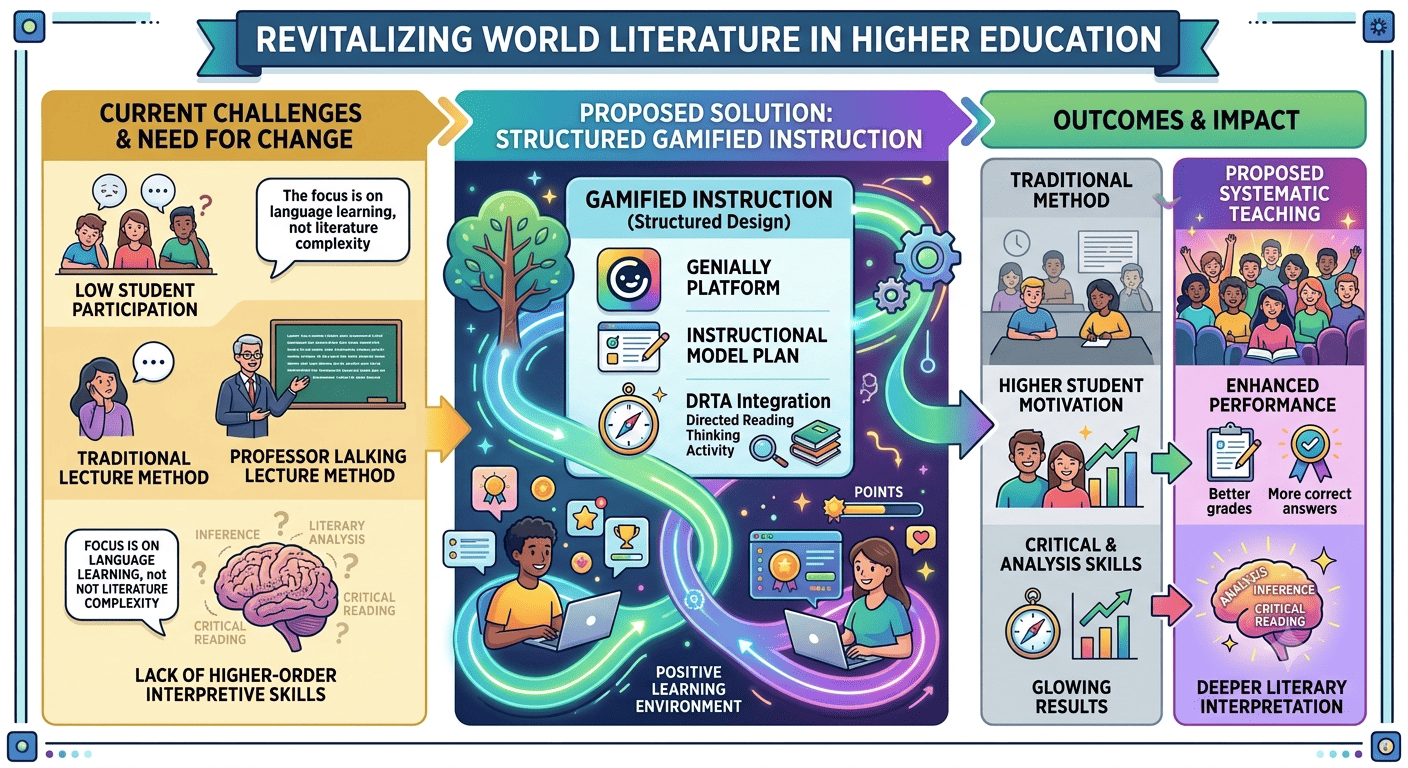
World Literature instruction in higher education still continues in facing challenges characterized by low level of students' participation, the use of traditional lecture teaching method, and lack of development of higher-order interpretive skills like inference, literary analysis and critical reading. While there is a considerable body of evidence on the positive effects of gamification on students' motivation and performance in learning languages and skills, the research interest is largely focused on the language learning field and less on courses with a literature focus, where the learning process is more complex. In addition, gamification is often talked about generally without being clearly expressed with reference to platforms, structured instructional designs, or a connection to existing reading comprehension activities, such as Directed Reading Thinking Activities (DRTA). The literature review focuses on the current studies on gamified instruction, traditional literature teaching approaches, student motivation, academic achievement, pedagogies based on DRTA, and with special emphasis on the interactive learning environments created with Genially in tertiary education. The results reveal that, though gamification has a positive impact on learner engagement and motivation, its use in the interpretation of literary texts still has not received much attention. Similarly, the relationship between students' motivation and academic achievement in the context of structured gamified literature is not well demonstrated. The review outlines the requirement of a more systematic teaching through instructional model plan in World Literature teaching that combines the use of games and DRTA to enhance interpretive learning outcomes.
Full text article
References
Abou Hashish, E. A., Al Najjar, H., Alharbi, M., Alotaibi, M., & Alqahtany, M. M. (2024). Faculty and students’ perspectives towards game-based learning in health sciences higher education. Heliyon, 10(12), e32898. https://doi.org/10.1016/j.heliyon.2024.e32898
Adeleye, O. O., Eden, C. A., & Adeniyi, I. S. (2024). Educational technology and the digital divide: A conceptual framework for technical literacy inclusion. International Journal of Science and Research Archive, 12(1), 150–156. https://doi.org/10.30574/ijsra.2024.12.1.0405
Alhasan, K., Alhasan, K., & Alhashimi, S. (2025). Optimizing gamification adoption in higher education: An in-depth qualitative case study applying the UTAUT framework. International Journal of Game-Based Learning, 15(1). https://doi.org/10.4018/IJGBL.372068
Alonso-Sánchez, J. A., Alonso, J. L. N., & Santana-Monagas, E. (2025). Gamification in higher education: A case study in educational sciences. TechTrends, 69(3), 507–518. https://doi.org/10.1007/s11528-025-01056-2
Baah, C., Govender, I., & Subramaniam, P. (2023). Exploring the role of gamification in motivating students to learn. https://doi.org/10.1080/2331186X.2023.2210045
Berry, L. A., & Kowal, K. B. (2022). Effect of role-play in online discussions on student engagement and critical thinking. Online Learning, 26(3), 4–21.
Boateng, J., Attiogbe, E. J., & Kunbour, V. (2022). Influence of adult learners’ self-direction on group learning. https://doi.org/10.1080/23311886.2022.2064592
Buñay Paguay, M. A., & Quizhpi Arce, E. R. (2025). Efectos de la herramienta digital Genially en la comprensión lectora en educación básica: Un estudio cuasi experimental con enfoque mixto. Ciencia Latina Revista Científica Multidisciplinar, 9(2), 6012–6027. https://doi.org/10.37811/cl_rcm.v9i2.17346
Cosculluela, C., Sánchez, V., & Toledo, S. (2025). Gamification, collaborative learning and transversal competences: Analysis of academic performance and students’ perceptions. Smart Learning Environments. https://doi.org/10.1186/s40561-024-00361-2
David, L., & Weinstein, N. (2023). Using technology to make learning fun: Technology use is best made fun and challenging to optimize intrinsic motivation and engagement. https://doi.org/10.1007/s10212-023-00734-0
De La Peña, C., & Luque-Rojas, M. J. (2021). Levels of reading comprehension in higher education: Systematic review and meta-analysis. Frontiers in Psychology, 12, 712901. https://doi.org/10.3389/fpsyg.2021.712901
Deane, P. (2020). Building and justifying interpretations of texts: A key practice in the English language arts. https://doi.org/10.1002/ets2.12304
Dekker, I., & Meeter, M. (2022). Evidence-based education: Objections and future directions. Frontiers in Education, 7, 941410. https://doi.org/10.3389/feduc.2022.941410
Désiron, J. C., Bétrancourt, M., & de Vries, E. (2021). Cross-representational signaling and cohesion support inferential comprehension of text-picture documents. Frontiers in Psychology, 11, 592509. https://doi.org/10.3389/fpsyg.2020.592509
Em, S. (2025). Exploring experimental research: Methodologies, designs, and applications across disciplines. Cambodian Journal of Educational and Social Sciences, 2(2), 1–8. https://doi.org/10.69496/cjess.v2i2.78
Felkey, A., Dziadula, E., & Chiang, E. (2023). Competition, motivation, and student engagement. https://doi.org/10.1257/pandp.20231047
Gamarra-Vargas, N. M., Cosio Borda, R. F., Quispe-Farfán, P. H., Bosmans Flores, F. G., & Robladillo-Bravo, L. M. (2025). Analysis of research on gamification, critical thinking and academic performance: A systematic review in the context of higher education. F1000Research, 14, 913. https://f1000research.com/articles/14-913/v1/pdf
Gomes-Koban, C., Calet, N., & Defior, S. (2019). Intervention programs in educational psychology: Bridging research and practice. Anales de Psicología, 35(3), 378–388.
Gonzales, L. A. (2024). Enhancing literary comprehension through interactive reading assignment via Kahoot!. Journal of Interdisciplinary Perspectives, 2(2), 92–101.
Gopal, T. R., Maniam, M., Jeyaraja, S. S. B., Singh, C. K. S. S., Gopal, R., & Ng, M. M. (2022). Examining the utilization of extensive reading from the perspective of ESL students’ reader response. World Journal of English Language, 12(5), 176–186. https://doi.org/10.5430/wjel.v12n5p176
Ho, Y., & Lim, W. (2020). Educating adult learners: Bridging learners’ characteristics and the learning sciences. https://link.springer.com/content/pdf/10.1007/978-981-15-1628-3_4.pdf
Honicke, T., Broadbent, J., & Fuller-Tyszkiewicz, M. (2023). The self-efficacy and academic performance reciprocal relationship: The influence of task difficulty and baseline achievement on learner trajectory. https://doi.org/10.1080/07294360.2023.2197194
Howard, J. L., Bureau, J. S., Guay, F., Chong, J. X. Y., & Ryan, R. M. (2021). Student motivation and associated outcomes: A meta-analysis from self-determination theory. https://doi.org/10.1177/1745691620966789
John, D., Hussin, N., Zaini, M., Helda, L., Ametefe, D., & Aliu, A. (2024). Gamification is not working: Why? https://doi.org/10.1177/15554120241228125
Kashefian-Naeeini, S., Shokrpour, N., & Pakdel, F. (2024). Optimizing EFL learning: Exploring learner motivation factors in university students. https://doi.org/10.1186/s40359-024-02034-8
Khaldi, A., Bouzidi, R., & Nader, F. (2023). Gamification of e-learning in higher education: A systematic literature review. https://doi.org/10.1186/s40561-023-00227-z
Kholisna, A., & Sukasih, S. (2025). Developing gamification media-based on RADEC model using Genially to enhance elementary students’ reading comprehension of narrative texts. Journal of Integrated Elementary Education, 5(1), 88–108.
Kim, J., Burey, J., Hwang, H. J., McMaster, K., & Kendeou, P. (2023). Supporting inference-making during COVID-19 through individualized scaffolding and feedback: A natural experiment. Reading and Writing, 36(2), 467–490. https://doi.org/10.1007/s11145-022-10391-2
Lepola, J., Kajamies, A., Laakkonen, E., & Niemi, P. (2020). Vocabulary, metacognitive knowledge and task orientation as predictors of narrative picture book comprehension: From preschool to grade 3. Reading and Writing, 33, 1351–1373. https://doi.org/10.1007/s11145-019-10010-7
Lewohl, J. (2023). Exploring student perceptions and use of face-to-face classes, technology-enhanced active learning, and online resources. https://doi.org/10.1186/s41239-023-00416-3
Li, L., Hew, K. F., & Du, J. (2024). Gamification enhances student intrinsic motivation, perceptions of autonomy and relatedness, but minimal impact on competency: A meta-analysis and systematic review. https://doi.org/10.1007/s11423-023-10337-7
Li, M., Ma, S., & Shi, Y. (2023). Examining the effectiveness of gamification as a tool promoting teaching and learning in educational settings: A meta-analysis. Frontiers in Psychology, 14, 1253549. https://doi.org/10.3389/fpsyg.2023.1253549
Liu, C., Lin, Y., Lo, F., Chang, C., & Lin, H. (2024). From readers to players: Exploring student engagement in a gamified metaverse and its effect on reading interest. https://doi.org/10.1007/s10639-024-13068-1
Lussiana, E., Versace, R., Sonnier, F., & Guéraud, S. (2024). Text comprehension difficulties and embodied memory processes. https://doi.org/10.21203/rs.3.rs-4349154/v1
McNamara, D. S. (2021). If integration is the keystone of comprehension: Inferencing is the key. Discourse Processes, 58(1), 86–91. https://doi.org/10.1080/0163853X.2020.1788323
Mercado, F. M., & Villenas, B. N. (2024). Grounded theory on creating and maintaining adult education programs in selected higher education institutions in the Philippines. European Journal of Educational Research, 13(4), 1455–1475. https://doi.org/10.12973/eu-jer.13.4.1455
Meng, C., Zhao, M., Pan, Z., Pan, Q., & Bonk, C. (2024). Investigating the impact of gamification components on online learners’ engagement. https://doi.org/10.1186/s40561-024-00336-3
Nhan, L. K. (2025). Examining the impact of gamification on English language instruction: A literature review. International Journal of Science and Management Studies, 46–54. https://ijsmsjournal.org/2024/volume-7%20issue-2/ijsms-v7i2p106.pdf
Poroçani, N., & Deda, A. (2021). Methodology of literary text approaches in high schools: Analysis and models. Journal of Language and Linguistic Studies, 17(1), 205–224. https://doi.org/10.52462/jlls.12
Purwandari, D. (2021). Directed reading thinking activity and students’ reading comprehension: An experimental research. Research and Innovation in Language Learning, 4(3), 231–252. http://jurnal.ugj.ac.id/index.php/RILL
Ramolula, K., & Molebatsi, N. (2023). The culture of reading for acquisition and learning of content knowledge for English language and literature in English in higher education. International Journal of Research in Business and Social Science, 12(9), 440–449. https://doi.org/10.20525/ijrbs.v12i9.2885
Salbaş, H. (2023). Nurturing language proficiency through literary exploration in EFL settings: A comprehensive document analysis. ELT Research Journal, 12(2), 193–211.
Satriani, R., Rahman, W. Z., Hikmah, N., & Fahira, A. (2022). Students reading comprehension strategy: Directed Reading Thinking Activity (DRTA). Indonesian Journal of Research and Educational Review, 1(3), 423–432. https://doi.org/10.51574/ijrer.v1i3.396
Schöbel, S., Janson, A., & Söllner, M. (2020). Capturing the complexity of gamification elements: A holistic approach for analysing existing and deriving novel gamification designs. https://doi.org/10.1080/0960085X.2020.1796531
Scott, B. A., & Manning, M. (2022). Designing the collaborative organization: A framework for how collaborative work, relationships, and behaviors generate collaborative capacity. https://doi.org/10.1177/00218863221106245
Smiderle, R., Rigo, S. J., Marques, L. B., De Miranda Coelho, J. A. P., & Jaques, P. A. (2020). The impact of gamification on students’ learning, engagement and behavior based on their personality traits. Smart Learning Environments, 7(1). https://doi.org/10.1186/s40561-019-0098-x
Snyder, H. (2024). Designing the literature review for a strong contribution. Journal of Decision Systems, 33(4), 551–558. https://doi.org/10.1080/12460125.2023.2197704
Srivastava, I., Sachdeva, H., & Tyabji, S. (2025). Integrating gamification in design research: A pedagogical approach for design education in India. https://doi.org/10.1007/s44217-025-00685-2
Sterpin, L. F., Ortiz, S. S., Formoso, J., & Barreyro, J. P. (2021). The role of vocabulary knowledge on inference generation: A meta-analysis. Psychology of Language and Communication, 25(1). https://doi.org/10.2478/plc-2021-0008
Triantafyllou, S., Georgiadis, C., & Sapounidis, T. (2025). Gamification in education and training: A literature review. https://doi.org/10.1007/s11159-024-10111-8
Videnovik, M., Vold, T., Dimova, G., Kiønig, L. V., & Trajkovik, V. (2022). Migration of an escape room-style educational game to an online environment: Design thinking methodology. JMIR Serious Games, 10(3), e32095. https://doi.org/10.2196/32095
Waluyo, B., Songkhai, K., & Li, J. (2024). Enhancing online English self-regulated learning through gamification and active learning in higher education. TESL-EJ, 28(2). https://eric.ed.gov/?id=EJ1434085
Wang, Y. (2024). Gamification in English teaching classes in higher education. In Addressing global challenges: Exploring socio-cultural dynamics and sustainable solutions in a changing world. Routledge. https://doi.org/10.1201/9781032676043
Wang, Z., Harun, J., & Yuan, Y. (2024). Enhancing reading instruction through gamification: A systematic review of theoretical models, implementation strategies, and measurable outcomes (2020–2024). Journal of Information Technology Education: Research, 23, Article 28. https://doi.org/10.28945/5394
Widhiatama, D. A., & Brameswari, C. (2024). The effectiveness of Wordwall in enhancing students’ engagement and motivation in literature classes. International Journal of Linguistics, Literature and Translation, 7(4), 15–24. https://doi.org/10.32996/ijllt.2024.7.4.3
Yaccob, N. S., Rahman, S. F. A., Mohamad, S. N. A., Rahim, A. A. A., Rashid, K. K. A., Aldaba, A. M. A., Yunus, M. M., & Hashim, H. (2022). Gamifying ESL classrooms through gamified teaching and learning. Arab World English Journal, 177–191. https://doi.org/10.24093/awej/call8.12
Yoo, Y. (2024). On the dynamics of inferential behavior while reading expository and narrative texts. Brain Sciences, 14(5), 428. https://doi.org/10.3390/brainsci14050428
Zainudin, Z. A., & Zulkiply, N. (2023). Gamification in learning: Students’ motivation and cognitive engagement in learning business using Quizizz. Asian Journal of University Education, 19(4). https://doi.org/10.24191/ajue.v19i4.24928
Zainuddin, Z., Chu, S. K., & Othman, J. (2024). The evaluation of gamification implementation for adult learners: A scale development study based on andragogical principles. https://doi.org/10.1007/s10639-024-12561-x
Zeng, J., Sun, D., Looi, C., & Fan, A. C. (2024). Exploring the impact of gamification on students’ academic performance: A comprehensive meta-analysis of studies from 2008 to 2023. https://doi.org/10.1111/bjet.13471
Zhang, Z., & Huang, X. (2024). Exploring the impact of the adaptive gamified assessment on learners in blended learning. https://doi.org/10.1007/s10639-024-12708-w
Authors
Copyright (c) 2026 JOURNAL OF DIGITAL LEARNING AND DISTANCE EDUCATION

This work is licensed under a Creative Commons Attribution 4.0 International License.
<a rel="license" href="http://creativecommons.org/licenses/by/4.0/"><img alt="Creative Commons License" style="border-width:0" src="https://i.creativecommons.org/l/by/4.0/88x31.png" /></a><br />This work is licensed under a <a rel="license" href="http://creativecommons.org/licenses/by/4.0/">Creative Commons Attribution 4.0 International License</a>.