
Artificial Intelligence and Environmental Sustainability in Benue State, Nigeria
DOI:
https://doi.org/10.56778/rjslr.v4i2.732Keywords:
Artificial Intelligence, Environmental sustainability, Climate change, Benue stateAbstract
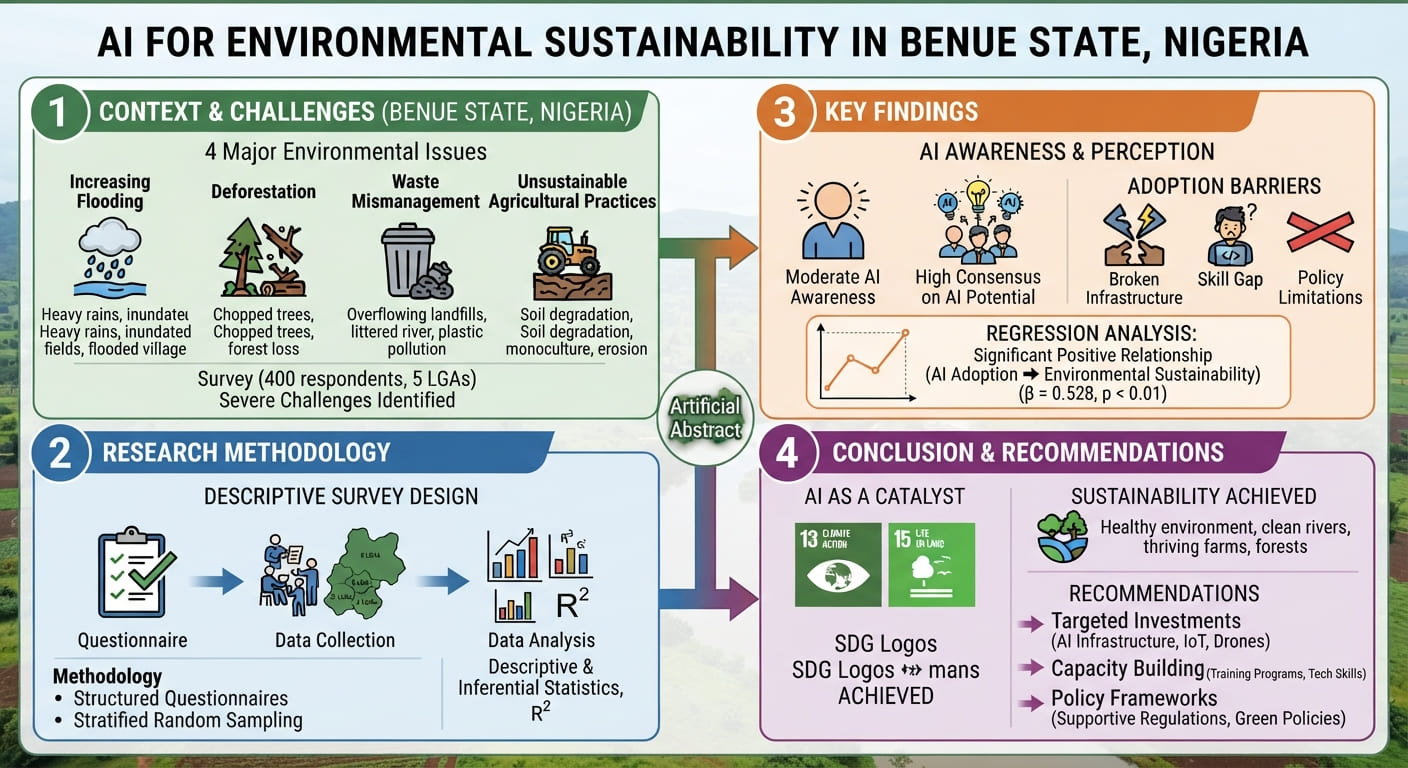
This research investigates the application of artificial intelligence (AI) in addressing critical environmental challenges in Benue State, Nigeria, specifically focusing on increasing flooding, deforestation, waste mismanagement, and unsustainable agricultural practices, collectively termed the "four environmental issues." Employing a descriptive survey design, data were gathered from a sample of 400 respondents across five local government areas selected via stratified random sampling using a structured questionnaire and were subsequently evaluated using descriptive and inferential statistics. The descriptive analysis revealed severe environmental challenges alongside a moderate level of awareness regarding various AI technologies, with respondents indicating a strong consensus on the potential of AI to enhance environmental management. Furthermore, regression analysis demonstrated a statistically significant positive relationship between AI adoption and environmental sustainability, while identifying infrastructural deficits, technical skill gaps, and policy limitations as primary adoption barriers. Anchored in the technology acceptance model, systems theory, and sustainable development theory, the study concludes that AI serves as a transformative catalyst for advancing environmental sustainability (SDGs 13, 14, and 15) in Benue State. Consequently, the research recommends targeted investments in AI infrastructure, capacity-building initiatives, and supportive policy frameworks to ensure effective implementation.
References
Adeyemo, J. T., Ahmed, A., Abaver, D. T., Riyadh, H. A., Tabash, M. I., & Lawal, A. I. (2024). Technological Innovation and Agricultural Productivity in Nigeria Amidst Oil Transition: ARDL Analysis. Economies, 12(9), 253. https://doi.org/10.3390/economies12090253
Alexandro, R. (2025). Strategic human resource management in the digital economy era: An empirical study of challenges and opportunities among MSMEs and startups in Indonesia. Cogent Business & Management, 12(1), 2528436. https://doi.org/10.1080/23311975.2025.2528436
Al-Faouri, E. H., Abu Huson, Y., Aljawarneh, N. M., & Alqmool, T. J. (2024). The Role of Smart Human Resource Management in the Relationship between Technology Application and Innovation Performance. Sustainability, 16(11), 4747. https://doi.org/10.3390/su16114747
Bastani, H., Bastani, O., Sungu, A., Ge, H., Kabakcı, Ö., & Mariman, R. (2025). Generative AI without guardrails can harm learning: Evidence from high school mathematics. Proceedings of the National Academy of Sciences, 122(26), e2422633122. https://doi.org/10.1073/pnas.2422633122
Behera, D., Fathima, J., Saady, N. M. C., Zendehboudi, S., Albayati, T. M., Al-nayili, A., Chatterjee, P., Ponnusami, V., Peach, B., & Espinoza, J. E. R. (2026). Sustainable agriculture through environmental adaptation engineering for waste management. Green Technologies and Sustainability, 4(1), 100242. https://doi.org/10.1016/j.grets.2025.100242
Chan, D. W. M., Olawumi, T. O., Saka, A. B., & Ekundayo, D. (2024). Comparative analysis of the barriers to smart sustainable practices adoption in the construction industry between Hong Kong and Nigeria. International Journal of Construction Management, 24(14), 1499–1509. https://doi.org/10.1080/15623599.2022.2108973
Dinneya-Onuoha, E. (2025). Unlocking renewable energy materials in Nigeria: Availability, application, and roadmap for sustainability. RSC Sustainability, 3(6), 2534–2566. https://doi.org/10.1039/D5SU00121H
El Garem, R. A. (2026). HR digital transformation: Enhancing human resource management through technology. Future Business Journal, 12(1), 5. https://doi.org/10.1186/s43093-025-00703-7
Emezirinwune, M. U., Adejumobi, I. A., Adebisi, O. I., & Akinboro, F. G. (2024). Synergizing hybrid renewable energy systems and sustainable agriculture for rural development in Nigeria. E-Prime - Advances in Electrical Engineering, Electronics and Energy, 7, 100492. https://doi.org/10.1016/j.prime.2024.100492
Faiz, F., Le, V., & Masli, E. K. (2024). Determinants of digital technology adoption in innovative SMEs. Journal of Innovation & Knowledge, 9(4), 100610. https://doi.org/10.1016/j.jik.2024.100610
Farooq, M. S., Uzair, M., Raza, A., Habib, M., Xu, Y., Yousuf, M., Yang, S. H., & Ramzan Khan, M. (2022). Uncovering the Research Gaps to Alleviate the Negative Impacts of Climate Change on Food Security: A Review. Frontiers in Plant Science, 13, 927535. https://doi.org/10.3389/fpls.2022.927535
Fellmann, T., Witzke, P., Weiss, F., Van Doorslaer, B., Drabik, D., Huck, I., Salputra, G., Jansson, T., & Leip, A. (2018). Major challenges of integrating agriculture into climate change mitigation policy frameworks. Mitigation and Adaptation Strategies for Global Change, 23(3), 451–468. https://doi.org/10.1007/s11027-017-9743-2
Flores, M., Canetta, L., Castrovinci, A., Pedrazzoli, P., Longhi, R., & Boër, C. R. (2008). Towards an integrated framework for sustainable innovation. International Journal of Sustainable Engineering, 1(4), 278–286. https://doi.org/10.1080/19397030802496339
Fróna, D., Szenderák, J., & Harangi-Rákos, M. (2021). Economic effects of climate change on global agricultural production. Nature Conservation, 44, 117–139. https://doi.org/10.3897/natureconservation.44.64296
Gerlich, M. (2025). AI Tools in Society: Impacts on Cognitive Offloading and the Future of Critical Thinking. Societies, 15(1), 6. https://doi.org/10.3390/soc15010006
Hariram, N. P., Mekha, K. B., Suganthan, V., & Sudhakar, K. (2023). Sustainalism: An Integrated Socio-Economic-Environmental Model to Address Sustainable Development and Sustainability. Sustainability, 15(13), 10682. https://doi.org/10.3390/su151310682
Harsanto, B., Farras, J. I., Mulyana, A., Faisal, Y. A., & Kasumaningrum, Y. (2026). Institutional environment and sustainability-oriented innovation: A systematic review using antecedents, decisions, and outcomes (ADO) framework. Sustainable Futures, 11, 101925. https://doi.org/10.1016/j.sftr.2026.101925
Isukuru, E. J., Opha, J. O., Isaiah, O. W., Orovwighose, B., & Emmanuel, S. S. (2024). Nigeria’s water crisis: Abundant water, polluted reality. Cleaner Water, 2, 100026. https://doi.org/10.1016/j.clwat.2024.100026
Kalogiannidis, S., Kalfas, D., Paschalidou, M., & Chatzitheodoridis, F. (2024). Synergistic Impacts of Climate Change and Wildfires on Agricultural Sustainability—A Greek Case Study. Climate, 12(9), 144. https://doi.org/10.3390/cli12090144
Khalifa, M., & Albadawy, M. (2024). Using artificial intelligence in academic writing and research: An essential productivity tool. Computer Methods and Programs in Biomedicine Update, 5, 100145. https://doi.org/10.1016/j.cmpbup.2024.100145
Khan, M., & Khan, I. (2024). Achieving environmental sustainability through technological innovation, good governance and financial development: Perspectives from low income countries. Sustainable Futures, 8, 100392. https://doi.org/10.1016/j.sftr.2024.100392
Lozano, R., Barreiro‐Gen, M., & Zafar, A. (2021). Collaboration for organizational sustainability limits to growth: Developing a factors, benefits, and challenges framework. Sustainable Development, 29(4), 728–737. https://doi.org/10.1002/sd.2170
Manucharyan, M. (2025). Climate change impacts on sustainable agriculture: Evidence from Armenia. Unconventional Resources, 6, 100159. https://doi.org/10.1016/j.uncres.2025.100159
Marzuki, Widiati, U., Rusdin, D., Darwin, & Indrawati, I. (2023). The impact of AI writing tools on the content and organization of students’ writing: EFL teachers’ perspective. Cogent Education, 10(2), 2236469. https://doi.org/10.1080/2331186X.2023.2236469
Mogaji, I. J., Mewomo, M. C., & Bondinuba, F. K. (2025). Assessment of barriers to the adoption of innovative building materials (IBM) for sustainable construction in the Nigerian construction industry. Engineering, Construction and Architectural Management, 32(13), 1–26. https://doi.org/10.1108/ECAM-04-2024-0430
Mujeeb, A., Oladigbolu, J., Bakare, M. S., & Ibrahim, A. A. (2025). Pathways to environmental sustainability through energy efficiency: A strategic next energy vision for sustainable development by 2050. Scientific African, 30, e03053. https://doi.org/10.1016/j.sciaf.2025.e03053
Ogunbode, T. O. (2025). A nine-year critical review of progress and future strategies for sustainable development goal 6 in Nigeria from 2016 to 2024. Discover Sustainability, 6(1), 1466. https://doi.org/10.1007/s43621-025-02009-8
Oise, G. (2026). Artificial Intelligence for Smart City Reinvention: A Systematic Literature Review and Conceptual Framework. Radinka Journal Of Science And Systematic Literature Review, 4(1). https://doi.org/10.56778/rjslr.v4i1.645
Okafor, C. C., Ajaero, C. C., Madu, C. N., Nzekwe, C. A., Otunomo, F. A., & Nixon, N. N. (2024). Climate Change Mitigation and Adaptation in Nigeria: A Review. Sustainability, 16(16), 7048. https://doi.org/10.3390/su16167048
Olafimihan, C. O., Atanda, L. A., Gbotosho, A. S., & Ekeh, E. M. (2024). Navigating the Digital Frontier: The Impact of Emerging Technologies in Libraries Services. Radinka Journal Of Science And Systematic Literature Review, 2(3), 504–513. https://doi.org/10.56778/rjslr.v2i3.373
Ossai, J., & Alordiah, C. (2024). Environmental Education In Social Studies: The Integrated Evaluation Model For Environmental Education (IEMEE). Jurnal Pendidikan Ilmu Sosial, 34(2), 168–187. https://doi.org/10.23917/jpis.v34i2.6136
Semeraro, T., Scarano, A., Leggieri, A., Calisi, A., & De Caroli, M. (2023). Impact of Climate Change on Agroecosystems and Potential Adaptation Strategies. Land, 12(6), 1117. https://doi.org/10.3390/land12061117
Slimani, S., Omri, A., & Ben Jabeur, S. (2025). When and how does artificial intelligence impact environmental performance? Energy Economics, 148, 108643. https://doi.org/10.1016/j.eneco.2025.108643
Straub, L., Trotter, P., Onsongo, E., Van Vuuren, D., & Kirchherr, J. (2026). Diversity of circular economies from Global South evidence. Nature Sustainability. https://doi.org/10.1038/s41893-026-01901-z
Surbakti, F. P. S. (2025). Opportunities and Challenges of Embedding AI in SINTA: A Systematic Literature Review. Metris: Jurnal Sains Dan Teknologi, 25(02), 115–121. https://doi.org/10.25170/metris.v25i02.6204
Tiago, F., & Almeida, A. (2026). Environmental, organizational, and individual determinants of AI adoption: A multilevel knowledge and analysis. Journal of Innovation & Knowledge, 13, 100934. https://doi.org/10.1016/j.jik.2025.100934
Vaccaro, M., Almaatouq, A., & Malone, T. (2024). When combinations of humans and AI are useful: A systematic review and meta-analysis. Nature Human Behaviour, 8(12), 2293–2303. https://doi.org/10.1038/s41562-024-02024-1
Vieriu, A. M., & Petrea, G. (2025). The Impact of Artificial Intelligence (AI) on Students’ Academic Development. Education Sciences, 15(3), 343. https://doi.org/10.3390/educsci15030343
Wang, Y., Pan, S., Yin, J., Feng, H., Wang, M., & Chen, T. (2022). Resource potential and global warming potential of fruit and vegetable waste in China based on different treatment strategies. Waste Management, 140, 225–232. https://doi.org/10.1016/j.wasman.2021.11.016
Wheeler, M. R., Everett, B., & Prybutok, V. (2026). Navigating the Environmental Paradox of AI: A Decision Framework for Clean Technology Practitioners. Clean Technologies, 8(2), 51. https://doi.org/10.3390/cleantechnol8020051
Downloads
Published
How to Cite
Issue
Section
License
Copyright (c) 2026 RADINKA JOURNAL OF SCIENCE AND SYSTEMATIC LITERATURE REVIEW

This work is licensed under a Creative Commons Attribution 4.0 International License.
<a rel="license" href="http://creativecommons.org/licenses/by/4.0/"><img alt="Creative Commons License" style="border-width:0" src="https://i.creativecommons.org/l/by/4.0/88x31.png" /></a><br />This work is licensed under a <a rel="license" href="http://creativecommons.org/licenses/by/4.0/">Creative Commons Attribution 4.0 International License</a>.


