
Digital Environmental Monitoring Systems and Sustainable Resource Management in the Niger Delta Region of Nigeria
DOI:
https://doi.org/10.56778/rjslr.v4i2.767Keywords:
: Digital environmental monitoring, Environmental sustainability, Internet of Things (IoT), Niger Delta, Sustainable resource management.Abstract
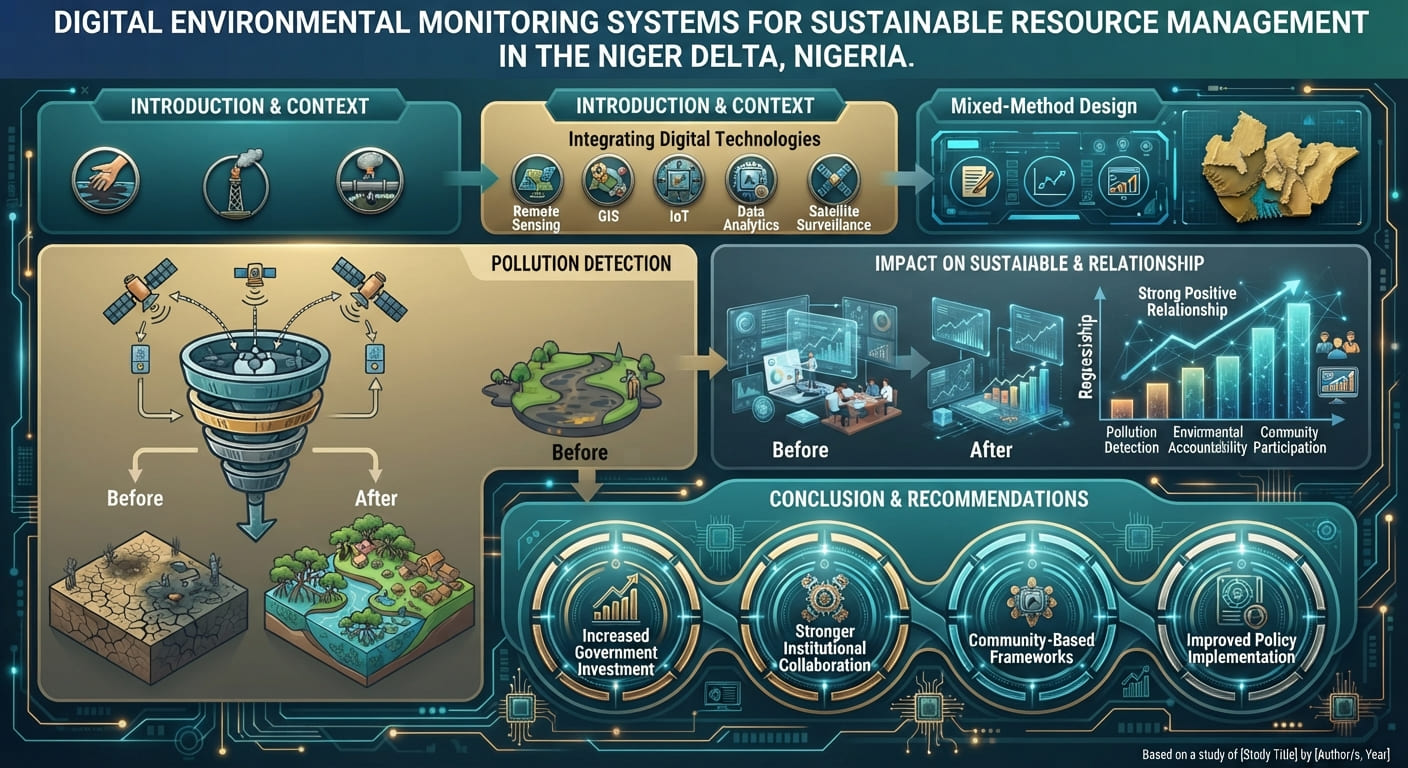
This study examined the role of digital environmental monitoring systems in promoting sustainable resource management in the Niger Delta region of Nigeria. The increasing environmental degradation caused by oil exploration, gas flaring, pipeline vandalism, deforestation, and water pollution has generated significant ecological and socio-economic challenges across the region. Consequently, the integration of digital technologies such as remote sensing, Geographic Information Systems (GIS), Internet of Things (IoT) devices, satellite surveillance, artificial intelligence, and environmental data analytics has emerged as a strategic mechanism for enhancing environmental governance and sustainable resource utilisation. The study adopted a mixed-method research design involving a descriptive survey, regression analysis, and thematic analysis. Data were collected from selected states and local government areas within the Niger Delta, including Rivers, Delta, Bayelsa, and Akwa Ibom States. Respondents comprised environmental officers, oil company staff, community leaders, farmers, fishermen, ICT professionals, and government regulators. Findings revealed that digital environmental monitoring systems significantly improve pollution detection, environmental compliance, resource accountability, and community participation in environmental governance. Regression analysis showed a strong positive relationship between digital monitoring adoption and sustainable resource management. Thematic analysis further indicated that technological innovation enhances transparency, early-warning systems, and environmental restoration processes. The study concluded that digital monitoring systems are indispensable for achieving environmental sustainability in the Niger Delta. The study recommended increased government investment in environmental technologies, stronger institutional collaboration, community-based digital monitoring frameworks, and improved policy implementation.
References
Angela Oyilieze, A., Munana Gilbert, O. P., Emmanuel, C., Nshimyimana, E., Jonathan, M., & Martin, A. (2026). Environmental and socio-economic impacts of illegal oil mining in the Niger Delta, Nigeria. Environmental Challenges, 24, 101545. https://doi.org/10.1016/j.envc.2026.101545
Bâra, A., Oprea, S.-V., & Georgescu, I. A. (2026). Digitalization and Economic Growth in Shaping Ecological Footprints. Evidence from the Four Selected Southeastern European Countries. Computational Economics, 68(4), 3045–3086. https://doi.org/10.1007/s10614-025-11155-0
Bocean, C. G. (2025). Sustainable Development in the Digital Age: Harnessing Emerging Digital Technologies to Catalyze Global SDG Achievement. Applied Sciences, 15(2), 816. https://doi.org/10.3390/app15020816
Bueloth, M. R., Pantaleón, A. J. S., Visalot, J. P., & Esparza–Huamanchumo, R. M. (2026). Community participation, governance, and environmental education as drivers of local sustainable development: Tutumberos community, Peruvian Amazon. World Development Sustainability, 8, 100283. https://doi.org/10.1016/j.wds.2026.100283
Bui, N. A., Oh, Y., & Lee, I. (2024). Oil spill detection and classification through deep learning and tailored data augmentation. International Journal of Applied Earth Observation and Geoinformation, 129, 103845. https://doi.org/10.1016/j.jag.2024.103845
Carvajal Romero, S., Rojas Ángel, J., & Gaitan-Angulo, M. (2026). Technological innovation for environmental monitoring of strategic ecosystems: Implications for sustainability. Frontiers in Environmental Science, 14, 1734506. https://doi.org/10.3389/fenvs.2026.1734506
Dai, J., Zhou, B., & Meng, W. (2025). The impact of digitization on environmental sustainability: New insights from G20 nations. Journal of Environmental Management, 394, 127225. https://doi.org/10.1016/j.jenvman.2025.127225
Daron, J., Bruno Soares, M., Janes, T., Colledge, F., Srinivasan, G., Agarwal, A., Hewitt, C., Richardson, K., Nepal, S., Singh Shrestha, M., Rasul, G., Suckall, N., Harrison, B., Oakes, R. L., & Corbelli, D. (2022). Advancing climate services in South Asia. Climate Services, 26, 100295. https://doi.org/10.1016/j.cliser.2022.100295
De Kerf, T., Sels, S., Samsonova, S., & Vanlanduit, S. (2024). A dataset of drone-captured, segmented images for oil spill detection in port environments. Scientific Data, 11(1), 1180. https://doi.org/10.1038/s41597-024-03993-8
Dickson, S. M. (2024). Detection of Anomalies in Internet of Things (IoT) Devices and Sensors. Radinka Journal Of Science And Systematic Literature Review, 2(3), 475–481. https://doi.org/10.56778/rjslr.v2i3.347
Dickson, S. M. & Ogbonnaya Okechukwu Ukegbu. (2024). IoT-Enabled Smart Agriculture: A Pathway to Nigeria’s Economic Recovery and Sustainable. Radinka Journal Of Science And Systematic Literature Review, 2(2), 313–318. https://doi.org/10.56778/rjslr.v2i2.252
Eddamiri, S., Bassine, F. Z., Hakam, O., Kambiet, P. L. K., & Chehbouni, A. (2025). Applications of artificial intelligence for forecasting and managing extremes. In Climate Change and Rainfall Extremes in Africa (pp. 91–113). Elsevier. https://doi.org/10.1016/B978-0-443-28867-8.00005-8
Gomes, V., Queiroz, G., & Ferreira, K. (2020). An Overview of Platforms for Big Earth Observation Data Management and Analysis. Remote Sensing, 12(8), 1253. https://doi.org/10.3390/rs12081253
Guo, J., & Shen, X. (2024). Does Digitalization Facilitate Environmental Governance Performance? An Empirical Analysis Based on the PLS-SEM Model in China. Sustainability, 16(7), 3026. https://doi.org/10.3390/su16073026
Heidari, M. D., Gandasasmita, S., Li, E., & Pelletier, N. (2021a). Proposing a framework for sustainable feed formulation for laying hens: A systematic review of recent developments and future directions. Journal of Cleaner Production, 288, 125585. https://doi.org/10.1016/j.jclepro.2020.125585
Heidari, M. D., Gandasasmita, S., Li, E., & Pelletier, N. (2021b). Proposing a framework for sustainable feed formulation for laying hens: A systematic review of recent developments and future directions. Journal of Cleaner Production, 288, 125585. https://doi.org/10.1016/j.jclepro.2020.125585
Hilson, G., & Maconachie, R. (2017). Formalising artisanal and small‐scale mining: Insights, contestations and clarifications. Area, 49(4), 443–451. https://doi.org/10.1111/area.12328
Huang, Y., Liu, Q., Xiong, N., & Liu, C. (2025). Digital transformation and environmentally sustainable innovation: Based on machine learning and text analysis methods. Journal of Environmental Management, 393, 127090. https://doi.org/10.1016/j.jenvman.2025.127090
Inakefe, G. I., Bassey, V. U., Ikeanyibe, O. M., Nwagboso, C. I., Agbor, U. I., Ebegbulem, J., Mbonu, F. I., & Ike, G. U. (2023). Digital Literacy and E-Governance Adoption for Service Delivery in Cross River State Civil Service: International Journal of Electronic Government Research, 19(1), 1–23. https://doi.org/10.4018/IJEGR.328327
Jalghaf, H. K., Kovács, E., & Bolló, B. (2022). Comparison of Old and New Stable Explicit Methods for Heat Conduction, Convection, and Radiation in an Insulated Wall with Thermal Bridging. Buildings, 12(9), 1365. https://doi.org/10.3390/buildings12091365
Kafi, K. M., Ponrahono, Z., Ash’aari, Z. H., & Barau, A. S. (2025). Flood risk prediction and modeling in Bauchi: Leveraging machine learning models and explainable AI for urban resilience. The Journal of Climate Change and Health, 26, 100490. https://doi.org/10.1016/j.joclim.2025.100490
Kantola, S., Fagerholm, N., & Nikula, A. (2023). Utilization and implementation of PPGIS in land use planning and decision-making from the perspective of organizations. Land Use Policy, 127, 106528. https://doi.org/10.1016/j.landusepol.2022.106528
Kochanek, A., Angrecka, S., Pietrucha, I., Zacłona, T., Petryk, A., Generowicz, A., Akbulut, L., & Atılgan, A. (2025). Integration of GIS, Big Data, and Artificial Intelligence in Modern Waste Management Systems—A Comprehensive Review. Sustainability, 18(1), 385. https://doi.org/10.3390/su18010385
Li, C., Zhang, Y., Li, X., & Hao, Y. (2024). Artificial intelligence, household financial fragility and energy resources consumption: Impacts of digital disruption from a demand-based perspective. Resources Policy, 88, 104469. https://doi.org/10.1016/j.resourpol.2023.104469
Li, Y., Chu, Z., Sun, Z., Wang, K., & Huang, W. (2025). Performance Evaluation of the Digital Governance of Water Pollution: A Dual Perspective of Digital Monitoring and Digital Administration. Systems, 13(6), 411. https://doi.org/10.3390/systems13060411
Liu, H., Zhang, X., & He, Y. (2025). Digital Transformation and ESG Performance—Empirical Evidence from Chinese Listed Companies. Sustainability, 17(13), 6165. https://doi.org/10.3390/su17136165
Luthin, A., Crawford, R. H., & Traverso, M. (2023). Demonstrating circular life cycle sustainability assessment – a case study of recycled carbon concrete. Journal of Cleaner Production, 433, 139853. https://doi.org/10.1016/j.jclepro.2023.139853
Ninčević Pašalić, I., & Ćukušić, M. (2024). Understanding E-participation adoption: Exploring technological, organizational, and environmental factors. Technological Forecasting and Social Change, 207, 123633. https://doi.org/10.1016/j.techfore.2024.123633
Nolasco, I., Singh, S., Morfi, V., Lostanlen, V., Strandburg-Peshkin, A., Vidaña-Vila, E., Gill, L., Pamuła, H., Whitehead, H., Kiskin, I., Jensen, F. H., Morford, J., Emmerson, M. G., Versace, E., Grout, E., Liu, H., Ghani, B., & Stowell, D. (2023). Learning to detect an animal sound from five examples. Ecological Informatics, 77, 102258. https://doi.org/10.1016/j.ecoinf.2023.102258
Oise, G. P., & Konyeha, S. (2025). Optimization of E-Waste Sorting Process Using Deep Learning. Radinka Journal Of Science And Systematic Literature Review, 3(2), 612–622. https://doi.org/10.56778/rjslr.v3i2.503
Olawade, D. B., Wada, O. Z., Ige, A. O., Egbewole, B. I., Olojo, A., & Oladapo, B. I. (2024). Artificial intelligence in environmental monitoring: Advancements, challenges, and future directions. Hygiene and Environmental Health Advances, 12, 100114. https://doi.org/10.1016/j.heha.2024.100114
Onifade, S. T., Erdoğan, S., & Alola, A. A. (2023). The role of alternative energy and globalization in decarbonization prospects of the oil-producing African economies. Environmental Science and Pollution Research, 30(20), 58128–58141. https://doi.org/10.1007/s11356-023-26581-6
Roziqin, A., Prasetyo, R. A., Bintang, R. M., Asmoro, B. T., Kurniawan, S. B., & Imron, M. F. (2026a). Smart City Innovation in Local Government: A Stakeholder Analysis. Sustainability, 18(14), 7347. https://doi.org/10.3390/su18147347
Roziqin, A., Prasetyo, R. A., Bintang, R. M., Asmoro, B. T., Kurniawan, S. B., & Imron, M. F. (2026b). Smart City Innovation in Local Government: A Stakeholder Analysis. Sustainability, 18(14), 7347. https://doi.org/10.3390/su18147347
Sinare, H., Coetzer, K., & Schultz, L. (2025). Participatory governance for people and nature in multifunctional landscapes—Insights from Biosphere Reserves. Current Opinion in Environmental Sustainability, 77, 101585. https://doi.org/10.1016/j.cosust.2025.101585
Sokolova, T. (2023). Co-producing ‘The Future(s) We Want’: How does political imagination translate into democratised knowledge-action models for sustainability transformations? Environmental Science & Policy, 144, 162–173. https://doi.org/10.1016/j.envsci.2023.03.018
Tandukar, S., Ghaju Shrestha, R., Malla, B., Sthapit, N., Sherchand, J. B., Sherchan, S. P., & Haramoto, E. (2021). Virus reduction at wastewater treatment plants in Nepal. Environmental Challenges, 5, 100281. https://doi.org/10.1016/j.envc.2021.100281
Vinueza-Martinez, J., Correa-Peralta, M., Ramirez-Anormaliza, R., Franco Arias, O., & Vera Paredes, D. (2024). Geographic Information Systems (GISs) Based on WebGIS Architecture: Bibliometric Analysis of the Current Status and Research Trends. Sustainability, 16(15), 6439. https://doi.org/10.3390/su16156439
Wei, Y., Ali, M. S. E., & Bhat, M. A. (2025). Exploring the impact of digital technology, circular technology and public management on environmental sustainability in emerging economies. Scientific Reports, 16(1), 3979. https://doi.org/10.1038/s41598-025-34092-2
Zhang, Y., Selamat, A., Zhang, Y., Alrabaiah, H., & Hisam Omar, A. (2022). Artificial neural networks/least squares fuzzy system methods to optimize the performance of a flat-plate solar collector according to the empirical data. Sustainable Energy Technologies and Assessments, 52, 102062. https://doi.org/10.1016/j.seta.2022.102062
Downloads
Published
How to Cite
Issue
Section
License
Copyright (c) 2026 RADINKA JOURNAL OF SCIENCE AND SYSTEMATIC LITERATURE REVIEW

This work is licensed under a Creative Commons Attribution 4.0 International License.
<a rel="license" href="http://creativecommons.org/licenses/by/4.0/"><img alt="Creative Commons License" style="border-width:0" src="https://i.creativecommons.org/l/by/4.0/88x31.png" /></a><br />This work is licensed under a <a rel="license" href="http://creativecommons.org/licenses/by/4.0/">Creative Commons Attribution 4.0 International License</a>.


