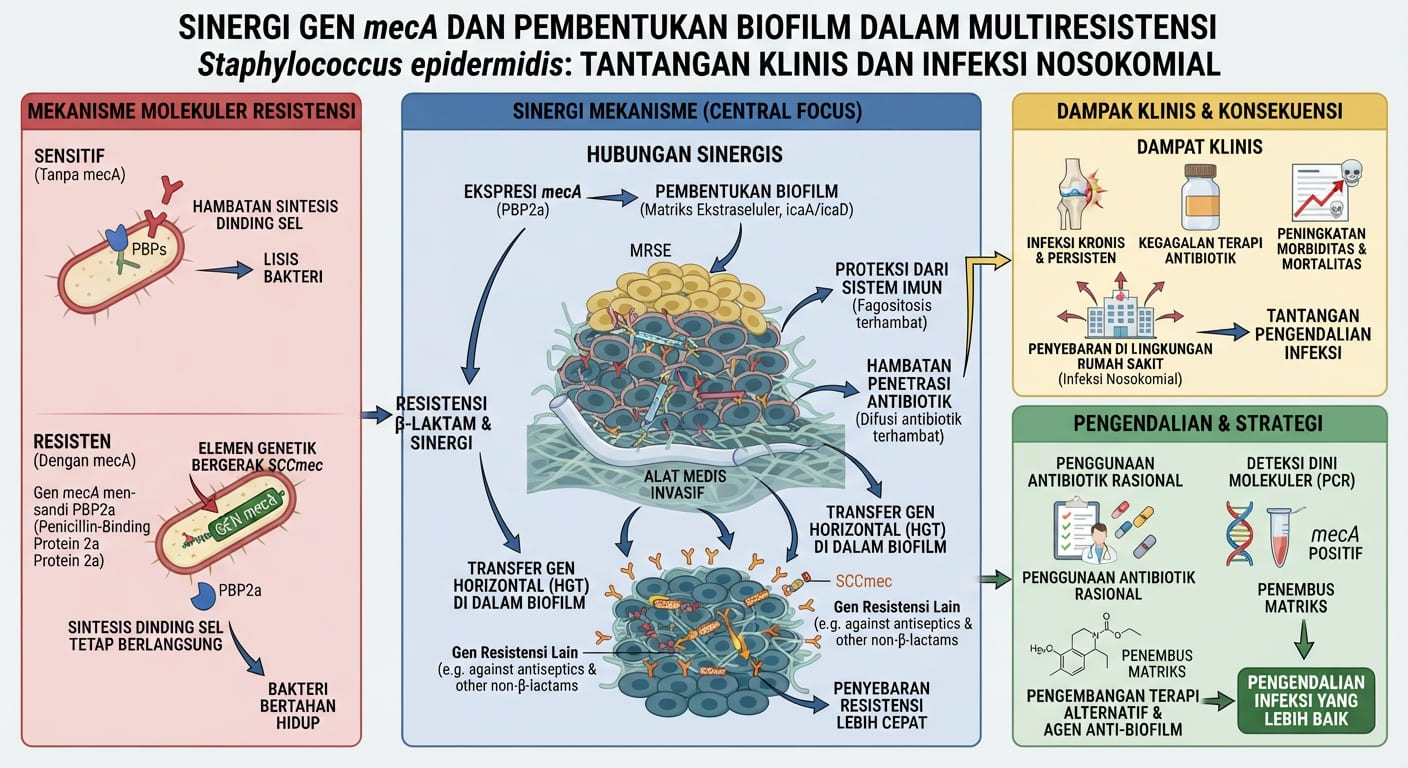
Sinergi Gen mecA dan Pembentukan Biofilm dalam Multiresistensi Staphylococcus epidermidis: Tantangan Klinis dan Infeksi Nosokomial
DOI:
https://doi.org/10.56778/rjhs.v4i2.813Keywords:
SCCmec, β-lactam resistance, Methicillin Resistant Staphylococcus epidermidis, biofilm, Antibiotic Resistance, mecA geneAbstract
Staphylococcus epidermidis is a skin commensal that can act as an opportunistic pathogen causing nosocomial infections in immunocompromised patients and individuals with invasive medical devices. Rising β-lactam resistance in methicillin-resistant Staphylococcus epidermidis (MRSE) and its biofilm-forming capacity pose major clinical challenges. This review examines S. epidermidis characteristics, mecA and Staphylococcal Cassette Chromosome mec (SCCmec) resistance mechanisms, synergistic biofilm formation, detection methods, and clinical impacts on nosocomial infections. A narrative literature review approach was applied to English and Indonesian publications from 2016–2026 across PubMed/MEDLINE, Scopus, ScienceDirect, and Google Scholar, analyzed descriptively and comparatively. β-lactam resistance in MRSE is primarily driven by the mecA gene encoding low-affinity penicillin-binding protein 2a (PBP2a), allowing cell wall synthesis to continue. mecA resides on mobile SCCmec elements (predominantly types III and IV in nosocomial isolates) disseminated via horizontal gene transfer. Synergy between mecA expression—linked to upregulated biofilm genes such as icaA and icaD—and the biofilm matrix enhances protection against antibiotics and host immunity. Polymerase Chain Reaction (PCR) serves as an accurate gold standard for mecA detection, though constrained by cost, laboratory accessibility, primer-site mutation false negatives, and genotypic-phenotypic discrepancies. Synergy between mecA and biofilms reinforces MRSE multidrug resistance and infection persistence, warranting early detection, rational antibiotic use, and antibiofilm therapies.
References
Ahmed, S. K., Hussein, S., Qurbani, K., Ibrahim, R. H., Fareeq, A., Mahmood, K. A., & Mohamed, M. G. (2024). Antimicrobial resistance: Impacts, challenges, and future prospects. Journal of Medicine, Surgery, and Public Health, 2, 100081. https://doi.org/10.1016/j.glmedi.2024.100081
Alatawi, A. D., Hetta, H. F., Ali, M. A. S., Ramadan, Y. N., Alaqyli, A. B., Alansari, W. K., Aldhaheri, N. H., Bin Selim, T. A., Merdad, S. A., Alharbi, M. O., Alatawi, W. A. H., & Algammal, A. M. (2025). Diagnostic Innovations to Combat Antibiotic Resistance in Critical Care: Tools for Targeted Therapy and Stewardship. Diagnostics, 15(17), 2244. https://doi.org/10.3390/diagnostics15172244
Alfouzan, W., Udo, E. E., Modhaffer, A., & Alosaimi, A. (2019). Molecular Characterization of Methicillin- Resistant Staphylococcus aureus in a Tertiary Care hospital in Kuwait. Scientific Reports, 9(1), 18527. https://doi.org/10.1038/s41598-019-54794-8
Ammann, C. G., Neuhauser, D., Eberl, C., Nogler, M., & Coraça-Huber, D. (2018). Tolerance towards gentamicin is a function of nutrient concentration in biofilms of patient-isolated Staphylococcus epidermidis. Folia Microbiologica, 63(3), 299–305. https://doi.org/10.1007/s12223-017-0568-x
Bălan, A.-M., Bodolea, C., Trancă, S. D., & Hagău, N. (2023). Trends in Molecular Diagnosis of Nosocomial Pneumonia Classic PCR vs. Point-of-Care PCR: A Narrative Review. Healthcare, 11(9), 1345. https://doi.org/10.3390/healthcare11091345
Besharati, S. (2024). The Expanding Antibiotic Resistance: The Requirement of New Therapeutic Strategy for the Development of New Anti-Infective. In A. Lasfar (Ed.), Innate Immunity—New Perspectives and Therapeutic Opportunities. IntechOpen. https://doi.org/10.5772/intechopen.1006935
Burke, Ó., Zeden, M. S., & O’Gara, J. P. (2024). The pathogenicity and virulence of the opportunistic pathogen Staphylococcus epidermidis. Virulence, 15(1), 2359483. https://doi.org/10.1080/21505594.2024.2359483
Callejón Fernández, M., Abreu Rodríguez, R., Arias, Á., Aguirre-Jaime, A., Castro Hernández, M. B., Ramos Real, M. J., Pedroso Fernández, Y., & Lecuona, M. (2023). The Impact of MRSA Colonization on Healthcare-Associated Infections in Long-Term Care Facility Residents: A Whole-Genome Sequencing-Based Study. Microorganisms, 11(12), 2842. https://doi.org/10.3390/microorganisms11122842
Candel, F. J., Salavert, M., Cantón, R., Del Pozo, J. L., Galán-Sánchez, F., Navarro, D., Rodríguez, A., Rodríguez, J. C., Rodríguez-Aguirregabiria, M., Suberviola, B., & Zaragoza, R. (2024). The role of rapid multiplex molecular syndromic panels in the clinical management of infections in critically ill patients: An experts-opinion document. Critical Care, 28(1), 440. https://doi.org/10.1186/s13054-024-05224-3
Fernández-Calderón, M. C., Fernández-Babiano, I., Navarro-Pérez, M. L., Pazos-Pacheco, C., & Calvo-Cano, A. (2025). Biofilm formation and role of other pathogenic factors in the virulence of Staphylococcus epidermidis clinical isolates. Frontiers in Cellular and Infection Microbiology, 15, 1630341. https://doi.org/10.3389/fcimb.2025.1630341
Frieri, M., Kumar, K., & Boutin, A. (2017). Antibiotic resistance. Journal of Infection and Public Health, 10(4), 369–378. https://doi.org/10.1016/j.jiph.2016.08.007
Gaio, V., & Cerca, N. (2019). Cells released from S. epidermidis biofilms present increased antibiotic tolerance to multiple antibiotics. PeerJ, 7, e6884. https://doi.org/10.7717/peerj.6884
Gigante, V., Murtagh, M., Bachmann, T. T., Rocke, T., Trainor, B. W., Poutanen, S. M., Roberts, T., Vila, J., & Cameron, A. (2026). Diagnostics for priority bacterial pathogens: Global gaps and research needs for curbing antimicrobial resistance in low-resource settings. The Lancet Microbe, 7(7), 101385. https://doi.org/10.1016/j.lanmic.2026.101385
Halawa, E. M., Fadel, M., Al-Rabia, M. W., Behairy, A., Nouh, N. A., Abdo, M., Olga, R., Fericean, L., Atwa, A. M., El-Nablaway, M., & Abdeen, A. (2024). Antibiotic action and resistance: Updated review of mechanisms, spread, influencing factors, and alternative approaches for combating resistance. Frontiers in Pharmacology, 14, 1305294. https://doi.org/10.3389/fphar.2023.1305294
Hareidy, F. A., Azmy, A. F., Kamel, N. M., Moawad, A. S., Rasslan, F. S., & Omran, M. E. (2025). Egyptian Apis mellifera bee propolis modulating resistance of Staphylococcus aureus to antibiotics. Annals of Microbiology, 75(1), 23. https://doi.org/10.1186/s13213-025-01815-9
Hefzy, E. M., Radwan, T. E. E., Hozayen, B. M. M., Mahmoud, E. E., & Khalil, M. A. F. (2023). Antiseptics and mupirocin resistance in clinical, environmental, and colonizing coagulase negative Staphylococcus isolates. Antimicrobial Resistance & Infection Control, 12(1), 110. https://doi.org/10.1186/s13756-023-01310-3
Koch, J. A., Pust, T. M., Cappellini, A. J., Mandell, J. B., Ma, D., Shah, N. B., Brothers, K. M., & Urish, K. L. (2020). Staphylococcus epidermidis Biofilms Have a High Tolerance to Antibiotics in Periprosthetic Joint Infection. Life, 10(11), 253. https://doi.org/10.3390/life10110253
Li, J., Cheng, F., Wei, X., Bai, Y., Wang, Q., Li, B., Zhou, Y., Zhai, B., Zhou, X., Wang, W., & Zhang, J. (2025). Methicillin-Resistant Staphylococcus aureus (MRSA): Resistance, Prevalence, and Coping Strategies. Antibiotics, 14(8), 771. https://doi.org/10.3390/antibiotics14080771
Liu, Y., & Breukink, E. (2016). The Membrane Steps of Bacterial Cell Wall Synthesis as Antibiotic Targets. Antibiotics, 5(3), 28. https://doi.org/10.3390/antibiotics5030028
Machowska, A., & Stålsby Lundborg, C. (2018). Drivers of Irrational Use of Antibiotics in Europe. International Journal of Environmental Research and Public Health, 16(1), 27. https://doi.org/10.3390/ijerph16010027
Mithuna, R., Tharanyalakshmi, R., Jain, I., Singhal, S., Sikarwar, D., Das, S., Ranjitha, J., Ghosh, D., Rahman, M. M., & Das, B. (2024). Emergence of antibiotic resistance due to the excessive use of antibiotics in medicines and feed additives: A global scenario with emphasis on the Indian perspective. Emerging Contaminants, 10(4), 100389. https://doi.org/10.1016/j.emcon.2024.100389
Mohammed, M. M., Isa, M. A., Abubakar, M. B., Dikwa, A. S. B., & Kappo, A. P. (2025). Molecular detection of mecA gene from methicillin-resistant Staphylococcus aureus isolated from clinical and environmental samples and its potential inhibition by phytochemicals using in vitro and in silico approach. In Silico Pharmacology, 13(1), 26. https://doi.org/10.1007/s40203-024-00297-y
Naccache, S. N., Callan, K., Burnham, C.-A. D., Wallace, M. A., Westblade, L. F., & Dien Bard, J. (2019). Evaluation of Oxacillin and Cefoxitin Disk Diffusion and Microbroth Dilution Methods for Detecting mecA -Mediated β-Lactam Resistance in Contemporary Staphylococcus epidermidis Isolates. Journal of Clinical Microbiology, 57(12), e00961-19. https://doi.org/10.1128/JCM.00961-19
Oliveira, F., Rohde, H., Vilanova, M., & Cerca, N. (2021). Fighting Staphylococcus epidermidis Biofilm-Associated Infections: Can Iron Be the Key to Success? Frontiers in Cellular and Infection Microbiology, 11, 798563. https://doi.org/10.3389/fcimb.2021.798563
Paillard, P., Rouger, Q., Thomet, M., & Macé, K. (2025). Type IV secretion systems: From structures to mechanisms. The EMBO Journal, 44(22), 6304–6319. https://doi.org/10.1038/s44318-025-00584-0
Rather, I. A., Kim, B.-C., Bajpai, V. K., & Park, Y.-H. (2017). Self-medication and antibiotic resistance: Crisis, current challenges, and prevention. Saudi Journal of Biological Sciences, 24(4), 808–812. https://doi.org/10.1016/j.sjbs.2017.01.004
Sagar, S., Singh, V. K., Das, C., Kumar, A., & Yadav, S. K. (2025). Antibiotic resistance in Staphylococcus epidermidis isolates from human and animal skin and soft tissue infections. The Microbe, 9, 100580. https://doi.org/10.1016/j.microb.2025.100580
Sanchini, A. (2022). Recent Developments in Phenotypic and Molecular Diagnostic Methods for Antimicrobial Resistance Detection in Staphylococcus aureus: A Narrative Review. Diagnostics, 12(1), 208. https://doi.org/10.3390/diagnostics12010208
Severn, M. M., & Horswill, A. R. (2023). Staphylococcus epidermidis and its dual lifestyle in skin health and infection. Nature Reviews Microbiology, 21(2), 97–111. https://doi.org/10.1038/s41579-022-00780-3
Shahida, S. M., Islam, A., Dey, B. R., Islam, F., Venkatesh, K., & Goodman, A. (2016). Hospital Acquired Infections in Low and Middle Income Countries: Root Cause Analysis and the Development of Infection Control Practices in Bangladesh. Open Journal of Obstetrics and Gynecology, 06(01), 28–39. https://doi.org/10.4236/ojog.2016.61004
Sharma, S., Mohler, J., Mahajan, S. D., Schwartz, S. A., Bruggemann, L., & Aalinkeel, R. (2023). Microbial Biofilm: A Review on Formation, Infection, Antibiotic Resistance, Control Measures, and Innovative Treatment. Microorganisms, 11(6), 1614. https://doi.org/10.3390/microorganisms11061614
Siddaway, A. P., Wood, A. M., & Hedges, L. V. (2019). How to Do a Systematic Review: A Best Practice Guide for Conducting and Reporting Narrative Reviews, Meta-Analyses, and Meta-Syntheses. Annual Review of Psychology, 70(1), 747–770. https://doi.org/10.1146/annurev-psych-010418-102803
Skiba-Kurek, I., Nowak, P., Empel, J., Tomczak, M., Klepacka, J., Sowa-Sierant, I., Żak, I., Pomierny, B., & Karczewska, E. (2021). Evaluation of Biofilm Formation and Prevalence of Multidrug-Resistant Strains of Staphylococcus epidermidis Isolated from Neonates with Sepsis in Southern Poland. Pathogens, 10(7), 877. https://doi.org/10.3390/pathogens10070877
Sukhera, J. (2022). Narrative Reviews: Flexible, Rigorous, and Practical. Journal of Graduate Medical Education, 14(4), 414–417. https://doi.org/10.4300/JGME-D-22-00480.1
Tang, B., Gong, T., Cui, Y., Wang, L., He, C., Lu, M., Chen, J., Jing, M., Zhang, A., & Li, Y. (2020). Characteristics of oral methicillin-resistant Staphylococcus epidermidis isolated from dental plaque. International Journal of Oral Science, 12(1), 15. https://doi.org/10.1038/s41368-020-0079-5
Timsit, J.-F., Ling, L., De Montmollin, E., Bracht, H., Conway-Morris, A., De Bus, L., Falcone, M., Harris, P. N. A., Machado, F. R., Paiva, J.-A., Paterson, D. L., Poulakou, G., Roberts, J. A., Roger, C., Shorr, A. F., Tabah, A., & Lipman, J. (2025). Antibiotic therapy for severe bacterial infections. Intensive Care Medicine, 51(10), 1867–1885. https://doi.org/10.1007/s00134-025-08063-0
Wolska-Gębarzewska, M., Międzobrodzki, J., & Kosecka-Strojek, M. (2024). Current types of staphylococcal cassette chromosome mec (SCC mec) in clinically relevant coagulase-negative staphylococcal (CoNS) species. Critical Reviews in Microbiology, 50(6), 1020–1036. https://doi.org/10.1080/1040841X.2023.2274841
Xu, Z., Shah, H. N., Misra, R., Chen, J., Zhang, W., Liu, Y., Cutler, R. R., & Mkrtchyan, H. V. (2018). The prevalence, antibiotic resistance, and mecA characterization of coagulase-negative staphylococci recovered from non-healthcare settings in London, UK. Antimicrobial Resistance & Infection Control, 7(1), 73. https://doi.org/10.1186/s13756-018-0367-4
Yaki, L. M. (2026). Bacterial biofilms and antimicrobial resistance: A global threat. Discover Bacteria, 3(1), 15. https://doi.org/10.1007/s44351-025-00035-5
Ye, Z., Li, M., Jing, Y., Liu, K., Wu, Y., & Peng, Z. (2025). What Are the Drivers Triggering Antimicrobial Resistance Emergence and Spread? Outlook from a One Health Perspective. Antibiotics, 14(6), 543. https://doi.org/10.3390/antibiotics14060543
Downloads
Published
How to Cite
Issue
Section
License
Copyright (c) 2026 RADINKA JOURNAL OF HEALTH SCIENCE

This work is licensed under a Creative Commons Attribution 4.0 International License.
<meta name="google-site-verification" content="qBtkk8rnBm0ZRgy_14UYrahahLnkC844dKsDOFjzrn4" />