Challenges in Sample Preparation, Matrix Effects, and Quality Control in CRISPR-Cas12 Diagnostics: Implications for Medical Laboratory Technology
DOI:
https://doi.org/10.56778/rjhs.v4i2.798Keywords:
CRISPR-Cas12, molecular diagnostics, matrix effects, point-of-care testing, quality controlAbstract
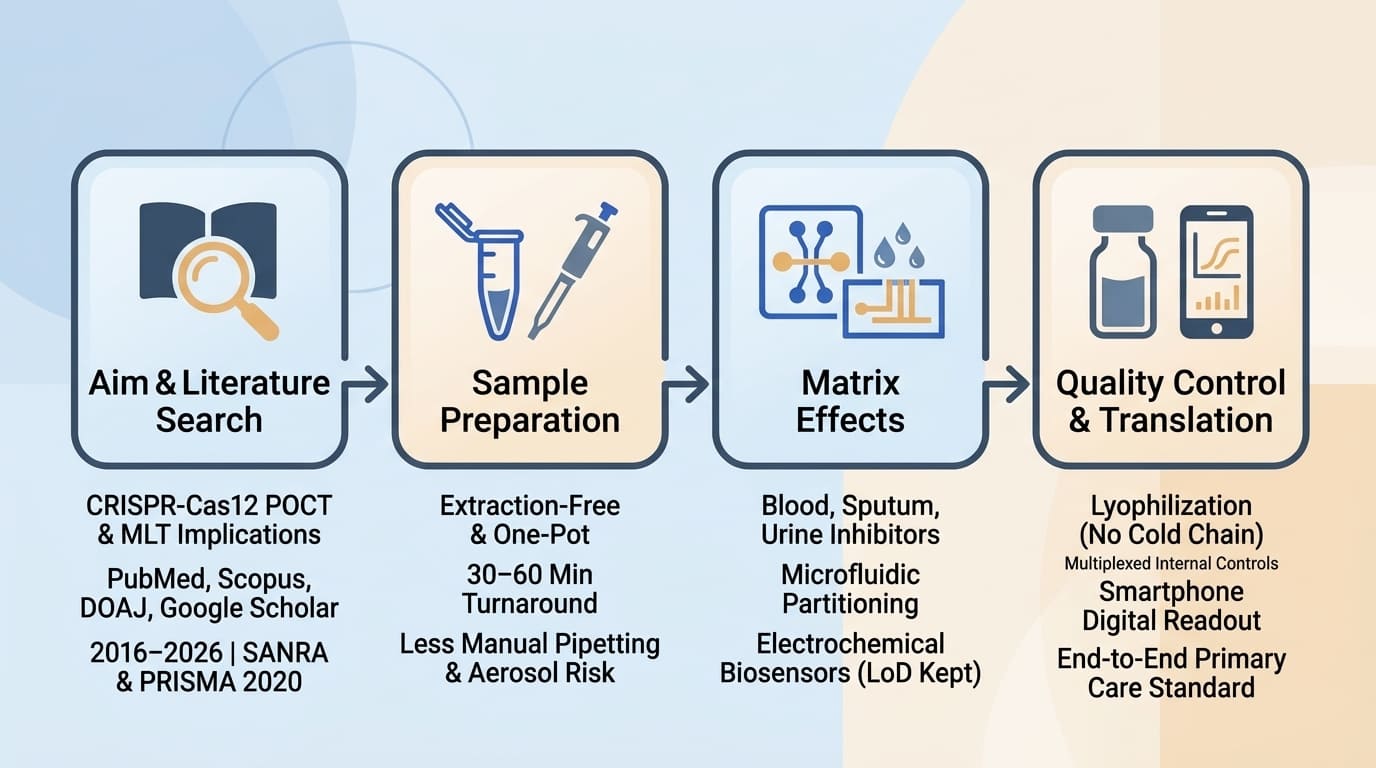
CRISPR-Cas12-based molecular diagnostics offer attomolar-level sensitivity and high specificity through trans-cleavage activity, presenting a potential, rapid, and affordable alternative for Point-of-Care Testing (POCT). However, operational challenges across the pre-analytical, analytical, and post-analytical phases continue to hinder the transition to routine clinical service. This narrative review aims to evaluate the challenges related to sample preparation, matrix effects, and quality control in CRISPR-Cas12 diagnostics while examining their implications for the practice of medical laboratory technology. A structured literature search was conducted across four major databases (PubMed, Scopus, DOAJ, and Google Scholar) for open-access publications from 2016–2026, following the SANRA guidelines and the PRISMA 2020 selection flow. The synthesis indicates that extraction-free and one-pot reaction protocols can reduce turnaround time to 30–60 minutes, alleviate the manual pipetting burden on medical laboratory technologists, and minimize the risk of aerosol contamination. Furthermore, interference from biological inhibitors in complex specimens—such as blood, sputum, and urine—can be mitigated by integrating microfluidic partitioning and electrochemical biosensors, without compromising the limit of detection. Testing reliability is further enhanced through the lyophilization of reagents (eliminating reliance on a cold chain), the inclusion of multiplexed internal controls, and the use of calibrated, smartphone-based digital readout systems. The successful clinical implementation of CRISPR-Cas12 diagnostics requires the standardization of a robust, end-to-end workflow suitable for primary healthcare facilities, rather than relying solely on superior analytical performance within a laboratory setting.
References
Aborode, A. T., Adesola, R. O., Scott, G. Y., Arthur-Hayford, E., Otorkpa, O. J., Kwaku, S. D., Elebesunu, E. E., Nibokun, E. O., Aruorivwooghene, I. J., Bakre, A. A., Ogundijo, O. A., Banwo, O. G., Ige, O., Adelakun, I. O., Onifade, I. A., Ogungbemi, S. E., Dosunmu, B. T., Ayando, O. D., Idowu, N., … Jimoh, O. O. (2025). Bringing lab to the field: Exploring innovations in point-of-care diagnostics for the rapid detection and management of tropical diseases in resource-limited settings. Advances in Biomarker Sciences and Technology, 7, 28–43. https://doi.org/10.1016/j.abst.2025.01.001
Ahamed, A., Politza, A. J., Liu, T., Asad, M., Khalid, U., Zhang, H., & Guan, W. (2025). CRISPR-based strategies for sample-to-answer monkeypox detection: Current status and emerging opportunities. Nanotechnology, 36. https://doi.org/10.1088/1361-6528/ad892b
Anderson, C. E., Huynh, T., Gasperino, D. J., Alonzo, L. F., Cantera, J. L., Harston, S. P., Hsieh, H. V., Marzan, R., McGuire, S. K., Williford, J. R., Oncina, C. I., Glukhova, V. A., Bishop, J. D., Cate, D. M., Grant, B. D., Nichols, K. P., & Weigl, B. H. (2022). Automated liquid handling robot for rapid lateral flow assay development. Analytical and Bioanalytical Chemistry, 414(8), 2607–2618. https://doi.org/10.1007/s00216-022-03897-9
Baethge, C., Goldbeck-wood, S., & Mertens, S. (2019). SANRA — a scale for the quality assessment of narrative review articles. Research Integrity and Peer Review, 8, 2–8.
Bogiel, T., Kwiecińska, P., Górniak, R., Kanarek, P., & Mikucka, A. (2024). The Use of Gel Electrophoresis to Separate Multiplex Polymerase Chain Reaction Amplicons Allows for the Easy Identification and Assessment of the Spread of Toxigenic Clostridioides difficile Strains. Gels, 10(12), 818. https://doi.org/10.3390/gels10120818
Cherie, N., Berta, D. M., Tamir, M., Yiheyis, Z., Angelo, A. A., Mekuanint Tarekegn, A., Chane, E., Nigus, M., & Teketelew, B. B. (2024). Improving laboratory turnaround times in clinical settings: A systematic review of the impact of lean methodology application. PLOS ONE, 19(10), e0312033. https://doi.org/10.1371/journal.pone.0312033
Christiansen, F., Konuk, E., Ganeshan, A. R., Welch, R., Palés Huix, J., Czekierdowski, A., Leone, F. P. G., Haak, L. A., Fruscio, R., Gaurilcikas, A., Franchi, D., Fischerova, D., Mor, E., Savelli, L., Pascual, M. À., Kudla, M. J., Guerriero, S., Buonomo, F., Liuba, K., … Epstein, E. (2025). International multicenter validation of AI-driven ultrasound detection of ovarian cancer. Nature Medicine, 31(1), 189–196. https://doi.org/10.1038/s41591-024-03329-4
Ghouneimy, A., Mahas, A., Marsic, T., Aman, R., & Mahfouz, M. (2023). CRISPR-Based Diagnostics: Challenges and Potential Solutions toward Point-of-Care Applications. ACS Synthetic Biology, 12(1), 1–16. https://doi.org/10.1021/acssynbio.2c00496
Guo, A., Bell, A. G., & Myhrvold, C. (2026). Towards deployable CRISPR-based nucleic acid detection RECEIVED. Prog. Biomed. Eng., 8. https://doi.org/10.1088/2516-1091/ae6e0b
Hang, Y., Boryczka, J., & Wu, N. (2022). Visible-light and near-infrared fluorescence and surface-enhanced Raman scattering point-of-care sensing and bio-imaging: A review. Chemical Society Reviews, 51(1), 329–375. https://doi.org/10.1039/C9CS00621D
Hensley, L. E., Klena, J. D., DeBoer, J. T., Montgomery, J. M., Mbala, P., Moses, M. E., Knapek, K. J., & Olinger, G. G. (2024). 9 Laboratory Needs for Research Response. In R. A. Sorenson (Ed.), Principles and Practice of Emergency Research Response (pp. 189–211). Springer International Publishing. https://doi.org/10.1007/978-3-031-48408-7_11
Hervás-Pérez, J. P., Izcara, S., & Sánchez-Paniagua, M. (2026). Magnetic Beads-Based Electrochemical Label-Free DNA-Bioassay for the Detection of Peanut Allergen Ara h2 in Food Matrices. Biosensors, 16(7), 387. https://doi.org/10.3390/bios16070387
Huang, Z., Lyon, C. J., Wang, J., Lu, S., & Hu, T. Y. (2023a). CRISPR Assays for Disease Diagnosis: Progress to and Barriers Remaining for Clinical Applications. Advanced Science, 10(20), 2301697. https://doi.org/10.1002/advs.202301697
Huang, Z., Lyon, C. J., Wang, J., Lu, S., & Hu, T. Y. (2023b). CRISPR Assays for Disease Diagnosis: Progress to and Barriers Remaining for Clinical Applications. Advanced Science, 2301697, 1–16. https://doi.org/10.1002/advs.202301697
Kemmer, A., Cai, L., Born, S., Cruz Bournazou, M. N., & Neubauer, P. (2024). Enzyme-Mediated Exponential Glucose Release: A Model-Based Strategy for Continuous Defined Fed-Batch in Small-Scale Cultivations. Bioengineering, 11(2), 107. https://doi.org/10.3390/bioengineering11020107
Khoshandam, M., Soltaninejad, H., Hosseinkhani, S., Saltanatpour, Z., Goudarzi, M. T. H., & Hamidieh, A. A. (2024). CRISPR/Cas and artificial intelligence to improve precision medicine: Future perspectives and potential limitations. Human Gene, 42, 201356. https://doi.org/10.1016/j.humgen.2024.201356
Khurshid, A., Akhtar, N., Mir, G., Chopra, C., Singh, R., Chan, J., & Sopanrao, U. (2024). CRISPR/Cas12a-based biosensors for environmental monitoring and diagnostics. Environmental Technology & Innovation, 34(April), 103625. https://doi.org/10.1016/j.eti.2024.103625
Lee, A. T., Ramasamy, R. K., & Subbarao, A. (2025). Understanding Psychosocial Barriers to Healthcare Technology Adoption: A Review of TAM Technology Acceptance Model and Unified Theory of Acceptance and Use of Technology and UTAUT Frameworks. Healthcare, 13(3), 250. https://doi.org/10.3390/healthcare13030250
Lee, M. (2023). Deep learning in CRISPR-Cas systems: A review of recent studies. Frontiers in Bioengineering and Biotechnology, 11, 1226182. https://doi.org/10.3389/fbioe.2023.1226182
Lee, S. M., Balakrishnan, H. K., Doeven, E. H., Yuan, D., & Guijt, R. M. (2023). Chemical Trends in Sample Preparation for Nucleic Acid Amplification Testing (NAAT): A Review. Biosensors, 13(11), 980. https://doi.org/10.3390/bios13110980
Li, J., Wu, S., Zhang, K., Sun, X., Lin, W., Wang, C., & Lin, S. (2024). Clustered Regularly Interspaced Short Palindromic Repeat/CRISPR-Associated Protein and Its Utility All at Sea: Status, Challenges, and Prospects. Microorganisms, 12(1), 118. https://doi.org/10.3390/microorganisms12010118
Li, Q., & Plebani, M. (2026). Metrological and Algorithmic Traceability of Machine Learning in Laboratory Medicine. Journal of Clinical Laboratory Analysis, 40(18), e70321. https://doi.org/10.1002/jcla.70321
Li, T., Yang, Y., Qi, H., Cui, W., Zhang, L., Fu, X., He, X., Liu, M., Li, P., & Yu, T. (2023). CRISPR/Cas9 therapeutics: Progress and prospects. Signal Transduction and Targeted Therapy, 8(1), 36. https://doi.org/10.1038/s41392-023-01309-7
Li, Z., Ding, X., Yin, K., Avery, L., Ballesteros, E., & Liu, C. (2020). Instrument-free, CRISPR-based diagnostics of SARS-CoV-2 using self-contained microfluidic system. Biosensors and Bioelectronics, (January).
Luo, Y., Pehrsson, M., Langholm, L., Karsdal, M., Bay-Jensen, A.-C., & Sun, S. (2023). Lot-to-Lot Variance in Immunoassays—Causes, Consequences, and Solutions. Diagnostics, 13(11), 1835. https://doi.org/10.3390/diagnostics13111835
Myke-Mbata, B. K., Basil, B., Mba, I. N., & Ugwu, A. O. (2026). Best practices in sample management & pre-analytical quality control: Overcoming challenges in resource-limited laboratory settings. Tropical Medicine and Health, 54(1), 131. https://doi.org/10.1186/s41182-026-01038-x
Page, M. J., McKenzie, J. E., Bossuyt, P. M., Boutron, I., Hoffmann, T. C., Mulrow, C. D., Shamseer, L., Tetzlaff, J. M., Akl, E. A., Brennan, S. E., Chou, R., Glanville, J., Grimshaw, J. M., Hróbjartsson, A., Lalu, M. M., Li, T., Loder, E. W., Mayo-Wilson, E., McDonald, S., … Moher, D. (2021). The PRISMA 2020 statement: An updated guideline for reporting systematic reviews. BMJ, n71. https://doi.org/10.1136/bmj.n71
Pan, Y., Xu, Q., Rossi, C. S., & Yang, Z. (2026). CRISPR‐Enabled Point‐of‐Care Diagnostics for Early Cancer Detection. Aggregate, 7(7), e70409. https://doi.org/10.1002/agt2.70409
Pan, Z., Xu, L., Fan, Z., Cao, Y., & Ren, F. (2026a). CRISPR-based diagnostics for infectious diseases: Mechanisms , advancements and clinical transformation prospects. Front. Cell. Infect. Microbiol., (February). https://doi.org/10.3389/fcimb.2026.1769226
Pan, Z., Xu, L., Fan, Z., Cao, Y., & Ren, F. (2026b). CRISPR-based diagnostics for infectious diseases: Mechanisms, advancements and clinical transformation prospects. Frontiers in Cellular and Infection Microbiology, 16, 1769226. https://doi.org/10.3389/fcimb.2026.1769226
Qiu, M., Zhou, X.-M., & Liu, L. (2022). Improved Strategies for CRISPR-Cas12-based Nucleic Acids Detection. Journal of Analysis and Testing, 6(1), 44–52. https://doi.org/10.1007/s41664-022-00212-4
Quintela, I. A., Vasse, T., Lin, C.-S., & Wu, V. C. H. (2022). Advances, applications, and limitations of portable and rapid detection technologies for routinely encountered foodborne pathogens. Frontiers in Microbiology, 13, 1054782. https://doi.org/10.3389/fmicb.2022.1054782
Shao, J., Sun, S., Liu, L., Li, J., Li, R., Dong, H., Wang, Y., Li, G., Dong, C., Yi, M., & Jin, Y. (2026). The impact of multicenter microbiology laboratory workflow optimization on antimicrobial susceptibility testing reporting time and outcomes of patients with bloodstream infection. Frontiers in Cellular and Infection Microbiology, 16, 1875923. https://doi.org/10.3389/fcimb.2026.1875923
Snyder, H. (2019). Literature review as a research methodology: An overview and guidelines. Journal of Business Research, 104(July), 333–339. https://doi.org/10.1016/j.jbusres.2019.07.039
Wang, Z., Wang, Q., Zhang, J., Li, B., Li, Y., Chen, Z., Guo, D., & Feng, S. (2025a). CRISPR-driven diagnostics: Molecular mechanisms, clinical efficacy and translational challenges. Clin. Transl. Med., 15:e70482.(February). https://doi.org/10.1002/ctm2.70482
Wang, Z., Wang, Q., Zhang, J., Li, B., Li, Y., Chen, Z., Guo, D., & Feng, S. (2025b). CRISPR‐driven diagnostics: Molecular mechanisms, clinical efficacy and translational challenges. Clinical and Translational Medicine, 15(10), e70482. https://doi.org/10.1002/ctm2.70482
Yuan, Y., He, N., Dong, L., Guo, Q., Zhang, X., Li, B., & Li, L. (2021). Multiscale Shellac-Based Delivery Systems: From Macro- to Nanoscale. ACS Nano, 15(12), 18794–18821. https://doi.org/10.1021/acsnano.1c07121
Zhao, L., Qiu, M., Li, X., Yang, J., Li, J., Mahas, A., Marsic, T., Masson, M. L.-P., Wang, Q., Aman, R., Zheng, C., Ali, Z., Alsanea, M., Al-Qahtani, A., Ghanem, B., Alhamlan, F., & Mahfouz, M. (2022). Characterization of a thermostable Cas13 enzyme for one-pot detection of SARS-CoV-2. Frontiers in Microbiology, Volume 13-2022(28), e2118260119. https://doi.org/10.1073/pnas.2118260119
Zhou, Z., Cho, I., & Kadam, U. S. (2025a). CRISPR-Cas-Based Diagnostics in Biomedicine: Principles , Applications , and Future Trajectories. Biosensors, 1–38.
Zhou, Z., Cho, I.-H., & Kadam, U. S. (2025b). CRISPR-Cas-Based Diagnostics in Biomedicine: Principles, Applications, and Future Trajectories. Biosensors, 15(10), 660. https://doi.org/10.3390/bios15100660
Downloads
Published
How to Cite
Issue
Section
License
Copyright (c) 2026 RADINKA JOURNAL OF HEALTH SCIENCE

This work is licensed under a Creative Commons Attribution 4.0 International License.
<meta name="google-site-verification" content="qBtkk8rnBm0ZRgy_14UYrahahLnkC844dKsDOFjzrn4" />