
Lexical Interference in Arabic Writing Proficiency: A Study of Tamil-Speaking Learners in Chennai
DOI:
https://doi.org/10.56778/rss.v1i2.717Keywords:
Language Education Research, Research Pedagogy FrameworkAbstract
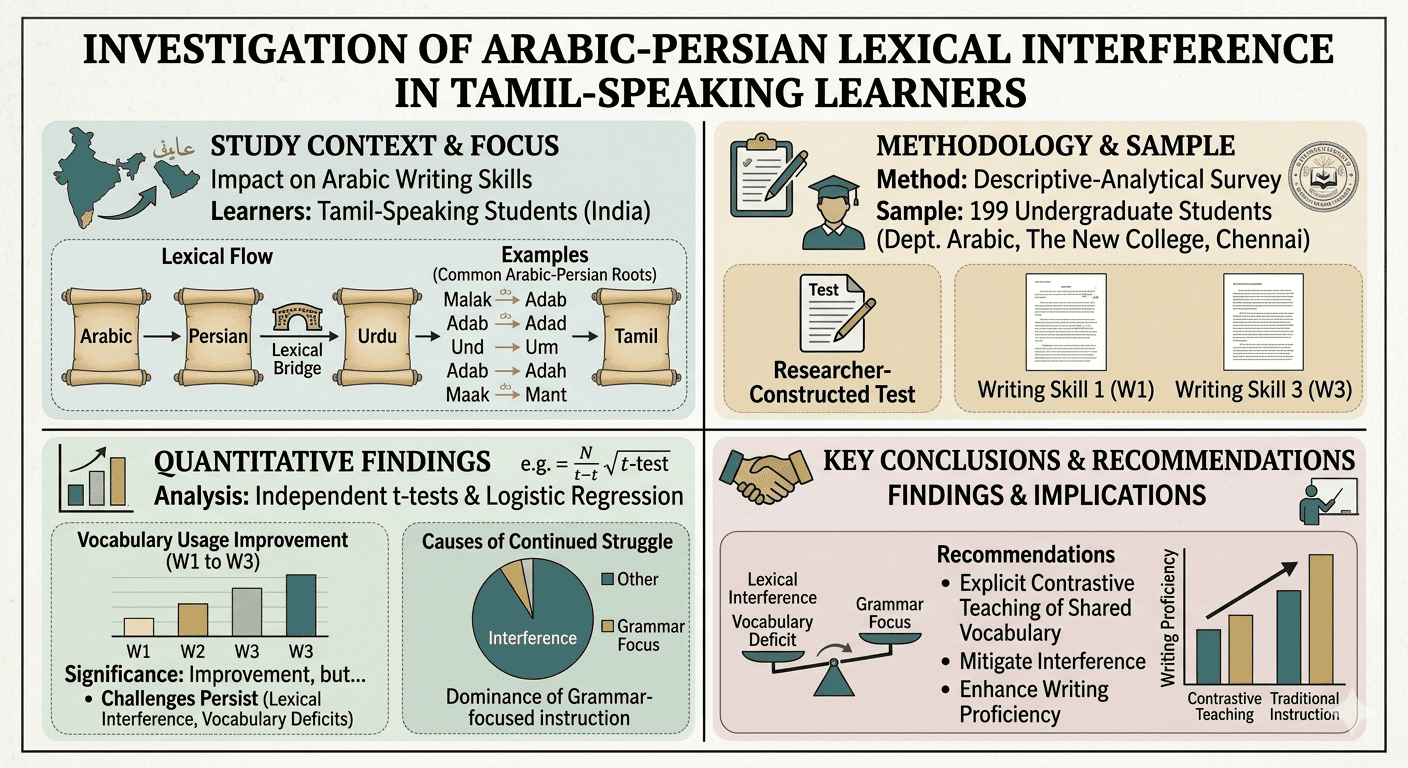
This study investigates the impact of vocabulary interference on the Arabic writing skills of Tamil-speaking learners in India, focusing on common Arabic-Persian vocabulary that also exists in Urdu and indirectly influences Tamil-speaking Arabic learners via historical lexical borrowing. Using a descriptive-analytical survey approach, a researcher-constructed test was administered to 199 undergraduates of Arabic Language and Literature at the Department of Arabic, The New College, Chennai, India. The test evaluated learners’ ability to use common Arabic-Persian vocabulary in Writing Skill 1 and Writing Skill 3 courses. Quantitative analysis using independent t-tests and logistic regression revealed that while students showed significant improvement in vocabulary usage from Writing 1 to Writing 3, they continued to struggle with semantic differentiation and the proper application of shared vocabulary due to lexical interference and vocabulary deficits. The dominance of grammar-focused instruction further exacerbated these challenges. The findings suggest that explicit contrastive teaching of shared vocabulary is essential for mitigating interference and enhancing writing proficiency.
References
Britwum, F. (2025). A cross-sectional study of subjective well-being, academic resilience, sense of coherence, student school connectedness, and academic achievement among college of education students in Ghana. Discover Education, 4(1), 562. https://doi.org/10.1007/s44217-025-00984-8
Charan, I. A., Chongjin, W., & Soomro, S. (2025). The relationship between academic stress, anxiety, and cognitive behavioral outcomes among young adults: The moderating role of prosocial behavior. Acta Psychologica, 258, 105234. https://doi.org/10.1016/j.actpsy.2025.105234
Chaudhry, S., Tandon, A., Shinde, S., & Bhattacharya, A. (2024). Student psychological well-being in higher education: The role of internal team environment, institutional, friends and family support and academic engagement. PLOS ONE, 19(1), e0297508. https://doi.org/10.1371/journal.pone.0297508
Chen, Y. (2026). L2 English interference in Chinese learners of L3 Portuguese: A corpus-based analysis of transfer-induced errors. Asian-Pacific Journal of Second and Foreign Language Education, 11(1), 17. https://doi.org/10.1186/s40862-025-00386-1
Dong, Y., Tang, Y., Chow, B. W.-Y., Wang, W., & Dong, W.-Y. (2020). Contribution of Vocabulary Knowledge to Reading Comprehension Among Chinese Students: A Meta-Analysis. Frontiers in Psychology, 11, 525369. https://doi.org/10.3389/fpsyg.2020.525369
Fernández‐Fontecha, A. (2026). Vocabulary Opens the Door; Creativity Guides the Search: Complementary Contributions to Second Language Semantic Fluency Across Domains. Language Learning, lang.70028. https://doi.org/10.1111/lang.70028
Flores, A. Z., Montag, J. L., & Willits, J. A. (2023). Using known words to learn more words: A distributional model of child vocabulary acquisition. Journal of Memory and Language, 132, 104446. https://doi.org/10.1016/j.jml.2023.104446
Ghafar, Z. N., Sozyar Raza Ali, & Hemn Mohammed Ali. (2025). The Impact of Using Youtube on Developing Kurdish EFL University Students’ Speaking Skills. Journal Of Digital Learning And Distance Education, 4(6), 1726–1739. https://doi.org/10.56778/jdlde.v4i6.601
Haque, Md. N., Abdul Jabar, M. A. B., & Abdullah, M. A. R. (2025). The impact of contextual lexis learning on vocabulary disambiguation in ESP students. Social Sciences & Humanities Open, 12, 102211. https://doi.org/10.1016/j.ssaho.2025.102211
Hoffman, P. (2018). An individual differences approach to semantic cognition: Divergent effects of age on representation, retrieval and selection. Scientific Reports, 8(1), 8145. https://doi.org/10.1038/s41598-018-26569-0
Huang, S., Hamdan, A. R. B., Hashim, A. T. B. M., & Zheng, M. (2024). Machine learning (ML) modelling techniques for mobile technology-integrated vocabulary learning on Chinese universities EFL students’ adoption. Journal of Autonomous Intelligence, 7(4). https://doi.org/10.32629/jai.v7i4.920
Liu, S., Zhang, Y., Zhou, S., Shen, X., & Sun, J. (2026). Mitigating orthographic interference: Exploring the combined effects of L2 interlexical similarities on vocabulary memory with big data. Journal of Memory and Language, 146, 104707. https://doi.org/10.1016/j.jml.2025.104707
Macedonia, M. (2025). Your Body as a Tool to Learn Second Language Vocabulary. Behavioral Sciences, 15(8), 997. https://doi.org/10.3390/bs15080997
Nakata, T., & Elgort, I. (2021). Effects of spacing on contextual vocabulary learning: Spacing facilitates the acquisition of explicit, but not tacit, vocabulary knowledge. Second Language Research, 37(2), 233–260. https://doi.org/10.1177/0267658320927764
Pedroso, J. E., Tubola, L. F. A., & Aquidado, E. J. (2023). Facebook Messenger: As Means of Communication for Academic Inquiries. Journal Of Digital Learning And Distance Education, 2(2), 491–505. https://doi.org/10.56778/jdlde.v2i2.116
Pérez-Serrano, M., Nogueroles-López, M., & Duñabeitia, J. A. (2022). Effects of semantic clustering and repetition on incidental vocabulary learning. Frontiers in Psychology, 13, 997951. https://doi.org/10.3389/fpsyg.2022.997951
Sukenik, N., & Tuller, L. (2023). Lexical Semantic Knowledge of Children with ASD—a Review Study. Review Journal of Autism and Developmental Disorders, 10(1), 130–143. https://doi.org/10.1007/s40489-021-00272-9
Tian, X., Griffith, A. E., Price, Z., Boyer, K. E., & Tang, K. (2025). Investigating Linguistic Alignment in Collaborative Dialogue: A Study of Syntactic and Lexical Patterns in Middle School Students. Language and Speech, 68(1), 63–86. https://doi.org/10.1177/00238309241234565
Zarrati, Z., Zohrabi, M., Abedini, H., & Xodabande, I. (2024). Learning academic vocabulary with digital flashcards: Comparing the outcomes from computers and smartphones. Social Sciences & Humanities Open, 9, 100900. https://doi.org/10.1016/j.ssaho.2024.100900
Zhang, D., & Koda, K. (2017). Assessing L2 vocabulary depth with word associates format tests: Issues, findings, and suggestions. Asian-Pacific Journal of Second and Foreign Language Education, 2(1), 1. https://doi.org/10.1186/s40862-017-0024-0
Downloads
Published
How to Cite
Issue
Section
License
Copyright (c) 2026 RADINKA IN SOCIAL SCIENCE

This work is licensed under a Creative Commons Attribution 4.0 International License.
<a rel="license" href="http://creativecommons.org/licenses/by/4.0/"><img alt="Creative Commons License" style="border-width:0" src="https://i.creativecommons.org/l/by/4.0/88x31.png" /></a><br />This work is licensed under a <a rel="license" href="http://creativecommons.org/licenses/by/4.0/">Creative Commons Attribution 4.0 International License</a>.


