
Revisiting the Framework of Higher Education: A Case Study of Universities in South–South Nigeria
DOI:
https://doi.org/10.56778/rjslr.v4i2.769Keywords:
Curriculum reform, Learning resources, Institutional policies, Academic performance, Higher education framework.Abstract
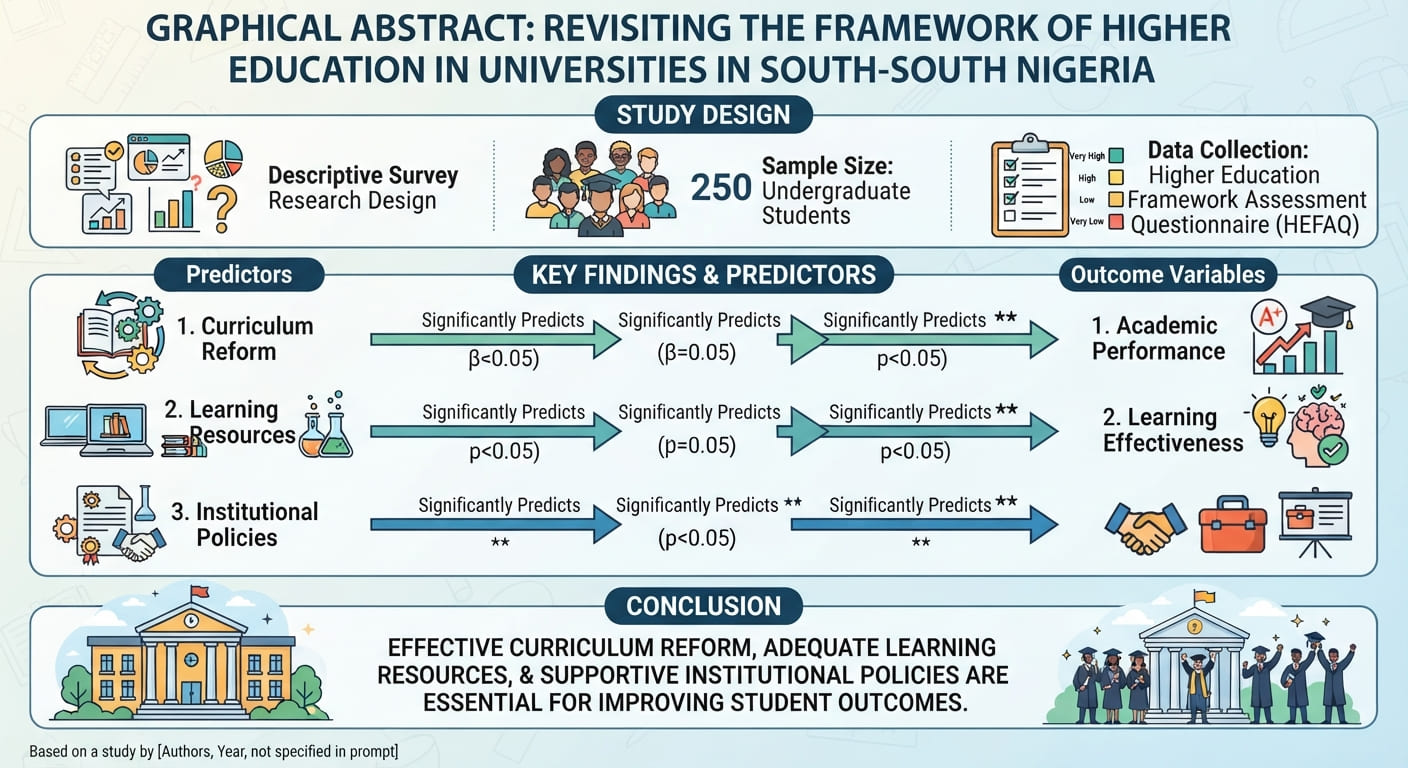
This study focused on Revisiting the Framework of Higher Education in Universities in South–South Nigeria. The study adopted a descriptive survey research design. Three hypotheses guided the study. The population comprised undergraduate students drawn from selected universities in South–South Nigeria, while a sample size of 250 students was used for the study. Data were collected using a structured questionnaire titled Higher Education Framework Assessment Questionnaire (HEFAQ) consisting of 25 items measured on a 4-point rating scale of Very High, High, Low, and Very Low. The instrument was validated by three experts comprising two lecturers in Social Science Education and one lecturer in Measurement and Evaluation from the University of Delta, Agbor. Reliability was established using the test–retest method with 20 undergraduate students of Anambra State University, yielding a reliability coefficient of 0.81. Data were analysed using simple regression analysis with the aid of the Statistical Package for Social Sciences (SPSS) at the 0.05 level of significance. Findings revealed that curriculum reform significantly predicts students’ academic performance, learning resources significantly predict students’ learning effectiveness, and institutional policies significantly predict students’ skill development in universities in South–South Nigeria. The study concluded that effective curriculum reform, adequate learning resources, and supportive institutional policies are essential for improving academic performance, enhancing learning effectiveness, and promoting skill development among university students.
References
Aldhafeeri, F. M., & Alotaibi, A. A. (2022). Effectiveness of digital education shifting model on high school students’ engagement. Education and Information Technologies, 27(5), 6869–6891. https://doi.org/10.1007/s10639-021-10879-4
Alyahyan, E., & Düştegör, D. (2020). Predicting academic success in higher education: Literature review and best practices. International Journal of Educational Technology in Higher Education, 17(1), 3. https://doi.org/10.1186/s41239-020-0177-7
Amaral, A. (2022). Equity in Higher Education: Evidences, Policies and Practices. Setting the Scene. In O. Tavares, C. Sá, C. Sin, & A. Amaral (Eds.), Equity Policies in Global Higher Education (pp. 23–46). Springer International Publishing. https://doi.org/10.1007/978-3-030-69691-7_2
Ashraf, M. A., Alam, J., & Kalim, U. (2025). Effects of ChatGPT on students’ academic performance in Pakistan higher education classrooms. Scientific Reports, 15(1), 16434. https://doi.org/10.1038/s41598-025-92625-1
Ayed Alshammari, A. (2025). The Governance of Higher Education and Its Role in Achieving Sustainable Development in the Arab World. In S. Mistretta (Ed.), Education and Human Development (Vol. 48). IntechOpen. https://doi.org/10.5772/intechopen.1011105
Bali, B., Garba, E. J., Ahmadu, A. S., Takwate, K. T., & Malgwi, Y. M. (2024). Analysis of emerging trends in artificial intelligence for education in Nigeria. Discover Artificial Intelligence, 4(1), 110. https://doi.org/10.1007/s44163-024-00163-y
Başgül, M., & Coştu, B. (2025). The effect of Education 4.0 tools on 7th grade students’ learning outcomes and attitudes in the electrical circuits unit. Education and Information Technologies, 30(11), 15645–15689. https://doi.org/10.1007/s10639-025-13404-z
Chaves-Yuste, B., & de-la-Peña, C. (2026). Evaluating the impact of digital resources on university students’ self-perception and academic performance in ESP learning. Asian-Pacific Journal of Second and Foreign Language Education, 11(1), 32. https://doi.org/10.1186/s40862-026-00404-w
Chen, C.-H., & Yang, Y.-C. (2019). Revisiting the effects of project-based learning on students’ academic achievement: A meta-analysis investigating moderators. Educational Research Review, 26, 71–81. https://doi.org/10.1016/j.edurev.2018.11.001
Chen, F.-Z., Chen, L.-A., Tseng, C.-C., Pai, C. H., Tsai, K.-E., Liang, E.-C., Chen, Y.-F., Chen, T.-L., Liu, S.-Y., Lee, P.-C., Lai, K.-C., Liu, B. R., Fouad, K. E., & Chen, C.-W. (2025). Enhancing student engagement and learning outcomes in life sciences: Implementing interactive learning environments and flipped classroom models. Discover Education, 4(1), 102. https://doi.org/10.1007/s44217-025-00501-x
Cui, Z., Song, Y., & Du, X. (2024). Multilevel modeling of technology use, student engagement, and fitness outcomes in physical education classes. Frontiers in Psychology, 15, 1458899. https://doi.org/10.3389/fpsyg.2024.1458899
Daher-Armache, G., Armache, J., & Ismail, H. N. (2025). Leadership development in U.S. Higher education: Strategies for lifelong learning and upskilling. Journal of Innovation & Knowledge, 10(4), 100754. https://doi.org/10.1016/j.jik.2025.100754
Dias-Oliveira, E., Pasion, R., Vieira Da Cunha, R., & Lima Coelho, S. (2024). The development of critical thinking, team working, and communication skills in a business school–A project-based learning approach. Thinking Skills and Creativity, 54, 101680. https://doi.org/10.1016/j.tsc.2024.101680
Dickson, S. M. (2024). Detection of Anomalies in Internet of Things (IoT) Devices and Sensors. Radinka Journal of Science and Systematic Literature Review, 2(3), 475–481. https://doi.org/10.56778/rjslr.v2i3.347
Didi Syahrir, Yeni Erita, Feby Kurniawan, & Vany Qhairum Nisa Utami. (2023). Improving IPS Learning Outcomes for Elementary School Students in Each Class Using the Problem Based Learning Model. Radinka Journal Of Science And Systematic Literature Review, 1(1), 14–22. https://doi.org/10.56778/rjslr.v1i1.87
Dolmaci, A., & Acar, F. E. (2025). Development of a twenty-first century skills curriculum through the flipped learning approach. Humanities and Social Sciences Communications, 12(1), 1666. https://doi.org/10.1057/s41599-025-05925-2
Du Plooy, E., Casteleijn, D., & Franzsen, D. (2024). Personalized adaptive learning in higher education: A scoping review of key characteristics and impact on academic performance and engagement. Heliyon, 10(21), e39630. https://doi.org/10.1016/j.heliyon.2024.e39630
Edvoll, M., Folstad, S. H., Eftedal, N. H., Poornikoo, M., Fang, Y., Ystrom, E., Nes, R. B., Røysamb, E., Bjørnebekk, G., Klomstén, A. T., & Nygaard, E. (2026). A Norwegian curriculum reform: Effects for 10th graders’ academic performance. Studies in Educational Evaluation, 89, 101616. https://doi.org/10.1016/j.stueduc.2026.101616
Eze, S. C., Chinedu-Eze, V. C. A., Okike, C. K., & Bello, A. O. (2020). Factors influencing the use of e-learning facilities by students in a private Higher Education Institution (HEI) in a developing economy. Humanities and Social Sciences Communications, 7(1), 133. https://doi.org/10.1057/s41599-020-00624-6
Falola, H. O., Adeniji, A. A., Adeyeye, J. O., Igbinnoba, E. E., & Atolagbe, T. O. (2020). Measuring institutional support strategies and faculty job effectiveness. Heliyon, 6(3), e03461. https://doi.org/10.1016/j.heliyon.2020.e03461
Fontalvo, H. R., Rico, F., De La Puente, M., Londoño, T., & Navarro, D. (2025). Digital task management platform enhances student academic achievement in economic development education. Discover Education, 4(1), 584. https://doi.org/10.1007/s44217-025-00993-7
Goode, E., Roche, T., Wilson, E., Naumann, F., Boyd, W., & McKenzie, J. W. (2026). Understanding student satisfaction during major curriculum reform: Implications from a transition to immersive block learning. Journal of Higher Education Policy and Management, 1–17. https://doi.org/10.1080/1360080X.2026.2723756
Guo, P., & Wang, Z. (2025). Implementation fidelity of universal design for learning and effects on student achievement engagement and belonging. Scientific Reports, 15(1), 45430. https://doi.org/10.1038/s41598-025-30079-1
Harvey, L. (2024). Extended Editorial: Defining quality thirty years on: quality, standards, assurance, culture and epistemology. Quality in Higher Education, 30(2), 145–184. https://doi.org/10.1080/13538322.2024.2355026
Herlinawati, H., Marwa, M., Ismail, N., Junaidi, Liza, L. O., & Situmorang, D. D. B. (2024). The integration of 21st century skills in the curriculum of education. Heliyon, 10(15), e35148. https://doi.org/10.1016/j.heliyon.2024.e35148
Jeilani, A., & Abubakar, S. (2025). Perceived institutional support and its effects on student perceptions of AI learning in higher education: The role of mediating perceived learning outcomes and moderating technology self-efficacy. Frontiers in Education, 10, 1548900. https://doi.org/10.3389/feduc.2025.1548900
Jiang, Y., Xie, L., & Cao, X. (2025). Exploring the Effectiveness of Institutional Policies and Regulations for Generative AI Usage in Higher Education. Higher Education Quarterly, 79(4), e70054. https://doi.org/10.1111/hequ.70054
Mukul, E., & Büyüközkan, G. (2023). Digital transformation in education: A systematic review of education 4.0. Technological Forecasting and Social Change, 194, 122664. https://doi.org/10.1016/j.techfore.2023.122664
Oise, G., Ejenarhome Otega Prosper, & Oyedotun Samuel Abiodun. (2025). Spatiotemporal Water Quality Modeling Using Deep Learning Architectures. Radinka Journal Of Science And Systematic Literature Review, 3(3), 761–770. https://doi.org/10.56778/rjslr.v3i3.519
Oise, G., Ejenarhome Otega Prospera, & Oyedotun Samuel Abiodun. (2025). Utilizing Deep Learning to Influence Design Decisions and Predict Future Scenarios. Radinka Journal Of Science And Systematic Literature Review, 3(3), 729–739. https://doi.org/10.56778/rjslr.v3i3.523
Oise, G., Oyedotun Samuel Abiodun, Onwuzo Chioma Julia, & Ejenarhome Otega Prosper. (2025). Intelligent Waste Management Systems: A Review of IoT, Deep Learning, and Optimization Techniques for Sustainable E-Waste and Solid Waste Handling. RADINKA JOURNAL OF SCIENCE AND SYSTEMATIC LITERATURE REVIEW, 3(2), 648–659. https://doi.org/10.56778/rjslr.v3i2.508
Panakaje, N., Ur Rahiman, H., Parvin, S. M. R., P, S., K, M., Yatheen, & Irfana, S. (2024). Revolutionizing pedagogy: Navigating the integration of technology in higher education for teacher learning and performance enhancement. Cogent Education, 11(1), 2308430. https://doi.org/10.1080/2331186X.2024.2308430
Riahi, I., Battikh, W., & Khanchel, H. (2025). Exploring the impact of smart learning technologies on student engagement, e-trust, and satisfaction in higher education institutions: The moderating role of ethical perceptions. Journal of New Approaches in Educational Research, 14(1), 21. https://doi.org/10.1007/s44322-025-00039-8
Saayir, P. T., Kwarteng, J. T., & Mensah, E. K. (2026). Competencies acquisition among potential accounting graduates: The influence of type of accounting education. Social Sciences & Humanities Open, 13, 102667. https://doi.org/10.1016/j.ssaho.2026.102667
Scott, T., Guan, W., Han, H., Zou, X., & Chen, Y. (2023). The Impact of Academic Optimism, Institutional Policy and Support, and Self-Efficacy on University Instructors’ Continuous Professional Development in Mainland China. Sage Open, 13(1), 21582440231153339. https://doi.org/10.1177/21582440231153339
Suryana, A., Dikdik, A., & Barlian, I. N. (2026). Digital leadership competencies of Indonesian university students in the fourth industrial revolution. Discover Education, 5(1), 699. https://doi.org/10.1007/s44217-026-01755-9
Udoinyang, Dr. N., Johnson Abor, Dr. I., & Daniel, Dr. R. (2026). Assessment of Students’ Safety and Environmental Activities for Teaching Milling Machine Maintenance in Technical Colleges. Radinka Journal Of Science And Systematic Literature Review, 4(1), 852–863. https://doi.org/10.56778/rjslr.v4i1.688
Ventista, O. M., & Brown, C. (2023). Teachers’ professional learning and its impact on students’ learning outcomes: Findings from a systematic review. Social Sciences & Humanities Open, 8(1), 100565. https://doi.org/10.1016/j.ssaho.2023.100565
Wilson, E., Roche, T., Goode, E., & McKenzie, J. W. (2025). Creating the conditions for student success through curriculum reform: The impact of an active learning, immersive block model. Higher Education, 89(5), 1423–1443. https://doi.org/10.1007/s10734-024-01283-1
Zou, Y., Kuek, F., Feng, W., & Cheng, X. (2025). Digital learning in the 21st century: Trends, challenges, and innovations in technology integration. Frontiers in Education, 10, 1562391. https://doi.org/10.3389/feduc.2025.1562391
Downloads
Published
How to Cite
Issue
Section
License
Copyright (c) 2026 RADINKA JOURNAL OF SCIENCE AND SYSTEMATIC LITERATURE REVIEW

This work is licensed under a Creative Commons Attribution 4.0 International License.
<a rel="license" href="http://creativecommons.org/licenses/by/4.0/"><img alt="Creative Commons License" style="border-width:0" src="https://i.creativecommons.org/l/by/4.0/88x31.png" /></a><br />This work is licensed under a <a rel="license" href="http://creativecommons.org/licenses/by/4.0/">Creative Commons Attribution 4.0 International License</a>.


