
Moral Education as a Tool for Curbing Migration Challenges and Fostering Sustainable Development in Nigeria
DOI:
https://doi.org/10.56778/rjslr.v4i2.768Keywords:
Moral education, Irregular migration, Sustainable development, Brain drain, NigeriaAbstract
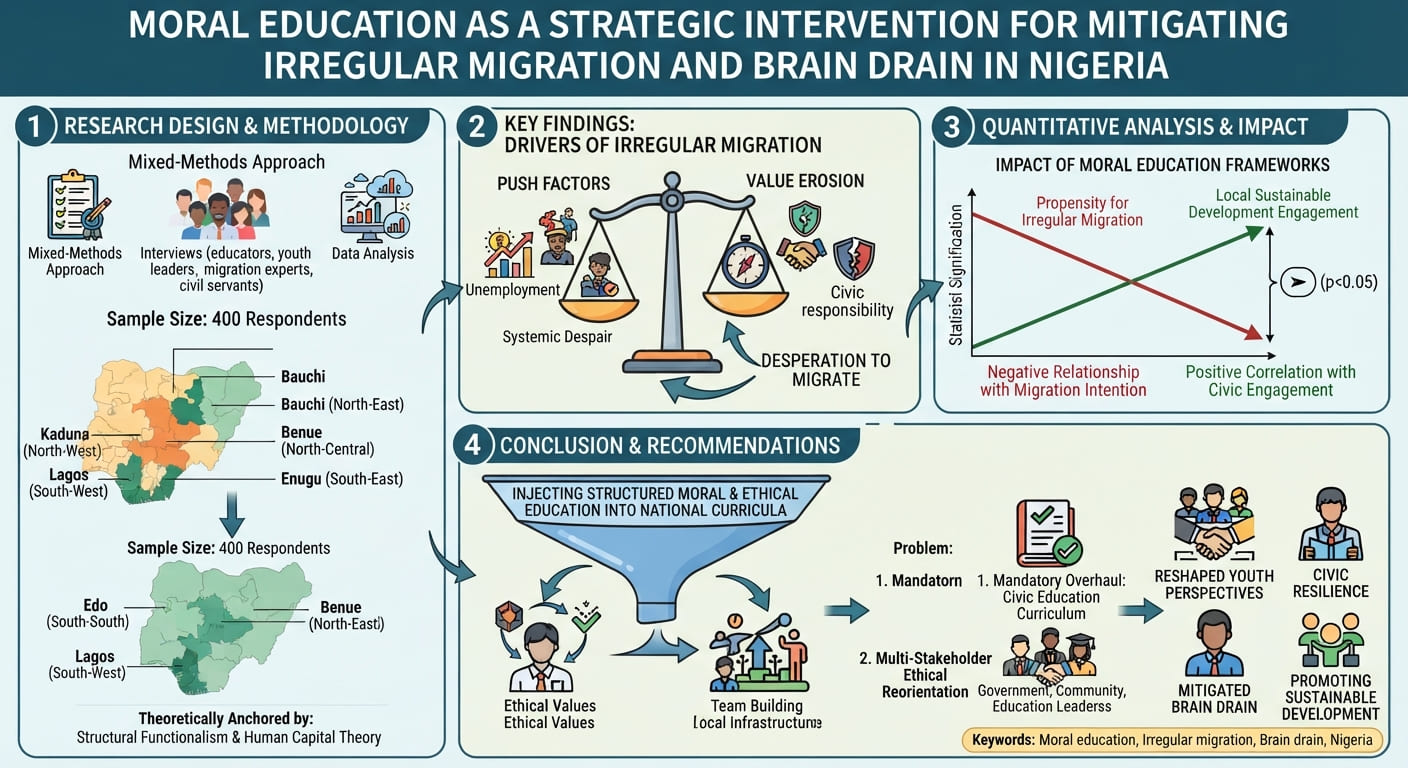
This study examines the function of moral education as a strategic intervention to mitigate irregular migration and brain drain while promoting sustainable development in Nigeria. Using a mixed-methods research design, data were collected from 400 respondents across six geopolitical zones (Edo [South-South], Enugu [South-East], Lagos [South-West], Bauchi [North-East], Benue [North-Central] and Kaduna [North-West]), comprising educators, youth leaders, migration experts, and civil servants. Quantitative data were analysed using descriptive statistics and multiple linear regression, while qualitative data underwent thematic analysis. The theoretical anchoring was based on structural functionalism and human capital theory. Findings reveal that while economic push factors remain potent, a significant erosion of civic values, ethical responsibility, and patriotism exacerbates the desperation to migrate illegally. The regression analysis demonstrated a statistically significant negative relationship between robust moral/civic education frameworks and the propensity for irregular migration, alongside a positive correlation with youth engagement in local sustainable development initiatives. Thematic analysis highlighted institutional corruption, lack of value-orientation, and systemic despair as core drivers. The study concludes that injecting structured moral and ethical education into national curricula can reshape youth perspectives, build civic resilience, and mitigate migration challenges. Specific recommendations include a mandatory overhaul of the civic education curriculum and multi-stakeholder ethical reorientation campaigns.
References
Adetula, V. (2026). Essay 27: From Intra-Africa Functionalism to Continental Federalism: Theorising Regionalism and Regional Cooperation in Africa. In A. Acharya, P. De Lombaerde, B. Futák-Campbell, L. C. Iroulo, & J. Peixoto Batista (Eds.), Essays on Global Regionalism I (Vol. 30, pp. 275–283). Springer Nature Switzerland. https://doi.org/10.1007/978-3-032-13642-8_27
Alizadeh, H., Sharifi, A., & Najafi, H. (2026). Reframing urban sustainability: Toward people-centric development through humanistic and social values. Peace and Sustainability, 2(1), 100044. https://doi.org/10.1016/j.nerpsj.2026.100044
Banda, L. O. L., Banda, C. V., Banda, J. T., & Singini, T. (2024). Preserving cultural heritage: A community-centric approach to safeguarding the Khulubvi Traditional Temple Malawi. Heliyon, 10(18), e37610. https://doi.org/10.1016/j.heliyon.2024.e37610
Bekele, M., Sassi, M., Jemal, K., & Ahmed, B. (2024). Human capital development and economic sustainability linkage in Sub-Saharan African countries: Novel evidence from augmented mean group approach. Heliyon, 10(2), e24323. https://doi.org/10.1016/j.heliyon.2024.e24323
Ceesay, A., & Asmorowati, S. (2026). Beyond the Peace Agreement: Institutional Weakness and Governance Challenges in Post-Conflict South Sudan. Journal of Asian and African Studies, 61(4), 3406–3423. https://doi.org/10.1177/00219096251376658
Cerchione, R., Morelli, M., Passaro, R., & Quinto, I. (2025). Balancing sustainability and circular justice: The challenge of the energy transition. Journal of Cleaner Production, 494, 144942. https://doi.org/10.1016/j.jclepro.2025.144942
Clark-Kazak, C. (2021). Ethics in Forced Migration Research: Taking Stock and Potential Ways Forward. Journal on Migration and Human Security, 9(3), 125–138. https://doi.org/10.1177/23315024211034401
Cruz-Sánchez, O., Cruz-Cázares, C., & Hernandez-Vivanco, A. (2026). Business model innovation from dynamic capabilities perspective: A systematic literature review. Journal of Business Research, 204, 115835. https://doi.org/10.1016/j.jbusres.2025.115835
Darling-Hammond, L., Flook, L., Cook-Harvey, C., Barron, B., & Osher, D. (2020). Implications for educational practice of the science of learning and development. Applied Developmental Science, 24(2), 97–140. https://doi.org/10.1080/10888691.2018.1537791
De Haas, H. (2021). A theory of migration: The aspirations-capabilities framework. Comparative Migration Studies, 9(1), 8. https://doi.org/10.1186/s40878-020-00210-4
Deng, Z., Chapman, A., & Gericke, N. (2025). Powerful knowledge, school subjects and the curriculum: An international and comparative perspective. Journal of Curriculum Studies, 57(4), 365–381. https://doi.org/10.1080/00220272.2025.2528744
Didi Syahrir, Yeni Erita, Feby Kurniawan, & Vany Qhairum Nisa Utami. (2023). Improving IPS Learning Outcomes for Elementary School Students in Each Class Using the Problem Based Learning Model. Radinka Journal Of Science And Systematic Literature Review, 1(1), 14–22. https://doi.org/10.56778/rjslr.v1i1.87
Duarte, J., & Robinson-Jones, C. (2024). Bridging theory and practice: Conceptualisations of global citizenship education in Dutch secondary education. Globalisation, Societies and Education, 22(2), 315–331. https://doi.org/10.1080/14767724.2022.2048800
Dwivedi, Y. K., Ismagilova, E., Hughes, D. L., Carlson, J., Filieri, R., Jacobson, J., Jain, V., Karjaluoto, H., Kefi, H., Krishen, A. S., Kumar, V., Rahman, M. M., Raman, R., Rauschnabel, P. A., Rowley, J., Salo, J., Tran, G. A., & Wang, Y. (2021). Setting the future of digital and social media marketing research: Perspectives and research propositions. International Journal of Information Management, 59, 102168. https://doi.org/10.1016/j.ijinfomgt.2020.102168
Evans, G. (2022). Back to the future? Reflections on three phases of education policy reform in Wales and their implications for teachers. Journal of Educational Change, 23(3), 371–396. https://doi.org/10.1007/s10833-021-09422-6
Fernández-Sánchez, H., James, J., Zahoui, Z., Ging, L., Vásquez-Ventura, I., Stockton, J., & Santa Maria, D. (2025). Labor trafficking among migrant populations: A scoping review and qualitative interview study with stakeholders. Frontiers in Human Dynamics, 7, 1620713. https://doi.org/10.3389/fhumd.2025.1620713
Haller, T., Acciaioli, G., & Rist, S. (2016). Constitutionality: Conditions for Crafting Local Ownership of Institution-Building Processes. Society & Natural Resources, 29(1), 68–87. https://doi.org/10.1080/08941920.2015.1041661
Hamann, S. (2026). Foreign Aid at a Crossroads: How Funding Cuts Reshape Global Development Cooperation. Global Policy, 17(1), 122–133. https://doi.org/10.1111/1758-5899.70116
Huang, F., Tang, J., Zhao, P., Chen, Z., Li, J., & Lyu, W. (2025). Human mobility under disasters: A systematic review and framework for equitable and resilient mobility governance. Npj Natural Hazards, 2(1), 99. https://doi.org/10.1038/s44304-025-00153-9
Iddrisu, I. (2025). Understanding the nexus between organizational culture and trust: The mediating roles of communication, leadership, and employee relationships. Sustainable Futures, 9, 100555. https://doi.org/10.1016/j.sftr.2025.100555
Kukić, L. (2023). The last Yugoslavs: Ethnic diversity and national identity. Explorations in Economic History, 88, 101504. https://doi.org/10.1016/j.eeh.2022.101504
Lesková, A., & Yochanna, M. (2024). Values and Education for Values of Today’s Youth. Journal of Education Culture and Society, 15(2), 35–42. https://doi.org/10.15503/jecs2024.2.19.33
Lim, W. M., & Homer, S. T. (2026). Do the young truly embrace sustainability? Evidence of the (un)willingness paradox of sustainability and implications for responsible management education and research. The International Journal of Management Education, 24(1), 101281. https://doi.org/10.1016/j.ijme.2025.101281
Long, L. W., Rabab, B., & Jamil, M. N. (2025). Government spending, political dynamics, and economic recovery: A cross-national analysis of fiscal resilience. Research in Globalization, 11, 100297. https://doi.org/10.1016/j.resglo.2025.100297
Massi, J. W., Anangisye, W. A. L., & Sarakikya, A. M. (2026). Examining the alignment of vocational education curricula with labour market demands for youth employability in Tanzania: Bridging the skills gap. Cogent Education, 13(1), 2626623. https://doi.org/10.1080/2331186X.2026.2626623
Meland, E. A., & Brion-Meisels, G. (2024). An integrative model for culturally sustaining SEL in the classroom. Social and Emotional Learning: Research, Practice, and Policy, 3, 100042. https://doi.org/10.1016/j.sel.2024.100042
Naseer, M. M., Hunjra, A. I., Palma, A., & Bagh, T. (2025). Sustainable development goals and environmental performance: Exploring the contribution of governance, energy, and growth. Research in International Business and Finance, 73, 102646. https://doi.org/10.1016/j.ribaf.2024.102646
Nguyen, T. H.-T., Zakarneh, M., McDonald, M., & Amankwah-Amoah, J. (2025). Reconceptualizing ethical leadership for the global south: An institutional logics perspective. The Leadership Quarterly, 36(5), 101897. https://doi.org/10.1016/j.leaqua.2025.101897
O’Sullivan, M., & Bjørndal, C. T. (2024). Reconceptualising Constructive Alignment within the epistemological distinction of ways of knowing in a higher education coach development course module. Physical Education and Sport Pedagogy, 1–17. https://doi.org/10.1080/17408989.2024.2439969
Peters, A.-K., Edling, S., & Francia, G. (2026). Conceptions of social sustainability in the context of education: A systematic literature review. Sustainability Science, 21(4), 1935–1951. https://doi.org/10.1007/s11625-026-01842-8
Rastegar, R. (2026). Justice and vulnerability in the face of global crises: Launching the annals of tourism research collection on justice in tourism. Annals of Tourism Research, 118, 104132. https://doi.org/10.1016/j.annals.2026.104132
Robinson, S., Keats, J., Bracken, C., Ekstrom, M., Lin, A., McCauley-Pearl, A., & Supple, M. (2026). Reimagining the Sustainable Development Goals: Centering Nature’s rights for a more-than-human future. Sustainability Science, 21(3), 1275–1293. https://doi.org/10.1007/s11625-026-01802-2
Sedovs, E., Volkova, T., & Ludviga, I. (2025). Sustainable development and strategic management—What is on the horizon in our non-ergodic world research? Sustainable Futures, 9, 100414. https://doi.org/10.1016/j.sftr.2024.100414
Sen, K. (2023). International organizations and human rights education curriculum reform. Human Rights Education Review, 6(1), 52–71. https://doi.org/10.7577/hrer.5098
Suplaag, M. C., Ashley Custodio, Jya Nicole Sapong Agbayani, Ailee Corbita Auman, & Danyl Amir Enterina Coliflores. (2026). Teachers’ Perception of Positive Discipline Intervention Support as Predictor of Effective Classroom Management. Radinka Journal Of Science And Systematic Literature Review, 4(2). https://doi.org/10.56778/rjslr.v4i2.694
Tesfaw, M., Tadesse, T., Daka, K., & Abebe, A. (2026). The Lived Experiences of Young People With Disabilities in Accessing Sexual and Reproductive Health Services in Ethiopia: An Interpretative Phenomenological Analysis. INQUIRY: The Journal of Health Care Organization, Provision, and Financing, 63, 00469580261466532. https://doi.org/10.1177/00469580261466532
Udoinyang, Dr. N., Johnson Abor, Dr. I., & Daniel, Dr. R. (2026). Assessment of Students’ Safety and Environmental Activities for Teaching Milling Machine Maintenance in Technical Colleges. Radinka Journal Of Science And Systematic Literature Review, 4(1), 852–863. https://doi.org/10.56778/rjslr.v4i1.688
Udoinyang, N. (2025). Accessing National Demand-Side Climate Change Mitigation Plan and Socio-Economic Impact in Nigeria. Radinka Journal Of Science And Systematic Literature Review, 3(2), 701–709. https://doi.org/10.56778/rjslr.v3i2.563
Wang, Z., Hanley, N., Kwak, J., Vari-Lavoisier, I., Al Hussein, M., Tyson, L. S., Akkad, A., & Chankseliani, M. (2024). How do international student returnees contribute to the development of their home countries? A systematic mapping and thematic synthesis. International Journal of Educational Research, 125, 102330. https://doi.org/10.1016/j.ijer.2024.102330
Weiss, J. (2024). Disengaged or raising voices? An analysis of the relationship between individual risk perception and non-institutionalised political participation. Acta Politica, 59(2), 439–457. https://doi.org/10.1057/s41269-023-00301-x
Downloads
Published
How to Cite
Issue
Section
License
Copyright (c) 2026 RADINKA JOURNAL OF SCIENCE AND SYSTEMATIC LITERATURE REVIEW

This work is licensed under a Creative Commons Attribution 4.0 International License.
<a rel="license" href="http://creativecommons.org/licenses/by/4.0/"><img alt="Creative Commons License" style="border-width:0" src="https://i.creativecommons.org/l/by/4.0/88x31.png" /></a><br />This work is licensed under a <a rel="license" href="http://creativecommons.org/licenses/by/4.0/">Creative Commons Attribution 4.0 International License</a>.


