
Infidelity, Emotional Abuse, and Domestic Violence as Predictors of Marital Dissolution Among Married Couples in Delta North Senatorial District, Delta State, Nigeria.
DOI:
https://doi.org/10.56778/rjslr.v4i2.750Keywords:
Domestic violence, emotional abuse, marital dissolution, married couples.Abstract
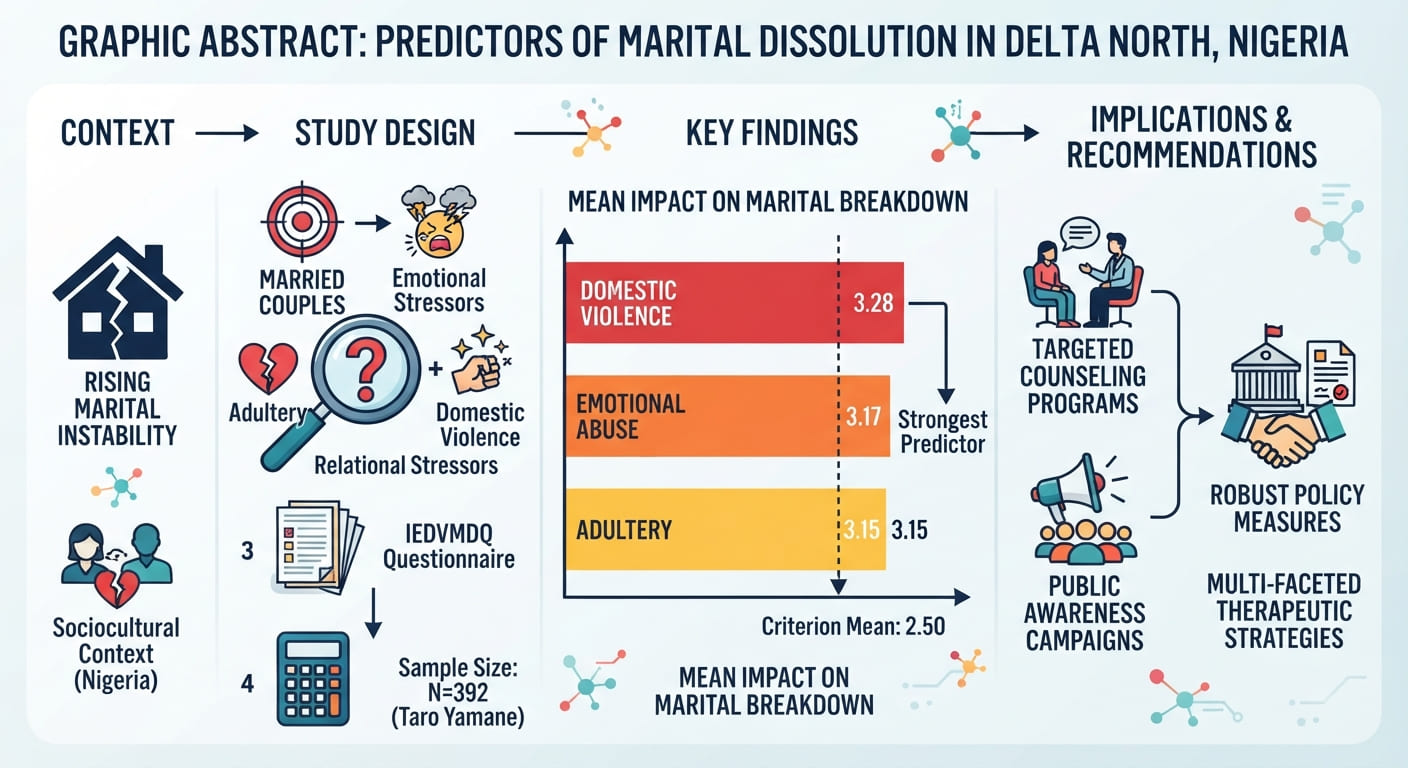
This study investigated adultery, emotional abuse, and domestic violence as key predictors of divorce, driven by the rising prevalence of marital instability and the need to comprehend the combined impact of relational stressors within the Nigerian sociocultural context. Utilizing a quantitative descriptive survey design, the population comprised married men and women in the study area, with a sample size of 392 respondents determined using the Taro Yamane formula via a multi-stage sampling technique. Data were gathered using a validated instrument entitled the Infidelity, Emotional Abuse, Domestic Violence, and Marital Dissolution Questionnaire (IEDVMDQ), which demonstrated high internal consistency with a Cronbach’s alpha coefficient greater than 0.70. Data were analyzed using IBM SPSS Statistics for descriptive statistics (mean and standard deviation) and inferential statistics at a significance level of 0.05. The results revealed that all variables exceeded the criterion mean of, indicating that infidelity (aggregate mean = ), emotional abuse (aggregate mean = ), and domestic violence (aggregate mean = ) significantly impact marital breakdown. Domestic violence emerged as the strongest predictor, followed by emotional abuse and adultery, while the combined effect of these factors substantially predicted marital dissolution among married couples. These findings underscore the multifaceted nature of marital instability and the critical need for coordinated therapeutic strategies. The study concludes that adultery, emotional abuse, and domestic violence are deeply intertwined factors driving marriage breakup in the Delta North Senatorial District, thereby recommending the implementation of targeted counseling programs, public awareness campaigns, and robust policy measures.
References
Abusbaitan, H. A., Eyadat, A. M., Holt, J. M., Telfah, R. K., Zahra, T. F. A., Zahra, T. F. A., Mobarki, A. A., Mkandawire-Valhmu, L., Kako, P. M., Gondwe, K. W., & Lopez, A. A. (2025). Emotional Abuse Against Women in the Context of Intimate Relationships: A Concept Analysis. Nursing Forum, 2025(1), 6301140. https://doi.org/10.1155/nuf/6301140
Ahmed, R. (2024). The Cyber Harassment in the Digital Age: Trends, Challenges, and Countermeasures. Radinka Journal Of Science And Systematic Literature Review, 2(3), 442–450. https://doi.org/10.56778/rjslr.v2i3.310
Alsawalqa, R. O., Sa’deh, Y. A. R., & Alrawashdeh, M. N. (2021). Jordanian Men’s Experience of Emotional Abuse in Marital Relationships: The Role of Marriage Length and Motivation. Frontiers in Psychology, 12, 689235. https://doi.org/10.3389/fpsyg.2021.689235
Ani, J. I., & Katende-Kyenda, L. N. (2025). Predictors of intimate partner violence and associated marital disruption among ever-married women in sub-Saharan Africa: A multi-country analysis for policy and intervention priorities. Frontiers in Sociology, 10, 1658603. https://doi.org/10.3389/fsoc.2025.1658603
Atta, G., Newton, P., & Shah, T. (2025). Insights into Intimate Partner Violence: Exploring Predictive Factors in Ghana Multiple Indicator Cluster Surveys 2018. Societies, 15(4), 100. https://doi.org/10.3390/soc15040100
Aydin, S., Sahin, A., & Bahadir, M. (2025). Gray Divorce in the Shadow of Modernization: Changing Family Dynamics in Türkiye. Social Sciences, 14(10), 615. https://doi.org/10.3390/socsci14100615
Bergvall, S. (2024). Women’s economic empowerment and intimate partner violence. Journal of Public Economics, 239, 105211. https://doi.org/10.1016/j.jpubeco.2024.105211
Bhardwaj, S., Ali, A., & Paul, F. A. (2026). From use to abuse: Psychological, neurobiological, and spiritual pathways in relational harm and recovery. Frontiers in Behavioral Neuroscience, 20, 1805594. https://doi.org/10.3389/fnbeh.2026.1805594
Bouroncle Velásquez, M., Gallegos, A., Flores Goycochea, C., Valencia, J., & Rodríguez-Correa, P. A. (2025). Trends in research on risk factors in domestic violence. Social Sciences & Humanities Open, 12, 102062. https://doi.org/10.1016/j.ssaho.2025.102062
Choi, H., Schoeni, R. F., Wiemers, E. E., Hotz, V. J., & Seltzer, J. A. (2020). Spatial Distance Between Parents and Adult Children in the United States. Journal of Marriage and Family, 82(2), 822–840. https://doi.org/10.1111/jomf.12606
Chonody, J. M., & Gabb, J. (2019). Understanding the Role of Relationship Maintenance in Enduring Couple Partnerships in Later Adulthood. Marriage & Family Review, 55(3), 216–238. https://doi.org/10.1080/01494929.2018.1458010
Donat Bacıoğlu, S., Kantar, A., & Gurbuz-Akcay, F. (2026). Exploring the role of psychological needs in dating victimization and relationship satisfaction: A mediation analysis among Turkish young couples grounded in self-determination theory. BMC Psychology, 14(1), 319. https://doi.org/10.1186/s40359-026-03988-7
Eisma, M. C., Tõnus, D., & De Jong, P. J. (2022). Desired attachment and breakup distress relate to automatic approach of the ex-partner. Journal of Behavior Therapy and Experimental Psychiatry, 75, 101713. https://doi.org/10.1016/j.jbtep.2021.101713
García Del Castillo-López, Á., Berenguer-Soler, M., Pineda, D., & A. García Del Castillo, J. (2024). Emotional Flooding in Couple Relationships: Psychosocial Aspects and Regulatory Strategies. In M. Ibrahim (Ed.), Emotional Regulation—Theory and Application Across Clinical Settings. IntechOpen. https://doi.org/10.5772/intechopen.1006183
Guo, C., Ko, J., Chen, X., & Leung, C. K. (2026). When the Economy Breaks Down, Do Marriages Follow? Crisis Type and Family Dissolution across 83 Countries (1990–2019). Applied Research in Quality of Life, 21(2), 615–641. https://doi.org/10.1007/s11482-025-10540-z
Hauer, M., & Byars, J. (2019). IRS county-to-county migration data, 1990‒2010. Demographic Research, 40, 1153–1166. https://doi.org/10.4054/DemRes.2019.40.40
King, V., Pragg, B., & Lindstrom, R. (2020). Family Relationships During Adolescence and Stepchilden’s Educational Attainment in Young Adulthood. Journal of Marriage and Family, 82(2), 622–638. https://doi.org/10.1111/jomf.12642
Kyegombe, N., Stern, E., & Buller, A. M. (2022). “We saw that jealousy can also bring violence”: A qualitative exploration of the intersections between jealousy, infidelity and intimate partner violence in Rwanda and Uganda. Social Science & Medicine, 292, 114593. https://doi.org/10.1016/j.socscimed.2021.114593
Li, X., Yu, R., Ding, Y., He, Q., Sun, Y., Zhang, C., & Chen, N. (2026). Gaslighting in parent-child relationships: Psychometric validation and longitudinal associations with depressive symptoms in Chinese samples. Child Abuse & Neglect, 176, 108038. https://doi.org/10.1016/j.chiabu.2026.108038
Liu, Y. K., Bradford, B., & Ristea, A. (2026). Sociocultural Influences on Attitudes and Behaviors Related to Domestic and Intimate Partner Violence: A Qualitative Study Across British and Chinese Contexts. Journal of Family Violence. https://doi.org/10.1007/s10896-026-01056-7
Lortkipanidze, M., Javakhishvili, N., & Schwartz, S. J. (2025). Mental health of intimate partner violence victims: Depression, anxiety, and life satisfaction. Frontiers in Psychology, 16, 1531783. https://doi.org/10.3389/fpsyg.2025.1531783
Mabunda, A., Mokgatle, M. M., & Madiba, S. (2025). Being Trapped in an Abusive Relationship: A Phenomenological Study of Women’s Experiences of Violence in Intimate Relationships. Social Sciences, 14(4), 250. https://doi.org/10.3390/socsci14040250
Malik, M., Munir, N., Ghani, U., & Ahmad, N. (2020). Domestic violence and its relationship with depression, anxiety and quality of life: A hidden dilemma of Pakistani women. Pakistan Journal of Medical Sciences, 37(1). https://doi.org/10.12669/pjms.37.1.2893
Mathews, B., & Dube, S. (2025). Childhood emotional abuse is becoming a public health priority: Evidentiary support for a paradigm change. Child Protection and Practice, 4, 100093. https://doi.org/10.1016/j.chipro.2024.100093
McCormack, M. (2025). Endless litigation in family court as a method of post-separation coercive control. Journal of Social Welfare and Family Law, 47(2–3), 183–212. https://doi.org/10.1080/09649069.2025.2530882
Nguyen, M., & Le, K. (2022). Can Legislation Reduce Domestic Violence in Developing Countries? Sustainability, 14(20), 13300. https://doi.org/10.3390/su142013300
Roman, N. V., Balogun, T. V., Butler-Kruger, L., Danga, S. D., Therese De Lange, J., Human-Hendricks, A., Thelma Khaile, F., October, K. R., & Olabiyi, O. J. (2025). Strengthening Family Bonds: A Systematic Review of Factors and Interventions That Enhance Family Cohesion. Social Sciences, 14(6), 371. https://doi.org/10.3390/socsci14060371
Rost, K., Gossmann, E., Fegert, J. M., Ziegenhain, U., & Köhler-Dauner, F. (2024). Long-term consequences of childhood emotional abuse in mothers on parental load and child mental health. Acta Psychologica, 244, 104169. https://doi.org/10.1016/j.actpsy.2024.104169
Rostami, F., Fathi, E., Hatami Varzaneh, A., & Daneshpour, M. (2021). Factors Impacting Why Women Stay in Marital Life with Substance dependent Husbands: A Grounded Theory Study. Journal of Community Health Research. https://doi.org/10.18502/jchr.v10i3.7276
Sadeghian, E., Ghasemi, S. A., & Maddineshat, M. (2025). Exploring marriage beliefs from the perspectives of married students. Frontiers in Psychology, 16, 1481905. https://doi.org/10.3389/fpsyg.2025.1481905
Salayani, F., Asghari Ebrahimabad, M. J., Besharat, M. A., Mahram, B., & Soltani Kouhbanani, S. (2024). Factors Influencing Relationship Disengagement in Married Couples: A Qualitative Study. Journal of Qualitative Research in Health Sciences, 13(2), 80–89. https://doi.org/10.34172/jqr.2024.12
Salcioglu, E., & Cankardas, S. (2026). Psychological violence in intimate relationships: Stressor interactions and psychological outcomes. Current Psychology, 45(3), 226. https://doi.org/10.1007/s12144-025-08676-0
Sayer, L. C. (2021). Editorial. Journal of Marriage and Family, 83(1), 7–9. https://doi.org/10.1111/jomf.12745
Trafford, L., & Le, B. L. (2025). Victim help-seeking patterns and how they can inform future support services for victims of intimate partner violence. Frontiers in Sociology, 10, 1694399. https://doi.org/10.3389/fsoc.2025.1694399
Van Doorn, G., Statham, D., Dye, J., Teese, R., & Jenkins, M. (2025). Cycles of Abuse: The Mediating Role of Emotional Abuse on the Relationship Between Childhood Adversity and Depressive Symptoms. Journal of Child & Adolescent Trauma, 18(4), 849–860. https://doi.org/10.1007/s40653-025-00722-0
Wang, H. C. (2025). Gender Perspective on the Effects of Husbands’ Post-Infidelity Behaviors on Wives’ Forgiveness: A Longitudinal Study in Taiwan. Social Sciences, 14(6), 369. https://doi.org/10.3390/socsci14060369
Wardani, D. E. K. (2024). Asset Recovery in Corruption Crimes. Radinka Journal Of Science And Systematic Literature Review, 2(1), 271–280. https://doi.org/10.56778/rjslr.v2i1.297
Waseem, A., & Firdous, N. (2025). Unheard and Unseen: A Systematic Literature Review of Emotional Abuse Among Indian Adolescents. Adolescents, 5(3), 41. https://doi.org/10.3390/adolescents5030041
Worley, T., & Samp, J. (2018). Initial goals, goal trajectories, and serial argument resolvability: A growth curve analysis. Personal Relationships, 25(2), 249–267. https://doi.org/10.1111/pere.12239
Yun, J.-Y., Shim, G., & Jeong, B. (2019). Verbal Abuse Related to Self-Esteem Damage and Unjust Blame Harms Mental Health and Social Interaction in College Population. Scientific Reports, 9(1), 5655. https://doi.org/10.1038/s41598-019-42199-6
Downloads
Published
How to Cite
Issue
Section
License
Copyright (c) 2026 RADINKA JOURNAL OF SCIENCE AND SYSTEMATIC LITERATURE REVIEW

This work is licensed under a Creative Commons Attribution 4.0 International License.
<a rel="license" href="http://creativecommons.org/licenses/by/4.0/"><img alt="Creative Commons License" style="border-width:0" src="https://i.creativecommons.org/l/by/4.0/88x31.png" /></a><br />This work is licensed under a <a rel="license" href="http://creativecommons.org/licenses/by/4.0/">Creative Commons Attribution 4.0 International License</a>.


