
Redefining Bacteria Resistant Pattern in Vended Sachets of Water from Mgbuoduahia, Port Harcourt, Nigeria
DOI:
https://doi.org/10.56778/rjslr.v4i2.735Keywords:
Sachet drinking water, bacterial contamination, antibiotic/chlorine resistance, biofilm, public health.Abstract
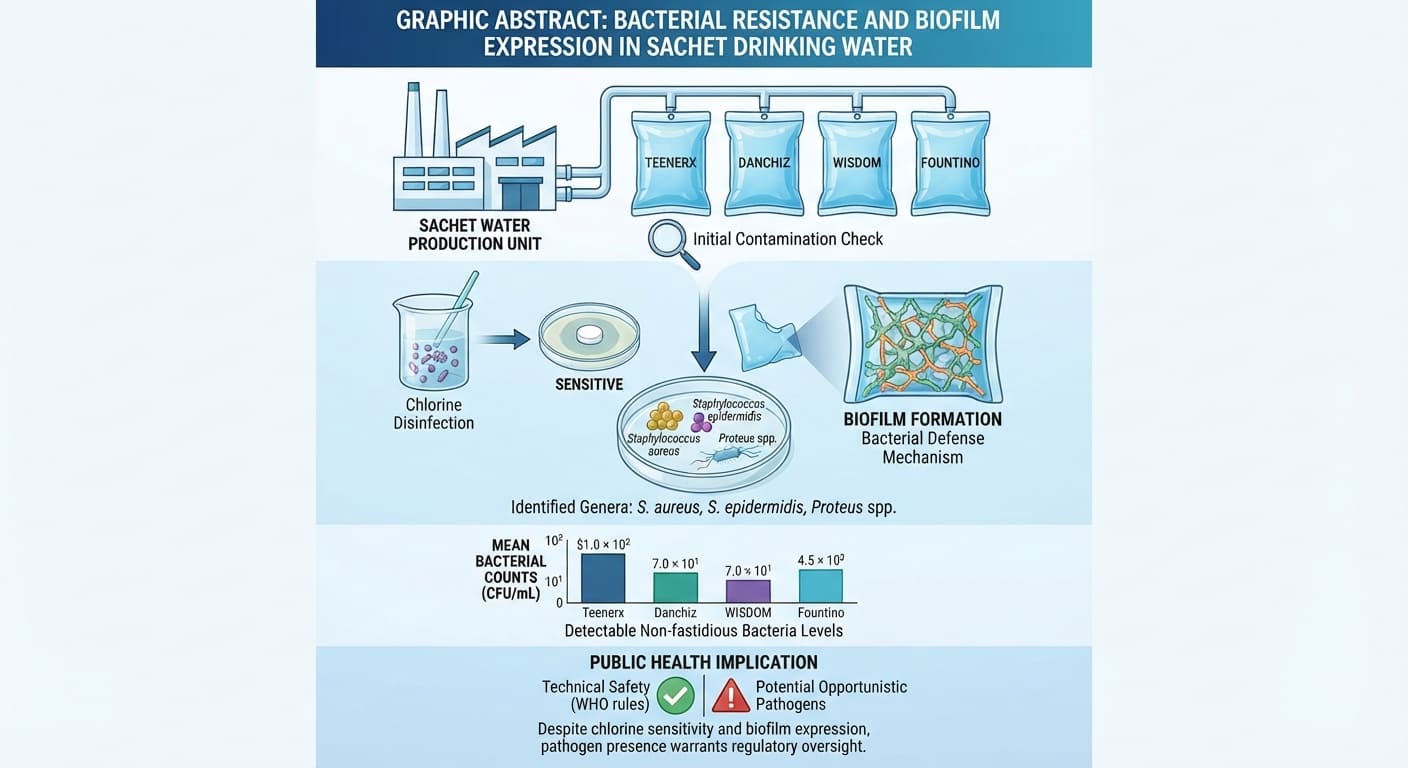
Bacterial resistance to water purification processes reflects the capacity of microorganisms to adapt to changing environments, necessitating a critical re-evaluation of bacterial resistance patterns in drinking water. Although sachet drinking water often contains detectable microbial loads, the potential role of inadequate disinfection procedures within quality control units is frequently overlooked. This study investigated ten samples from each of four popular brands of sachet drinking water (Teenerx, Danchiz, Wisdom, and Fountino table water) purchased within the study area in Nigeria. Isolation and enumeration of bacteria were performed using the spread plate technique, while morphological and biochemical characterizations were conducted to identify specific bacterial genera. The results revealed detectable concentrations of non-fastidious bacteria across the samples, with mean total viable counts of 1.0 x 10², 7.0 x 101, and 4.5 x 10² CFU/mL for Teenerx, Danchiz, and Fountino table water, respectively, showing statistically significant differences (p < 0.05). The isolated bacteria were identified as Staphylococcus aureus, Staphylococcus epidermidis, and Proteus spp., all of which exhibited sensitivity to chlorine alongside distinct biofilm-forming features. While chlorine susceptibility indicates effective protein denaturation, the expression of biofilm structures serves as a cellular defense mechanism that enhances bacterial persistence in water systems. Although these levels may technically comply with specific baseline colony-forming thresholds, the presence of opportunistic pathogens poses potential public health concerns that warrant strict regulatory oversight. Therefore, this study recommends a comprehensive reassessment of bacterial resistance traits and optimization of disinfection protocols in sachet water production to ensure consumer safety.
References
Adesakin, T. A., Oyewale, A. T., Mohammed, N. A., Bayero, U., Adedeji, A. A., Aduwo, I. A., Bolade, A. C., & Adam, M. (2022). Effects of Prolonged Storage Condition on the Physicochemical and Microbiological Quality of Sachet Water and Its Health Implications: A Case Study of Selected Water Brands Sold within Samaru Community, Northwest Nigeria. Microbiology Research, 13(4), 706–720. https://doi.org/10.3390/microbiolres13040051
Ahiabor, W. K., & Donkor, E. S. (2025). Microbial Safety of Sachet Water in Ghana: A Systematic Review. Environmental Health Insights, 19, 11786302241307830. https://doi.org/10.1177/11786302241307830
Ali, S., Mishra, P., Brindha, K., Gutiérrez, M., Kumar, R., Sunkari, E. D., Gevera, P. K., Karro, E., Egbueri, J. C., Dehbandi, R., Chandrajith, R., Li, P., Islam, A. R. Md. T., Yun, S.-T., Sabino, H., Emilio, M. D., Baba, A., Durrani, T. S., Amiri, V., … Bhattacharya, P. (2026). Global groundwater contamination by geogenic fluoride. Environmental Geochemistry and Health, 48(9), 410. https://doi.org/10.1007/s10653-026-03187-8
Anwar, S., Alrumaihi, F., Sarwar, T., Babiker, A. Y., Khan, A. A., Prabhu, S. V., & Rahmani, A. H. (2024). Exploring Therapeutic Potential of Catalase: Strategies in Disease Prevention and Management. Biomolecules, 14(6), 697. https://doi.org/10.3390/biom14060697
Asril, M., Rini, I. A., Rismawati, R., Yuspiah, E. F., Ananta, M. I., Ivanka, T., Agustin, R., & Putri, A. N. (2023). Assessment of Bacterial Contaminants Associated with Hygiene Behaviour in Thai Tea Sold on the Roadside Around Educational Area, Lampung, Indonesia. Jurnal Kesehatan Lingkungan, 15(3), 183–195. https://doi.org/10.20473/jkl.v15i3.2023.183-195
Baranzoni, G. M., Fratamico, P. M., Boccia, F., Bagi, L. K., Kim, G. ‐H., Anastasio, A., & Pepe, T. (2017). Evaluation of the performance of the IQ ‐Check kits and the USDA Microbiology Laboratory Guidebook methods for detection of Shiga toxin‐producing Escherichia coli ( STEC ) and STEC and Salmonella simultaneously in ground beef. Journal of Applied Microbiology, 122(3), 809–816. https://doi.org/10.1111/jam.13380
Botondi, R., Barone, M., & Grasso, C. (2021). A Review into the Effectiveness of Ozone Technology for Improving the Safety and Preserving the Quality of Fresh-Cut Fruits and Vegetables. Foods, 10(4), 748. https://doi.org/10.3390/foods10040748
Dimpor, J. J., Lucky, O. P., Kwarkye, D. F., Watts, S., Oguayo, C. P., Ojewole, C. O., & Kusi, J. (2025). Identifying spatiotemporal patterns and drivers of fecal indicator bacteria in an urban lake for water quality assessment and management. Heliyon, 11(1), e40955. https://doi.org/10.1016/j.heliyon.2024.e40955
Dissasa, G., Lemma, B., & Mamo, H. (2022). Isolation and identification of major bacteria from three Ethiopian rift valley lakes live and processed fish, and water samples: Implications in sanitary system of fish products. BMC Veterinary Research, 18(1), 439. https://doi.org/10.1186/s12917-022-03508-w
El-Nemr, I., Mushtaha, M., Irungu, P., Asim, H., Tang, P., Hasan, M., & Goktepe, I. (2019). Assessment of Food Safety Knowledge, Self-Reported Practices, and Microbiological Hand Hygiene Levels of Produce Handlers in Qatar. Journal of Food Protection, 82(4), 561–569. https://doi.org/10.4315/0362-028X.JFP-18-191
Espina, G., Atalah, J., & Blamey, J. M. (2021). Extremophilic Oxidoreductases for the Industry: Five Successful Examples With Promising Projections. Frontiers in Bioengineering and Biotechnology, 9, 710035. https://doi.org/10.3389/fbioe.2021.710035
Fijan, S., Kürti, P., Rozman, U., & Šostar Turk, S. (2024). A critical assessment of microbial-based antimicrobial sanitizing of inanimate surfaces in healthcare settings. Frontiers in Microbiology, 15, 1412269. https://doi.org/10.3389/fmicb.2024.1412269
Foote, A. M., Woods, E., Fredes, F., & Leon, J. S. (2017). Rendering fecal waste safe for reuse via a cost-effective solar concentrator. Journal of Water, Sanitation and Hygiene for Development, 7(2), 252–259. https://doi.org/10.2166/washdev.2017.112
Gomes, M. P. (2024). The Convergence of Antibiotic Contamination, Resistance, and Climate Dynamics in Freshwater Ecosystems. Water, 16(18), 2606. https://doi.org/10.3390/w16182606
Gross, E., Guenther, I., & Schipper, Y. (2022). Improved water supply and water handling technologies: Revealed complements but perceived substitutes for safe water quality. Development Engineering, 7, 100089. https://doi.org/10.1016/j.deveng.2021.100089
Hu, Y., Meng, F.-L., Hu, Y.-Y., Habibul, N., & Sheng, G.-P. (2020). Concentration- and nutrient-dependent cellular responses of microalgae Chlorella pyrenoidosa to perfluorooctanoic acid. Water Research, 185, 116248. https://doi.org/10.1016/j.watres.2020.116248
Izah, S. C., & Ogwu, M. C. (2025). Modeling solutions for microbial water contamination in the global south for public health protection. Frontiers in Microbiology, 16, 1504829. https://doi.org/10.3389/fmicb.2025.1504829
Koumassa, O. A. B., Ouétchéhou, R., Hounsou, M., Zannou, O., & Dabadé, D. S. (2025). Factors influencing street-vended foods quality and safety in developing countries: A review. Discover Food, 5(1), 18. https://doi.org/10.1007/s44187-025-00286-w
Kudakwashe, S., Alfred, M. G., Obadiah, M., Farai, C. F., Nkazimulo, M. B., & Calletta, G. (2020). Evaluation of the Appropriateness of the Current Sugarcane Out-grower Support Programs towards Improving Yields in the Lowveld of Zimbabwe. Asian Journal of Advances in Agricultural Research, 20–40. https://doi.org/10.9734/ajaar/2020/v13i230101
Lee, H., Abdul Halim, H., Thong, K., & Chai, L. (2017). Assessment of Food Safety Knowledge, Attitude, Self-Reported Practices, and Microbiological Hand Hygiene of Food Handlers. International Journal of Environmental Research and Public Health, 14(1), 55. https://doi.org/10.3390/ijerph14010055
Mehdipour, M., Gholipour, S., Mohammadi, F., Hatamzadeh, M., & Nikaeen, M. (2023). Incidence of co-resistance to antibiotics and chlorine in bacterial biofilm of hospital water systems: Insights into the risk of nosocomial infections. Journal of Infection and Public Health, 16, 210–216. https://doi.org/10.1016/j.jiph.2023.10.032
Mosi, L., Adadey, S. M., Sowah, S. A., & Yeboah, C. (2019). Microbiological assessment of sachet water “pure water” from five regions in Ghana. AAS Open Research, 1, 12. https://doi.org/10.12688/aasopenres.12837.2
Nishmitha, P. S., Akhilghosh, K. A., Aiswriya, V. P., Ramesh, A., Muthuchamy, M., & Muthukumar, A. (2025). Understanding emerging contaminants in water and wastewater: A comprehensive review on detection, impacts, and solutions. Journal of Hazardous Materials Advances, 18, 100755. https://doi.org/10.1016/j.hazadv.2025.100755
Nwaiwu, O., Claret Aduba, C., & Eniola Oni, O. (2020). Bacteriological Quality of Borehole and Sachet Water from a Community in Southeastern Nigeria. In S. Kırmusaoğlu & S. Bhonchal Bhardwaj (Eds.), Pathogenic Bacteria. IntechOpen. https://doi.org/10.5772/intechopen.91812
Onyebuchi Okafor, C., Ibiam Ude, U., Ngozi Okoh, F., & Osose Eromonsele, B. (2024). Safe Drinking Water: The Need and Challenges in Developing Countries. In S. Dincer, H. Aysun Mercimek Takci, & M. Sumengen Ozdenefe (Eds.), Water Quality—New Perspectives. IntechOpen. https://doi.org/10.5772/intechopen.108497
Pereira, E. D. A. A., De Araujo, M. M. C., De Sousa, A. F. N., Batista, G. D. S., De Lacerda, M. C., Cunha, P. H., & Silva, V. F. (2026). Microbial contamination in drinking water sources: A study on safety and public health. Total Environment Microbiology, 2(3), 100095. https://doi.org/10.1016/j.temicr.2026.100095
Popoola, B. M., Ogwerel, J. P., & Oladipo, O. G. (2024). Bacterial isolates from drinking water river sources exhibit multi-drug resistant trait. Environmental Monitoring and Assessment, 196(11), 1054. https://doi.org/10.1007/s10661-024-13117-9
Rodríguez‐Melcón, C., Alonso‐Calleja, C., & Capita, R. (2024). The One Health approach in food safety: Challenges and opportunities. Food Frontiers, 5(5), 1837–1865. https://doi.org/10.1002/fft2.458
Rosemiarti, T., Sunardi, D., & Putri, N. M. (2026). Safe Drinking Water and Its Impact on Children’s Growth and Development: A Systematic Review. International Journal of Environmental Research and Public Health, 23(3), 313. https://doi.org/10.3390/ijerph23030313
Rossi, F., Santonicola, S., Amadoro, C., Marino, L., & Colavita, G. (2024). Food and Drinking Water as Sources of Pathogenic Protozoans: An Update. Applied Sciences, 14(12), 5339. https://doi.org/10.3390/app14125339
Saeed, S. W. Z., Naseer, I., Zahir, Z. A., Hilger, T., Shahid, S., Iqbal, Z., & Ahmad, M. (2023). Bacillus Strains with Catalase Enzyme Improve the Physiology and Growth of Rice (Oryza sativa L.). Stresses, 3(4), 736–748. https://doi.org/10.3390/stresses3040050
Sharma, S., Chauhan, A., Ranjan, A., Mathkor, D. M., Haque, S., Ramniwas, S., Tuli, H. S., Jindal, T., & Yadav, V. (2024). Emerging challenges in antimicrobial resistance: Implications for pathogenic microorganisms, novel antibiotics, and their impact on sustainability. Frontiers in Microbiology, 15, 1403168. https://doi.org/10.3389/fmicb.2024.1403168
Singh, A., Yelverton, C. J., & Barnard, T. G. (2019). Rapid Quantification of the Total Viable Bacterial Population on Human Hands Using Flow Cytometry with SYBR® Green I. Cytometry Part B: Clinical Cytometry, 96(5), 397–403. https://doi.org/10.1002/cyto.b.21776
Singh, C. K., Sodhi, K. K., V, N., Rajagopalan, V., Sharma, S., Kaur, J., & Kumar, Y. (2025). Managing the complexity of emerging contaminants in aquatic environments: Exploring their ecotoxicological impacts, detection techniques, and the use of innovative technologies for their remediation. Discover Catalysis, 2(1), 9. https://doi.org/10.1007/s44344-025-00013-8
Tenebe, I. T., Babatunde, E. O., Eddy-Ugorji, C. C., Etu, E.-E. E., Ogarekpe, N. M., Ekeanyanwu, C. V., Diekola, O. A., Oladele, O. S., & Ezeudu, O. B. (2023). Bacterial Contamination Levels and Brand Perception of Sachet Water: A Case Study in Some Nigerian Urban Neighborhoods. Water, 15(9), 1762. https://doi.org/10.3390/w15091762
Tenebe, I. T., Babatunde, E. O., Ogarekpe, N. M., Emakhu, J., Etu, E.-E., Edo, O. C., Omeje, M., & Benson, N. U. (2024). Detection and Measurement of Bacterial Contaminants in Stored River Water Consumed in Ekpoma. Water, 16(18), 2696. https://doi.org/10.3390/w16182696
Umoafia, N. E., Edet, U. O., Joseph, A. P., Henshaw, O. U., Mbim, E. N., Obeten, H., Edet, B. O., Edet, A., Ibor, O. R., Nkang, N., Louis, H., Nwaokorie, F. O., & Nkang, A. (2023). Impacts of sunlight exposure on physicochemical parameters, potential toxic metals, and microbial characteristics of sachet drinking water sold in Calabar metropolis, Nigeria. SN Applied Sciences, 5(12), 380. https://doi.org/10.1007/s42452-023-05585-4
Umoessien, U. S., Antia, U. E., Christopher, M., & Owowo, E. E. (2019). Antibiotic Susceptibility Patterns of Bacteria Isolated from Sachet-packaged Water Sold in Uyo Metropolis, Akwa Ibom State, Nigeria. International Journal of Pathogen Research, 1–11. https://doi.org/10.9734/ijpr/2019/v3i130085
Volf, G., Sušanj Čule, I., Atanasova, N., Zorko, S., & Ožanić, N. (2025). Explaining and Predicting Microbiological Water Quality for Sustainable Management of Drinking Water Treatment Facilities. Sustainability, 17(15), 6659. https://doi.org/10.3390/su17156659
Ya’aba, Y., Chuku, A., Okposhi, U. S., Mohammed, S. B., Adigwe, O. P., & Ramalan, A. S. (2021). Bacterial contaminants associated with automated teller machines (ATMS) keypads in Lafia Metropolis, Nasarawa State, Nigeria. Bayero Journal of Pure and Applied Sciences, 13(1), 46–53. https://doi.org/10.4314/bajopas.v13i1.8
Downloads
Published
How to Cite
Issue
Section
License
Copyright (c) 2026 RADINKA JOURNAL OF SCIENCE AND SYSTEMATIC LITERATURE REVIEW

This work is licensed under a Creative Commons Attribution 4.0 International License.
<a rel="license" href="http://creativecommons.org/licenses/by/4.0/"><img alt="Creative Commons License" style="border-width:0" src="https://i.creativecommons.org/l/by/4.0/88x31.png" /></a><br />This work is licensed under a <a rel="license" href="http://creativecommons.org/licenses/by/4.0/">Creative Commons Attribution 4.0 International License</a>.


