
Teachers’ Perception of Positive Discipline Intervention Support as Predictor of Effective Classroom Management
DOI:
https://doi.org/10.56778/rjslr.v4i2.694Keywords:
Keywords Positive Discipline Intervention Support, Classroom Management, Descriptive-Correlative Design, Liloan National High SchoolAbstract
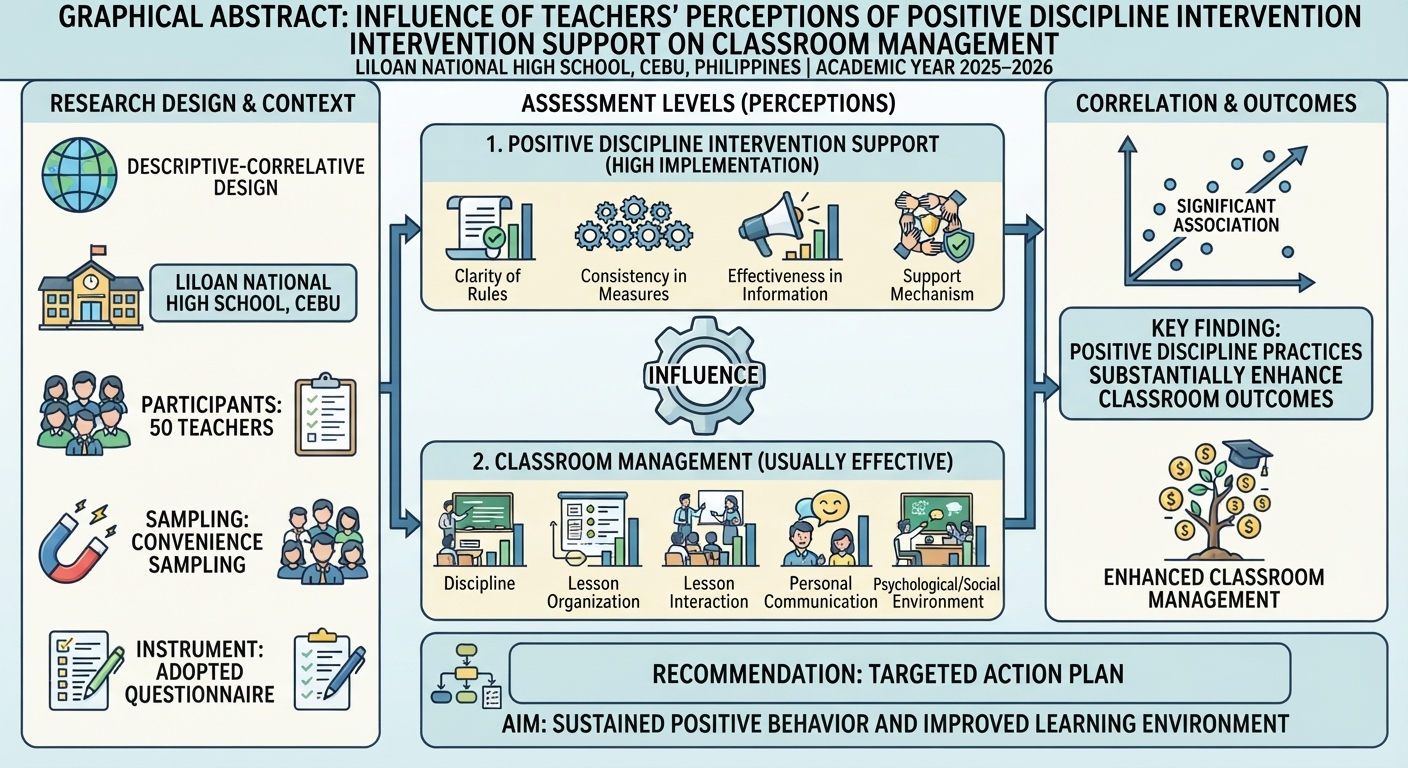
This study examined the influence of teachers’ perceptions of positive discipline intervention support on their classroom management at Liloan National High School, Poblacion, Liloan, Cebu, Philippines during the academic year 2025–2026, serving as a basis for a targeted action plan. Employing a descriptive-correlative research design, the study involved 50 teachers selected through convenience sampling who completed an adopted questionnaire to assess their implementation levels of support and classroom management, as well as the relationship between them. The findings revealed that teachers highly implemented positive discipline intervention support across dimensions such as clarity of rules and expectations, consistency in applying positive discipline measures, effectiveness in conveying information, and support mechanisms. Furthermore, teachers perceived their classroom management as usually effective across dimensions, including discipline, lesson organization, lesson interaction, teacher-student personal communication, and the psychological and social classroom environment. The results also established a significant association between positive discipline intervention support and effective classroom management, indicating that structured positive discipline practices substantially enhance classroom outcomes and serving as an empirical foundation for the proposed action plan.
References
Ahmed, N., & Pierre, D. P. (2024). The role of classroom management in enhancing learners’ academic performance: Teachers’ experiences. Studies in Learning and Teaching, 5(1), 202–218. https://doi.org/10.46627/silet.v5i1.364
Amor, M., & Palomer, N. (2024). Perceptions on classroom discipline management of intermediate learners and teachers: Bases for an enhanced classroom discipline program. International Journal of Education Humanities and Social Science, 07(03), 499–534. https://doi.org/10.54922/ijehss.2024.0729
Angelical, M. J. R. L., & Doronio, F. III R. (2025). Best practices of teachers in maintaining students discipline: A phenomenological inquiry. Asian Journal of Education and Social Studies, 51(8), 383–394. https://doi.org/10.9734/ajess/2025/v51i82248
Apan, C. E. (2024). Classroom management practices and learners’ discipline: Foundation for an enhanced classroom environment program. International Journal of Education Humanities and Social Science, 07(06), 606–640. https://doi.org/10.54922/ijehss.2024.0867
Cabasag, M. (2024). Classroom Management Skills and Work Performance: Faculty Enhancement Plan. Psychology and Education: A Multidisciplinary Journal, 26(9), 1–1. https://ejournals.ph/article.php?id=32715
Chen, Z. (2023, February 7). The influence of school’s reward systems on students’ development. ResearchGate; Darcy & Roy Press Co. Ltd. https://www.researchgate.net/publication/368383934_The_Influence_of_School
Curayag, E., & Naquila, A. (2025). Effectiveness of Teachers’ Classroom Styles and Students’ Learning Engagement. Psychology and Education: A Multidisciplinary Journal, 47(4), 1–1. https://ejournals.ph/article.php?id=31930
Hasanov, M., & Brandišauskienė, A. (2025). The expression of positive discipline in the primary classroom: A case study of one school. Education Sciences, 15(4), 490. https://doi.org/10.3390/educsci15040490
Islam, F. (2025, April 30). The impact of positive classroom management strategies and student engagement in young learner’s English classroom: A thematic review. https://doi.org/10.13140/RG.2.2.22178.
Korpershoek, H., Harms, T., de Boer, H., van Kuijk, M., & Doolaard, S. (2016). A Meta-Analysis of the Effects of Classroom Management Strategies and Classroom Management Programs on Students’ Academic, Behavioral, Emotional, and Motivational Outcomes. Review of Educational Research, 86(3), 643–680. https://doi.org/10.3102/0034654315626799
Marquez, J., & Oropa, J. (2025). Effective Classroom Management for the Modern Learning Environment. Journal of Interdisciplinary Perspectives, 3(6). https://doi.org/10.69569/jip.2025.205
McIntosh, K. (2023). Schoolwide positive behavioural interventions and supports and human rights: transforming our educational systems into levers for social justice. International Journal of Developmental Disabilities, 69(1), 5–12. https://doi.org/10.1080/20473869.2022.2116223
Putra, E., & Yanto, M. (2025). Classroom management: boosting student success—a meta-analysis review. Cogent Education, 12(1). https://doi.org/10.1080/2331186x.2025.2458630
Sambo, T., & Dilabayan, N. (2024). Teachers classroom management and disciplinary practices towards learners’ behavior. Psychology and Education: A Multidisciplinary Journal, 20(4), 1–1. https://ejournals.ph/article.php?id=27660
Sandoval, M. T. (2025). Teacher communication and effective classroom management in the Division of Davao del Norte. EPRA International Journal of Environmental Economics, Commerce and Educational Management, 108–115. https://doi.org/10.36713/epra23109
Saro, J. M., Apat, J. Q., & Pareja, M. S. (2023). A Descriptive-Correlational Study of the Teachers’ Motivation, Competences, and Perceptions in Writing Action Research. Journal of Advances in Education and Philosophy, 7(1), 14–24. https://doi.org/10.36348/jaep.2023.v07i01.003
Selda, G., Ong, J. K., Famaranglas, B., Camus, M., & Cosme, J. (2025). Learning Environment and Academic Achievement: A Descriptive-Correlational Study of Fifth Graders. Psychology and Education: A Multidisciplinary Journal, 34(5), 630–637. https://doi.org/10.70838/pemj.340509
The Lawphil Project. (1992, June 17). R.A. 7610. Lawphil.net. https://lawphil.net/statutes/repacts/ra1992/ra_7610_1992.html
Wang, X. (2023). Exploring positive teacher-student relationships: the synergy of teacher mindfulness and emotional intelligence. Frontiers in Psychology, 14(14). https://doi.org/10.3389/fpsyg.2023.1301786
Wilkins, N. J., Verlenden, J. M. V., Szucs, L. E., & Johns, M. M. (2022). Classroom management and facilitation approaches that promote school connectedness. Journal of School Health, 93(7), 582–593. https://doi.org/10.1111/josh.13279
Zeinstra, L., Kupers, E., Loopers, J., & de Boer, A. (2023). Real-time teacher-student interactions: The dynamic interplay between need supportive teaching and student engagement over the course of one school year. Teaching and Teacher Education, 121, 103906. https://doi.org/10.1016/j.tate.2022.103906
Zhang, H., Yang, J., & Liu, Z. (2024). Effect of teachers’ teaching strategies on students’ learning engagement: Moderated mediation model. Frontiers in Psychology, 15, 1475048. https://doi.org/10.3389/fpsyg.2024.1475048
Downloads
Published
How to Cite
Issue
Section
License
Copyright (c) 2026 RADINKA JOURNAL OF SCIENCE AND SYSTEMATIC LITERATURE REVIEW

This work is licensed under a Creative Commons Attribution 4.0 International License.
<a rel="license" href="http://creativecommons.org/licenses/by/4.0/"><img alt="Creative Commons License" style="border-width:0" src="https://i.creativecommons.org/l/by/4.0/88x31.png" /></a><br />This work is licensed under a <a rel="license" href="http://creativecommons.org/licenses/by/4.0/">Creative Commons Attribution 4.0 International License</a>.


