
Profitability Analysis of Pepper (Capsicum Species) Production in Okene Local Government Area, Kogi State, Nigeria
DOI:
https://doi.org/10.56778/rjslr.v4i2.674Keywords:
Profitability,capsicum spp,okene LGA,Abstract
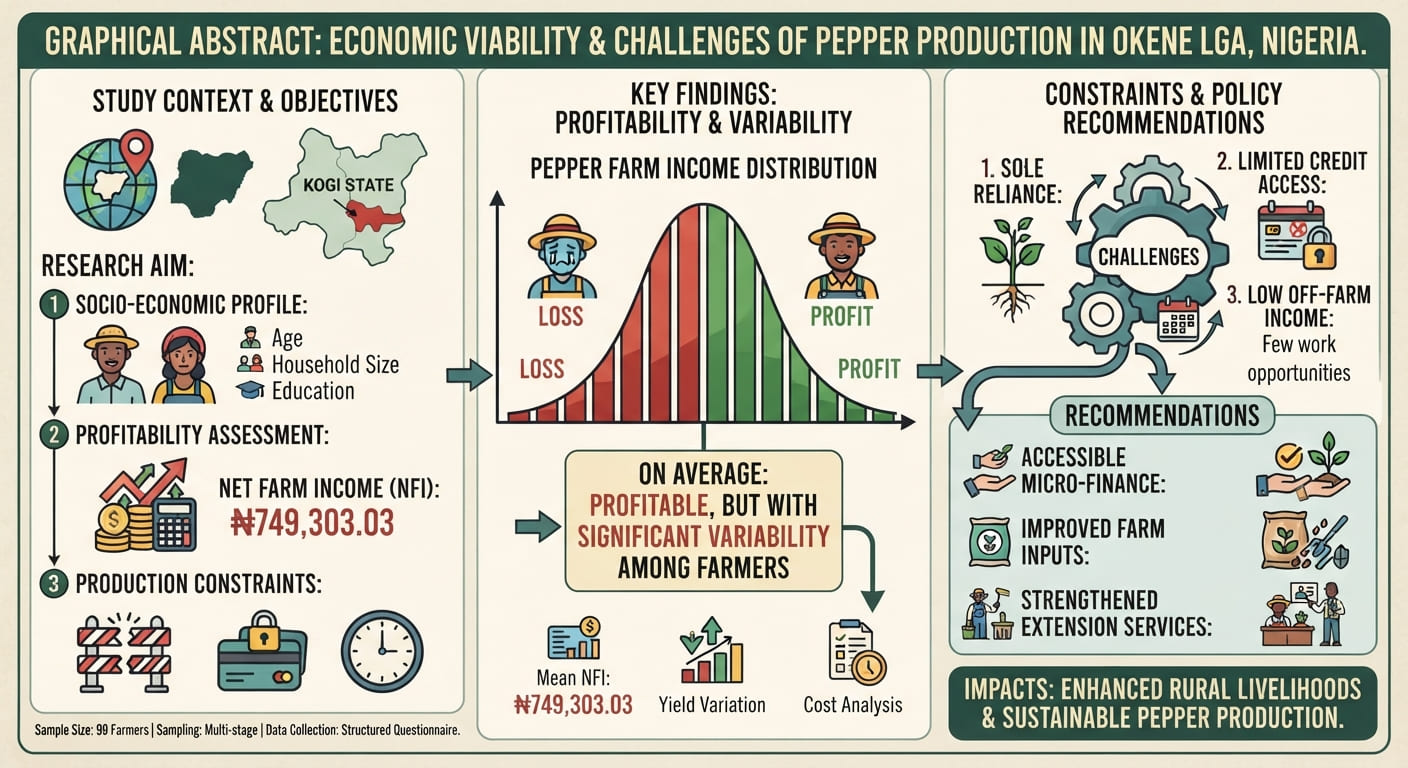
This study investigates the economic viability of and challenges faced by pepper farmers in the region. As a globally significant spice crop of immense culinary and economic importance, pepper contributes to nutritional health and accounts for approximately 40% of vegetable consumption in Nigeria, which yielded 762,174 tonnes of green chilies and peppers in 2020. The research aimed to describe the socio-economic characteristics of chili pepper farmers, assess profitability, and identify production constraints within Okene Local Government Area. Employing a multi-stage sampling technique, data were gathered from 99 respondents using structured questionnaires, personal visits, and interviews. Findings reveal that pepper production in Okene LGA is, on average, profitable, yielding a mean Net Farm Income (NFI) of ₦749,303.03, though significant variability exists, with some farmers experiencing losses. Key constraints identified include sole reliance on pepper farming, limited access to formal credit, and a lack of off-farm employment opportunities. Consequently, the study recommends targeted policy interventions—such as accessible microfinance, improved farm inputs, and stronger agricultural extension services—while emphasizing gender-sensitive development and income diversification to enhance rural sustainability and livelihoods.
References
Adebukola Adeyanju, A., Rebecca Oyenihi, O., & Omoniyi Oguntibeju, O. (2022). Antioxidant-Rich Vegetables: Impact on Human Health. In E. Yildirim & M. Ekinci (Eds.), Vegetable Crops—Health Benefits and Cultivation. IntechOpen. https://doi.org/10.5772/intechopen.101126
Ahmed, N., Zhang, B., Chachar, Z., Li, J., Xiao, G., Wang, Q., Hayat, F., Deng, L., Narejo, M.-N., Bozdar, B., & Tu, P. (2024). Micronutrients and their effects on Horticultural crop quality, productivity and sustainability. Scientia Horticulturae, 323, 112512. https://doi.org/10.1016/j.scienta.2023.112512
Aït-Kaddour, A., Hassoun, A., Tarchi, I., Loudiyi, M., Boukria, O., Cahyana, Y., Ozogul, F., & Khwaldia, K. (2024). Transforming plant-based waste and by-products into valuable products using various “Food Industry 4.0” enabling technologies: A literature review. Science of The Total Environment, 955, 176872. https://doi.org/10.1016/j.scitotenv.2024.176872
Akinola, R., Pereira, L. M., Mabhaudhi, T., De Bruin, F.-M., & Rusch, L. (2020). A Review of Indigenous Food Crops in Africa and the Implications for more Sustainable and Healthy Food Systems. Sustainability, 12(8), 3493. https://doi.org/10.3390/su12083493
Al-Habsi, N., Al-Khalili, M., Haque, S. A., Al Akhzami, N., Gonzalez-Gonzalez, C. R., Al Harthi, S., & Al Jufaili, S. M. (2025). Herbs and spices as functional food ingredients: A comprehensive review of their therapeutic properties, antioxidant and antimicrobial activities, and applications in food preservation. Journal of Functional Foods, 129, 106882. https://doi.org/10.1016/j.jff.2025.106882
Ambarwati, E., Alam, T., Ansari, A., Widada, J., Arwiyanto, T., & Taryono. (2026). Study on root architecture of tropical chili peppers (Capsicum frutescens) inoculated with arbuscular mycorrhizal fungi. Heliyon, 12(1), e44402. https://doi.org/10.1016/j.heliyon.2025.e44402
Ansari, P., Reberio, A. D., Ansari, N. J., Kumar, S., Khan, J. T., Chowdhury, S., Abd El-Mordy, F. M., Hannan, J. M. A., Flatt, P. R., Abdel-Wahab, Y. H. A., & Seidel, V. (2025). Therapeutic Potential of Medicinal Plants and Their Phytoconstituents in Diabetes, Cancer, Infections, Cardiovascular Diseases, Inflammation and Gastrointestinal Disorders. Biomedicines, 13(2), 454. https://doi.org/10.3390/biomedicines13020454
Ateş Akkaya, D., Tunçel, H., & Günay, S. (2026). Peri-urban commercial farmers shaping food security: Challenges and adaptation strategies. Frontiers in Sustainable Food Systems, 10, 1851920. https://doi.org/10.3389/fsufs.2026.1851920
Bal, S., Sharangi, A. B., Upadhyay, T. K., Khan, F., Pandey, P., Siddiqui, S., Saeed, M., Lee, H.-J., & Yadav, D. K. (2022). Biomedical and Antioxidant Potentialities in Chilli: Perspectives and Way Forward. Molecules, 27(19), 6380. https://doi.org/10.3390/molecules27196380
Devirgiliis, C., Guberti, E., Mistura, L., & Raffo, A. (2024). Effect of Fruit and Vegetable Consumption on Human Health: An Update of the Literature. Foods, 13(19), 3149. https://doi.org/10.3390/foods13193149
Dey, S., & Roy, A. (2025). Biotechnological Approaches to Combat Mycetoma in Farmers: Impacts and Sustainable Solutions. Radinka Journal Of Science And Systematic Literature Review, 3(1), 524–536. https://doi.org/10.56778/rjslr.v3i1.456
Dhamodharan, K., Vengaimaran, M., & Sankaran, M. (2023). Pharmacological Properties and Health Benefits of Capsicum Species: A Comprehensive Review. In O. Baylen Yllano (Ed.), Capsicum—Current Trends and Perspectives. IntechOpen. https://doi.org/10.5772/intechopen.104906
Dickson, S. M. & Ogbonnaya Okechukwu Ukegbu. (2024). IoT-Enabled Smart Agriculture: A Pathway to Nigeria’s Economic Recovery and Sustainable. Radinka Journal Of Science And Systematic Literature Review, 2(2), 313–318. https://doi.org/10.56778/rjslr.v2i2.252
Dodocioiu, A. M., Buzatu, G.-D., & Botu, M. (2025). Nitrates and Nitrites in Vegetables and the Health Risk. Foods, 14(17), 3037. https://doi.org/10.3390/foods14173037
El-Saadony, M. T., Saad, A. M., Mohammed, D. M., Alkafaas, S. S., Abd El-Mageed, T. A., Fahmy, M. A., Ezzat Ahmed, A., Algopishi, U. B., Abu-Elsaoud, A. M., Mosa, W. F. A., AbuQamar, S. F., & El-Tarabily, K. A. (2025). Plant bioactive compounds: Extraction, biological activities, immunological, nutritional aspects, food application, and human health benefits—A comprehensive review. Frontiers in Nutrition, 12, 1659743. https://doi.org/10.3389/fnut.2025.1659743
Faisal, A. F., & Mustafa, Y. F. (2025). Chili pepper: A delve into its nutritional values and roles in food-based therapy. Food Chemistry Advances, 6, 100928. https://doi.org/10.1016/j.focha.2025.100928
Fenibo, E. O., & Matambo, T. (2025). Biopesticides for sustainable agriculture: Feasible options for adopting cost-effective strategies. Frontiers in Sustainable Food Systems, 9, 1657000. https://doi.org/10.3389/fsufs.2025.1657000
Frankowska, A., Jeswani, H. K., & Azapagic, A. (2019). Environmental impacts of vegetables consumption in the UK. Science of The Total Environment, 682, 80–105. https://doi.org/10.1016/j.scitotenv.2019.04.424
García Castellanos, B., Villa, P. E. F., García, J. G., & Egea Clemente, F. (2026). Comparative Economic Evaluation of Greenhouse Pepper Cultivation Under Conventional and Organic Management. Agriculture, 16(8), 889. https://doi.org/10.3390/agriculture16080889
García-Gurrola, A., Martínez, A. L., Wall-Medrano, A., Olivas-Aguirre, F. J., Ochoa-Ruiz, E., & Escobar-Puentes, A. A. (2024). Phytochemistry, Anti-cancer, and Anti-diabetic Properties of Plant-Based Foods from Mexican Agrobiodiversity: A Review. Foods, 13(24), 4176. https://doi.org/10.3390/foods13244176
Gutierrez, E. D. U., Dressler, W. H., Brown, T., Glover, D., Wilmsen, B., Limsa, M., Cañete, R., Agravio, R., Pido, M., & Divinagracia, D. (2026). Hanapbuhay: Coping with Informality, Risk, and Insecurity in a Philippine Rice Farming Village. Critical Asian Studies, 58(2), 229–253. https://doi.org/10.1080/14672715.2025.2601952
Habib, M., Singh, S., Jan, S., Jan, K., & Bashir, K. (2025). The future of the future foods: Understandings from the past towards SDG-2. Npj Science of Food, 9(1), 138. https://doi.org/10.1038/s41538-025-00484-x
Jayan, L. S., Rajan, S. S., Mujahid, S. M., Sharma, S., & Wani, K. M. (2025). Capsaicin: An in-depth review of its chemical properties, health benefits, and challenges in food applications. Food Production, Processing and Nutrition, 7(1), 47. https://doi.org/10.1186/s43014-025-00321-4
Jokinen, J. C. (2018). Migration-related land use dynamics in increasingly hybrid peri-urban space: Insights from two agricultural communities in Bolivia. Population and Environment, 40(2), 136–157. https://doi.org/10.1007/s11111-018-0305-7
Lin, J., Shen, H., Ou, H., Luo, H., Huang, D., & Ye, L. (2026). Capsaicin for cardiometabolic syndrome: Multitarget mechanisms and therapeutic potential. Frontiers in Nutrition, 13, 1771003. https://doi.org/10.3389/fnut.2026.1771003
Lukas, A., N. Kairupan, A., Hendriadi, A., Arianto, A., Parulian Manalu, L., Sumarno, L., Munarso, J., Hadipernata, M., M. Elmatsani, H., O. Benyamin, B., Junaidi, A., Jusuf Djafar, M., Elizabeth, R., Sahlan, Nasruddin, Astuti, P., Subandrio, Yohanes, H., E. Koeslulat, E., … Polakitan, A. (2024). Fresh Chili Agribusiness: Opportunities and Problems in Indonesia. In O. Özçatalbaş (Ed.), Sustainable Development (Vol. 16). IntechOpen. https://doi.org/10.5772/intechopen.112786
Maru, A., Bi, J., Wang, J., & Nie, F. (2026). Sustainable Agricultural Industry Development and Poverty Alleviation via Public–Private–Producer Partnership (4P): A Multinational Case Study. Economies, 14(4), 104. https://doi.org/10.3390/economies14040104
Nemzer, B., & Kalita, D. (2023). Bioaccessibility, Bioavailability, Antioxidant Activities and Health Beneficial Properties of Some Selected Spices. In E. Ivanišová (Ed.), Herbs and Spices—New Advances. IntechOpen. https://doi.org/10.5772/intechopen.109774
Oliveira, J. T. D., Cunha, F. F. D., Torezani, S. C., Alves, C. H. A., & Santos, K. B. G. (2025). Economic Viability of Raffia in Black Pepper Crops: An Analysis Based on IRR, NPV, and Payback. Horticulturae, 11(9), 1057. https://doi.org/10.3390/horticulturae11091057
Panchal, S. K., Bliss, E., & Brown, L. (2018). Capsaicin in Metabolic Syndrome. Nutrients, 10(5), 630. https://doi.org/10.3390/nu10050630
Rachmaniah, M., Suroso, A. I., Syukur, M., & Hermadi, I. (2022). Supply and Demand Model for a Chili Enterprise System Using a Simultaneous Equations System. Economies, 10(12), 312. https://doi.org/10.3390/economies10120312
Sehlola, B., & Malahlela-Kgasago, N. D. (2026). Agro-processing participation and economic efficiency of smallholder crop farmers: Pathways to sustainable food systems in Limpopo Province, South Africa. Frontiers in Sustainable Food Systems, 10, 1852426. https://doi.org/10.3389/fsufs.2026.1852426
Sridhar, R., Longkumer, L. T., Pilla, A., Bharteey, P. K., Jatav, H. S., Hareesh, D., Vilakar, K., Singh, A. P., Srikar, K., Aruna, K., & Paarshitha Reddy, M. S. (2026). Diverse fields for stronger yields: Crop diversification strategies for sustainable agriculture and climate-resilient ecosystems. Frontiers in Agronomy, 7, 1746895. https://doi.org/10.3389/fagro.2025.1746895
Szallasi, A. (2022). Dietary Capsaicin: A Spicy Way to Improve Cardio-Metabolic Health? Biomolecules, 12(12), 1783. https://doi.org/10.3390/biom12121783
Truong, L., Morash, D., Liu, Y., & King, A. (2019). Food waste in animal feed with a focus on use for broilers. International Journal of Recycling of Organic Waste in Agriculture, 8(4), 417–429. https://doi.org/10.1007/s40093-019-0276-4
Wan, J., Li, R., Wang, W., Liu, Z., & Chen, B. (2016). Income Diversification: A Strategy for Rural Region Risk Management. Sustainability, 8(10), 1064. https://doi.org/10.3390/su8101064
Wang, G., & Xu, M. (2025). Effect of cooperative membership on farmers’ technology adoption based on the mediating effects of technology cognition. Heliyon, 11(2), e42130. https://doi.org/10.1016/j.heliyon.2025.e42130
Yang, S., Liu, L., Meng, L., & Hu, X. (2019). Capsaicin is beneficial to hyperlipidemia, oxidative stress, endothelial dysfunction, and atherosclerosis in Guinea pigs fed on a high-fat diet. Chemico-Biological Interactions, 297, 1–7. https://doi.org/10.1016/j.cbi.2018.10.006
Yusriadi, Y., Cahaya, A., & Hamzah, F. (2026). Motivations and challenges in adopting food security strategies: Insights from rural Indonesia. Social Sciences & Humanities Open, 13, 102497. https://doi.org/10.1016/j.ssaho.2026.102497
Zhu, X., & Wang, G. (2024). Impact of Agricultural Cooperatives on Farmers’ Collective Action: A Study Based on the Socio-Ecological System Framework. Agriculture, 14(1), 96. https://doi.org/10.3390/agriculture14010096
Downloads
Published
How to Cite
Issue
Section
License
Copyright (c) 2026 RADINKA JOURNAL OF SCIENCE AND SYSTEMATIC LITERATURE REVIEW

This work is licensed under a Creative Commons Attribution 4.0 International License.
<a rel="license" href="http://creativecommons.org/licenses/by/4.0/"><img alt="Creative Commons License" style="border-width:0" src="https://i.creativecommons.org/l/by/4.0/88x31.png" /></a><br />This work is licensed under a <a rel="license" href="http://creativecommons.org/licenses/by/4.0/">Creative Commons Attribution 4.0 International License</a>.


