The Relationship between Nutritional Status and Cognitive Function among Elementary School Students on Pari Island, Kepulauan Seribu, Indonesia
DOI:
https://doi.org/10.56778/rjhs.v4i2.803Keywords:
nutritional status, cognitive function, MMSE-C, elementary school students, Pulau PariAbstract
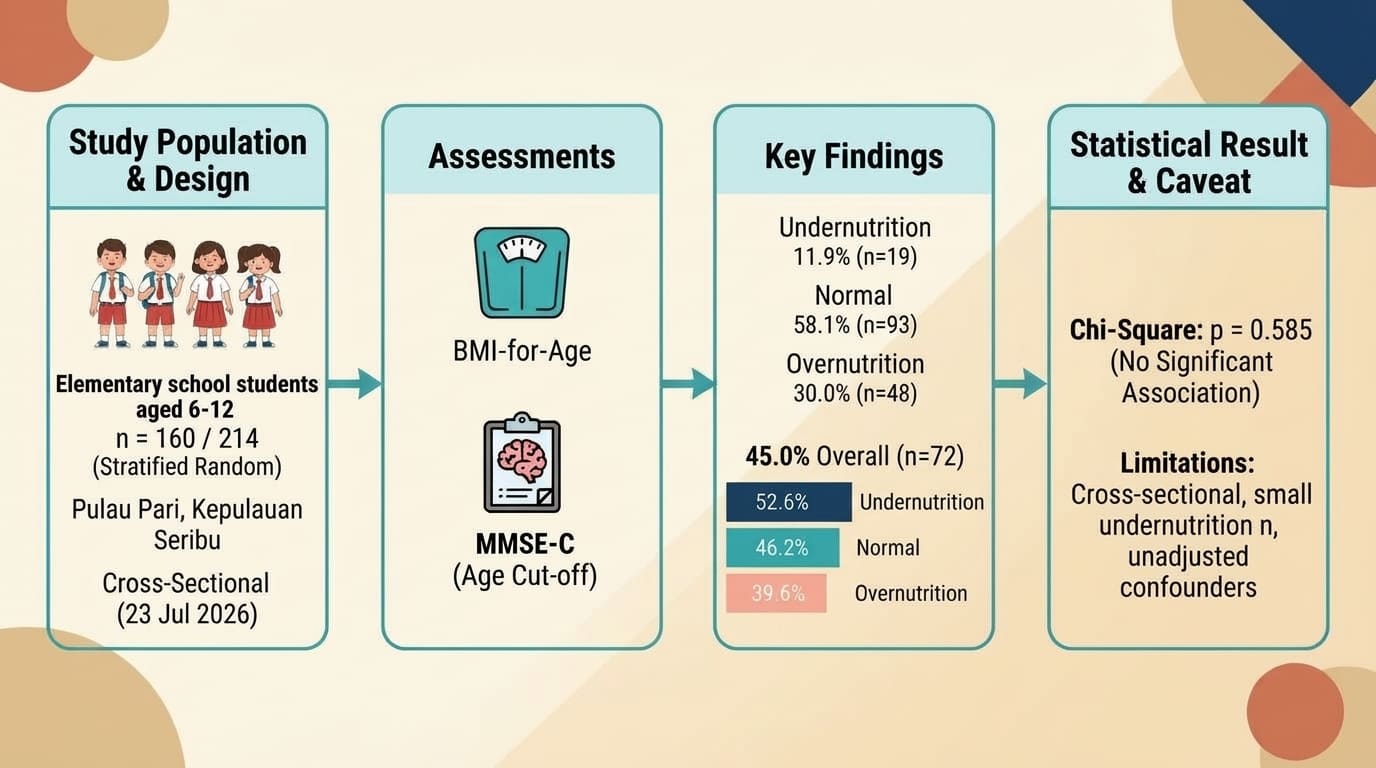
Nutritional status in school-aged children remains a public health concern because an imbalance between nutrient requirements and intake can affect growth, attention, memory, and learning ability. Research on the relationship between nutritional status and cognitive function among elementary school students in island regions such as Pulau Pari remains limited. This study aimed to determine the relationship between nutritional status and cognitive function among elementary school students in Pulau Pari, Kepulauan Seribu. This observational analytic study used a cross-sectional design and involved 160 students aged 6–12 years selected by stratified random sampling from 214 students; data were collected on 23 July 2026. Nutritional status was assessed using body mass index-for-age (BMI-for-age) and categorized as undernutrition, normal nutrition, and overnutrition. Cognitive function was assessed using the Modified Mini Mental State Examination for Children (MMSE-C) with age-specific cut-off scores. Data were analyzed using the chi-square test (α = 0.05). A total of 19 students (11.9%) were undernourished, 93 students (58.1%) had normal nutritional status, and 48 students (30.0%) were overnourished. Cognitive impairment was found in 72 students (45%): 52.6% in the undernutrition group, 46.2% in the normal nutrition group, and 39.6% in the overnutrition group. There was no significant relationship between nutritional status and cognitive function (p = 0.585). These findings do not prove that nutritional status has no effect on cognitive function, given the cross-sectional design, the small number of undernourished respondents, and a bivariate analysis that did not control for confounding factors.
References
Adugna, Y. M., Ayelign, A., & Zerfu, T. A. (2024). Suboptimal nutritional status of school-age children in Addis Ababa: evidence from the analysis of socioeconomic, environmental, and behavioral factors. Frontiers in Public Health, 12. https://doi.org/10.3389/fpubh.2024.1409202
Afni, F., Setianti, Y., Novilla, A., Hudzaifah, M. H., & Rita, R. S. (2024). Dampak Gizi Pada Perkembangan Kognitif Anak: Kajian Literatur Dan Temuan Baru. Jurnal Cahaya Mandalika, 3(2), 1178–1184. https://ojs.cahayamandalika.com/index.php/jcm/article/view/2199
Alam, I. G., Darajat, J., Negara, K., & Zelphira, F. (2020). Effect of Obesity on Cognitive Function: A Comparative Study of Cognitive Level in Normal Weight and Obesity Students at Senior High School in West Java Indonesia. Atlantis Press, 21, 273–276. https://doi.org/10.2991/ahsr.k.200214.072
Daracantika, A., Ainin, A., & Besral. (2021). Systematic Literature Review: Pengaruh Negatif Stunting terhadap Perkembangan Kognitif Anak. Jurnal Biostatistik, Kependudukan, Dan Informatika Kesehatan, 1(2). https://doi.org/10.7454/bikfokes.v1i2.1012
Fayola, A. P., Rosita, S. Z., Griffith, Tarigan, G. H., & Apriliano, W. D. (2025). Determinan Status Gizi Pada Anak Usia Sekolah Dasar Di Perkotaan. Jurnal Penelitian Dan Karya Ilmiah Lembaga Penelitian Universitas Trisakti, 48–61. https://doi.org/10.25105/pdk.v10i1.21912
Hamka, Sumarmi, Patmawati Patmawati, Dewiyanti, Dina, Suardi, Ernawati, & Anita Kartini. (2024). Pengukuran Status Gizi Anak Usia Sekolah menggunakan Indeks Massa Tubuh di Kabupaten Takalar. Jurnal Pengabdian Bidang Kesehatan, 2(4), 01–08. https://doi.org/10.57214/jpbidkes.v2i4.116
Hasanah, idaul. (2017). Hubungan Status Gizi Dengan Tingkat Kognitif Pada Anak Usia Sekolah (11-12 Tahun) Di Sdn Sumbersari 01 Kabupaten Jember [Universitas Muhammadiyah Jember]. https://repository.unmuhjember.ac.id/id/eprint/1029
Hayati, M. A., Anwar, S., Iskandar, W., & Mulyani, I. (2025). The Relationship Between Nutritional Status and Intellectual Intelligence in School-Age Children at State Islamic Elementary School (MIN) 11 West Aceh. JNS: Journal of Nutrition Science Hayati, 6(2), 46–50. https://doi.org/10.35308/jns.v6i2.14638
Isfahani, A., Isfanda, & Rahmayanti, Y. (2025). Gambaran Status Gizi Pada Anak Usia Sekolah Dasar Di Kecamatan Kuta Baro Kabupaten Aceh Besar. Jurnal Ilmu Kedokteran Dan Kesehatan, 12(2), 445–449. https://doi.org/doi.org/10.33024/jikk.v12i2.17146
Jain, M., & Passi, G. R. (2005). Assessment of a Modified Mini-Mental Scale for Cognitive Functions in Children. Indian Pediatrics, 42(9), 907–912.
Kementrian Kesehatan Republik Indonesia. (2023). Survey Kesehatan Indonesia 2023. https://www.badankebijakan.kemkes.go.id/ski-2023-dalam-angka/
Khoe, L. C., Widyahening, I. S., Ali, S., & Khusun, H. (2022). Assessment of the obesogenic environment in primary schools: a multi-site case study in Jakarta. BMC Nutrition, 8(1). https://doi.org/10.1186/s40795-022-00513-y
Komalasari, R., Evry, I., Widianti, D., Siti, M., Sari, I., Farida, Y., Batubara, L., Zakiyah, M., & Rahayu, S. (2025). Nutritional Status And Anemia In Adolescents: Preparation Of A Nutritional Lunch Program At Smpn 01 Kepulauan Seribu. In CoMPHI Journal: Community Medicine and Public Health of Indonesia Journal (Vol. 6, Number 2). https://doi.org/doi.org/10.37148/comphijournal.v6i2.313
Lin, Y. C., Chang, C. C., Chang, Y. T., Liu, W. L., Liao, Y. C., & Lin, R. T. (2026). The Cognitive Functions of Youth With Obesity: A Meta-Analysis. In Brain and Behavior (Vol. 16, Number 11). John Wiley and Sons Ltd. https://doi.org/10.1002/brb3.71884
Ma’arif, I., & Mahfud, F. (2022). Survey Status Gizi saat Pandemi Covid-19 pada Siswa Sekolah Dasar Negeri Se-Kecamatan Gudo. 3(1), 1–5. https://doi.org/doi.org/10.46838/spr.v3i1.138
Mubarak, R., Rizkidawati, & Denafianti. (2025). Gambaran Fungsi Kognitif Pada Anak Sekolah Dasar Dengan Menggunakan Kuesioner Mini Mental State Examination Modified di Kecamatan Ingin Jaya Aceh Besar. Future Academia : The Journal of Multidisciplinary Research on Scientific and Advanced, 3(3), 1330–1338. https://doi.org/10.61579/future.v3i3.574
Nia, M., & Setyowati, S. (2022). Hubungan Status Gizi terhadap Perkembangan Kognitif Anak Kelompok B di TKIT Al-Uswah, Bangil, Pasuruan. PAUD Teratai, 11(1), 148–154. https://ejournal.unesa.ac.id/index.php/paud-teratai/article/view/46785?
Peni, T., Laili, S. I., Jayanti, E. D., & Sari, D. A. (2020). Analysis Of Cognitive Abilities Of School-Age Children Based On Eating Habits And Nutritional Status. International Journal of Nursing and Midwifery Science, 4(1), 37–45. https://doi.org/doi.org/10.29082/IJNMS/2020/Vol4/Iss1/257
Putri, W. A., Suyono, Salbila, I., & Adella, S. (2019). Perkembangan Kognitif dan Landasan Mendidik Siswa di SD PAB 12 SAMPAL. Informatics Media Journal, 5(2), 153–158. https://ejournal.sisfokomtek.org/index.php/jumin/article/view/3467
Rakhmalia Imeldawati. (2025). Dampak Terjadinya Stunting terhadap Perkembangan Kognitif Anak : Literature Review. Jurnal Medika Nusantara, 3(1), 101–107. https://doi.org/10.59680/medika.v3i1.1632
Samigullin, A., Gählert, J., Groß, G., Morcos, M., Schwertz, R., Öste, R., Siegel, E., & Humpert, P. (2025). A central role of nutrition in cognitive function among primary school children: a cross-sectional analysis. BMC Nutrition, 11(1). https://doi.org/10.1186/s40795-025-01016-2
Samson, K. L. I., Fischer, J. A. J., & Roche, M. L. (2022). Iron Status, Anemia, and Iron Interventions and Their Associations with Cognitive and Academic Performance in Adolescents: A Systematic Review. In Nutrients (Vol. 14, Number 1). MDPI. https://doi.org/10.3390/nu14010224
Saputra, H. E., Handryastuti, S., Mangunatmadja, I., Widodo, D. P., & Pardede, S. O. (2020). Ouvrier’s modified mini mental state examination as a screening test for cognitive impairment in pediatric epilepsy. Paediatrica Indonesiana(Paediatrica Indonesiana), 60(3), 137–141. https://doi.org/10.14238/pi60.3.2020.137-41
Sartika, A. N., Ekasari, A., & Prasetya, G. (2025). Snacking behavior among school-aged children in urban area. 13, 179–187. https://doi.org/doi.org/10.21927/ijnd.2025.13(2).179-187
Simamora, M., Sipayung, R., Sinaga, J., & Sutrisna, A. A. (2023). Kejadian Stunting Dengan Kemampuan Kognitif Anak Usia Sekolah. Jurnal Online Keperawatan Indonesia, 6(1), 29–36. https://doi.org/10.51544/keperawatan.v6i1.4304
Tia, A., Hauser, J., Konan, A. G., Ciclet, O., Grzywinski, Y., Mainardi, F., Visconti, G., Frézal, A., & Nindjin, C. (2025). Unraveling the relationship between nutritional status, cognitive function, and school performance among school-aged children in Taabo, Côte d’Ivoire: a school-based observational study. Frontiers in Nutrition, 12. https://doi.org/10.3389/fnut.2025.1630497
Utami, U. P., & Fadjri, T. K. (2023). Pengaruh Status Gizi dan Status Anemia terhadap Prestasi Belajar Siswa SD Negeri 2 Aceh Tamiang. NASUWAKES: Jurnal Kesehatan Ilmiah, 16(1), 29–37. https://doi.org/doi.org/10.30867/nasuwakes.v16i1.417
Wikurendra, E. A. (2018). Masalah Gizi Pada Anak Usia Sekolah. Jurnal Ilmiah Kesehatan Media Husada, 7(2), 65–70. https://doi.org/10.33475/jikmh.v7i2.21
Wongbusarakum, S., & Ayson, E. G. D. J. (2017). Building Climate-Resilient Fisheries And Aquaculture In The Asia-Pacific Region. FAO. https://www.fao.org/fishery/publication/259172/en
Wrottesley, S. V., Mates, E., Brennan, E., Bijalwan, V., Menezes, R., Ray, S., Ali, Z., Yarparvar, A., Sharma, D., & Lelijveld, N. (2023). Nutritional status of school-age children and adolescents in low- and middle-income countries across seven global regions: a synthesis of scoping reviews. In Public Health Nutrition (Vol. 26, Number 1, pp. 63–95). Cambridge University Press. https://doi.org/10.1017/S1368980022000350
Yusnita, Batubara, L., & Komalasari, R. (2026). Pemetaan Kesiapan Sekolah Dan Status Gizi Siswa Untuk Program Makan Bergizi Gratis Di Wilayah Kepulauan. Doi.Org/10.31604/Jpm.V9i6.2347-2360, 9(6), 2347–2360. https://doi.org/10.31604/jpm.v9i6.2347-2360
Zega, B. K., & suprihati, W. (2021). Pengaruh Perkembangan Kognitif Pada Anak. Jurnal Teologi Dan Pendidikan Kristen), 3(1), 17–24. https://doi.org/doi.org/10.59177/veritas.v3i1.101
Downloads
Published
How to Cite
Issue
Section
License
Copyright (c) 2026 RADINKA JOURNAL OF HEALTH SCIENCE

This work is licensed under a Creative Commons Attribution 4.0 International License.
<meta name="google-site-verification" content="qBtkk8rnBm0ZRgy_14UYrahahLnkC844dKsDOFjzrn4" />