The Effectiveness of Community-Based Triggering on Waste Management Behavior Change and Fly Density in Tambang Village, Tambang District, Kampar Regency, Indonesia 2026
DOI:
https://doi.org/10.56778/rjhs.v4i2.781Keywords:
Triggering, waste management, fly density, environmental health, behaviorAbstract
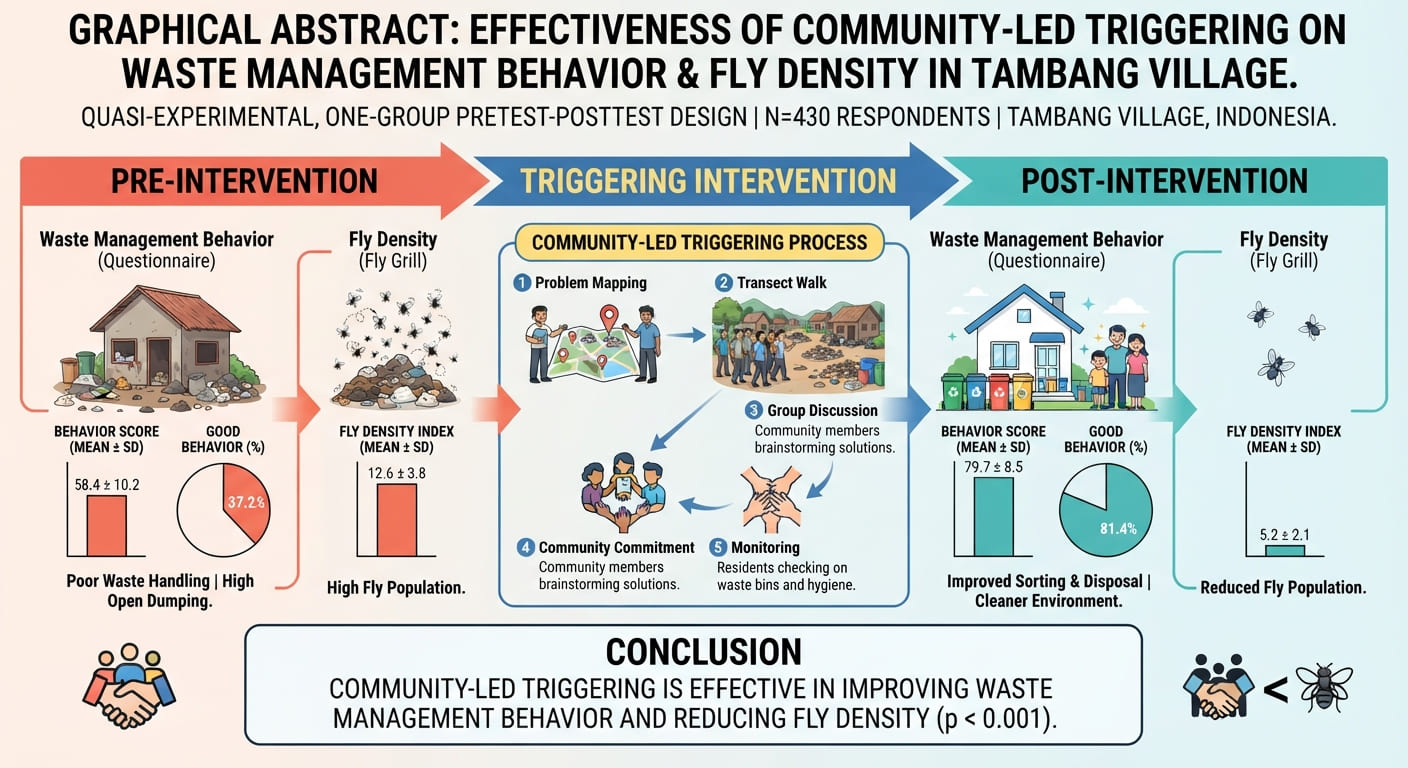
Inadequate waste management remains an environmental health issue in many rural areas. Unmanaged waste piles can serve as breeding grounds for flies, potentially transmitting environmental-related diseases. Efforts to change community behavior through a community-led triggering approach require evaluation regarding their effectiveness—not only in terms of behavioral change but also the resulting environmental impact. This study aimed to analyze the effectiveness of community-led triggering on waste management behavior and fly density in Tambang Village, Tambang District, Kampar Regency. A quasi-experimental, one-group pretest-posttest design was employed. A sample of 430 respondents was selected using purposive sampling. The intervention consisted of a four-week triggering program comprising problem mapping, transect walks, group discussions, community commitment, and monitoring. Behavior was assessed using a structured questionnaire, while fly density was measured using a fly grill at 20 observation points. Data were analyzed using a paired t-test with a 95% confidence level. The average score for waste management behavior increased from 58.4 ± 10.2 to 79.7 ± 8.5 following the intervention (p < 0.001). The percentage of respondents categorized as having "good" behavior rose from 37.2% to 81.4%. The mean fly density index decreased from 12.6 ± 3.8 to 5.2 ± 2.1 (p < 0.001). In conclusion, community-led triggering is effective in improving how households manage waste and reducing fly density in residential areas.
References
Adhikari, S., Hunter, E., Vossenberg, J. V. D., & Thomas, J. (2023). A review of latrine front-end characteristics associated with microbial infection risk; reveals a lack of pathogen density data. International Journal of Hygiene and Environmental Health, 254, 114261. https://doi.org/10.1016/j.ijheh.2023.114261
Agamuthu, P., & Babel, S. (2023). Waste management developments in the last five decades: Asian perspective. Waste Management & Research: The Journal for a Sustainable Circular Economy, 41(12), 1699–1716. https://doi.org/10.1177/0734242X231199938
Akhtar, N., Syakir Ishak, M. I., Bhawani, S. A., & Umar, K. (2021). Various Natural and Anthropogenic Factors Responsible for Water Quality Degradation: A Review. Water, 13(19), 2660. https://doi.org/10.3390/w13192660
Amato, C., Jerie, S., Mutekwa, T. V., Shabani, T., Shabani, T., & Tafadzwa, M. (2024). Impacts of solid waste management strategies in urban high density suburbs: A case of Amaveni suburb, Kwekwe, Zimbabwe. Discover Environment, 2(1), 97. https://doi.org/10.1007/s44274-024-00118-1
Arista, N. I. D., Handayani, D., & Ernawati, N. (2023). Is It Possible to Implement the Same Circular-Economy Concept in Rural and Urban Areas? Study on Willingness to Pay for Household Waste. Sustainability, 15(7), 5843. https://doi.org/10.3390/su15075843
Asih, A. M. S., Prasetyo, D. H., & Sopha, B. M. (2026). Household recycling behavior and community-based waste management: An agent-based modeling of socioeconomic heterogeneity in urban Indonesia. Journal of Environmental Management, 399, 128658. https://doi.org/10.1016/j.jenvman.2026.128658
Dara, M. Z. N., Abbas, A., Temitope, A., Li, L., Duan, G., & Sun, W. (2026). Plant-pathogen interactions and transmissions: Unraveling the complex role of pathogen vectors in disease ecology. Journal of Integrative Agriculture, 25(7), 2635–2668. https://doi.org/10.1016/j.jia.2025.04.028
Glova Végsöová, O., & Straka, M. (2025). Illegal Waste Dumps and Water Quality: Environmental and Logistical Challenges for Sustainable Development—A Case Study of the Ružín Reservoir (Slovakia). Environments, 12(8), 251. https://doi.org/10.3390/environments12080251
Gunarathne, V., Phillips, A. J., Zanoletti, A., Rajapaksha, A. U., Vithanage, M., Di Maria, F., Pivato, A., Korzeniewska, E., & Bontempi, E. (2024). Environmental pitfalls and associated human health risks and ecological impacts from landfill leachate contaminants: Current evidence, recommended interventions and future directions. Science of The Total Environment, 912, 169026. https://doi.org/10.1016/j.scitotenv.2023.169026
Hajam, Y. A., Kumar, R., & Kumar, A. (2023). Environmental waste management strategies and vermi transformation for sustainable development. Environmental Challenges, 13, 100747. https://doi.org/10.1016/j.envc.2023.100747
Hossain, M. A., Ferdous, N., & Ferdous, E. (2024). Crisis-driven disruptions in global waste management: Impacts, challenges and policy responses amid COVID-19, Russia-Ukraine war, climate change, and colossal food waste. Environmental Challenges, 14, 100807. https://doi.org/10.1016/j.envc.2023.100807
Islam, N. F., Gogoi, B., Saikia, R., Yousaf, B., Narayan, M., & Sarma, H. (2024). Encouraging circular economy and sustainable environmental practices by addressing waste management and biomass energy production. Regional Sustainability, 5(4), 100174. https://doi.org/10.1016/j.regsus.2024.100174
Kafle, S., Karki, B. K., Sakhakarmy, M., & Adhikari, S. (2025). A Review of Global Municipal Solid Waste Management and Valorization Pathways. Recycling, 10(3), 113. https://doi.org/10.3390/recycling10030113
Koller, K., Pankowska, P. K., & Brick, C. (2023). Identifying bias in self-reported pro-environmental behavior. Current Research in Ecological and Social Psychology, 4, 100087. https://doi.org/10.1016/j.cresp.2022.100087
Kreitchmann, R. S., Abad, F. J., Ponsoda, V., Nieto, M. D., & Morillo, D. (2019). Controlling for Response Biases in Self-Report Scales: Forced-Choice vs. Psychometric Modeling of Likert Items. Frontiers in Psychology, 10, 2309. https://doi.org/10.3389/fpsyg.2019.02309
Lavidas, K., Papadakis, S., Manesis, D., Grigoriadou, A. S., & Gialamas, V. (2022). The Effects of Social Desirability on Students’ Self-Reports in Two Social Contexts: Lectures vs. Lectures and Lab Classes. Information, 13(10), 491. https://doi.org/10.3390/info13100491
Li, S., Hao, J., Li, T., Zhang, Y., Feng, T., & Zhu, X. (2026). Unpacking the emotional drive: A grounded theory model of online collective action in social media. Frontiers in Psychology, 17, 1753234. https://doi.org/10.3389/fpsyg.2026.1753234
Lim, W. M. (2025). What Is Qualitative Research? An Overview and Guidelines. Australasian Marketing Journal, 33(2), 199–229. https://doi.org/10.1177/14413582241264619
Liu, M., Lei, Z., Gao, Y., & Li, X. (2025). A framework for rural spatial governance based on the eco-environment oriented development mode: The case of coal mining subsidence area on the Weibei Plateau. Frontiers of Architectural Research, 14(1), 224–247. https://doi.org/10.1016/j.foar.2024.07.013
Macaulay, O. A., Sobola, A. O., & Obayori, O. S. (2026). Environmental and health implications of emerging pollutants in landfill leachate: A review. Discover Hazards, 2(1), 40. https://doi.org/10.1007/s44475-026-00042-3
Midtgård, K., & Selart, M. (2025). Cognitive Biases in Strategic Decision-Making. Administrative Sciences, 15(6), 227. https://doi.org/10.3390/admsci15060227
Niu, S.-H., Liu, S., Deng, W.-K., Wu, R.-T., Cai, Y.-F., Liao, X.-D., & Xing, S.-C. (2022). A sustainable and economic strategy to reduce risk antibiotic resistance genes during poultry manure bioconversion by black soldier fly Hermetia illucens larvae: Larval density adjustment. Ecotoxicology and Environmental Safety, 232, 113294. https://doi.org/10.1016/j.ecoenv.2022.113294
Nugraha, L. F., Sulistyowati, L., Setiawan, I., & Noor, T. I. (2022). Alternative Community-Based Village Development Strategies in Indonesia: Using Multicriteria Decision Analysis. Agriculture, 12(11), 1903. https://doi.org/10.3390/agriculture12111903
Okin, Y. K., Yabar, H., Kevin, K. L., Mizunoya, T., & Higano, Y. (2024). Geospatial Analysis of Malaria and Typhoid Prevalence Due to Waste Dumpsite Exposure in Kinshasa Districts with and Without Waste Services: A Case Study of Bandalungwa and Bumbu, Democratic Republic of Congo. International Journal of Environmental Research and Public Health, 21(11), 1495. https://doi.org/10.3390/ijerph21111495
Qi, J., Mazumdar, S., & Vasconcelos, A. C. (2024). Understanding the Relationship between Urban Public Space and Social Cohesion: A Systematic Review. International Journal of Community Well-Being, 7(2), 155–212. https://doi.org/10.1007/s42413-024-00204-5
Raghu, S. J., & Rodrigues, L. L. R. (2020). Behavioral aspects of solid waste management: A systematic review. Journal of the Air & Waste Management Association, 70(12), 1268–1302. https://doi.org/10.1080/10962247.2020.1823524
Rashed, A. H. (2025). Sustainable solid waste management in the context of environmental governance. Discover Sustainability, 7(1), 148. https://doi.org/10.1007/s43621-025-02385-1
Saha, S., & Melnik, R. (2025). Integrating Emotion-Specific Factors into the Dynamics of Biosocial and Ecological Systems: Mathematical Modeling Approaches Accounting for Psychological Effects. Mathematical and Computational Applications, 30(6), 136. https://doi.org/10.3390/mca30060136
Sattayapanich, T., Janmaimool, P., & Chontanawat, J. (2022). Factors Affecting Community Participation in Environmental Corporate Social Responsibility Projects: Evidence from Mangrove Forest Management Project. Journal of Open Innovation: Technology, Market, and Complexity, 8(4), 209. https://doi.org/10.3390/joitmc8040209
Segala, F. V., Guido, G., Stroffolini, G., Masini, L., Cattaneo, P., Moro, L., Motta, L., Gobbi, F., Nicastri, E., Vita, S., Iatta, R., Otranto, D., Locantore, P., Occa, E., Putoto, G., Saracino, A., & Di Gennaro, F. (2025). Insights into the ecological and climate crisis: Emerging infections threatening human health. Acta Tropica, 262, 107531. https://doi.org/10.1016/j.actatropica.2025.107531
Sembiring, E., Fenitra, R. M., Dangkua, A. R., Khoeriyah, Z. B. A., Van Der Laan, A. Z., Fan, Y., Ceschin, F., & Jobling, S. (2024). Improving household waste management in Indonesia: A mixed-methods approach for waste Sorting. Cleaner Waste Systems, 9, 100185. https://doi.org/10.1016/j.clwas.2024.100185
Su, H., Zhang, B., Shi, J., He, S., Dai, S., Zhao, Z., Wu, D., & Li, J. (2025). Black Soldier Fly Larvae as a Novel Protein Feed Resource Promoting Circular Economy in Agriculture. Insects, 16(8), 830. https://doi.org/10.3390/insects16080830
Su, H., Zhang, B., Yang, R., Shi, J., He, S., Dai, S., Wu, D., & Zhao, Z. (2026). The Valorization of Food Waste into High-Value Biomass and Organic Fertilizers Through Bioconversion Using Black Soldier Fly Larvae (Hermetia illucens). Recycling, 11(1), 8. https://doi.org/10.3390/recycling11010008
Sumiyati, S., Samadikun, B. P., Khallouf, N. N., Puspita, A. S., Budihardjo, M. A., & Ammar, M. A. (2026). Modeling a circular economy–based community solid waste processing system: Life cycle assessment and local economic feasibility. Cleaner Chemical Engineering, 15, 100232. https://doi.org/10.1016/j.clce.2026.100232
Surya, B., Hadijah, H., Suriani, S., Baharuddin, B., Fitriyah, A. T., Menne, F., & Rasyidi, E. S. (2020). Spatial Transformation of a New City in 2006–2020: Perspectives on the Spatial Dynamics, Environmental Quality Degradation, and Socio—Economic Sustainability of Local Communities in Makassar City, Indonesia. Land, 9(9), 324. https://doi.org/10.3390/land9090324
Syamsiyah, N., Sadeli, A. H., Saidah, Z., Noor, T. I., & Widiyanesti, S. (2025). Community Participation in the Development of Sustainable, Environmentally Conscious Villages in the Cirasea Sub-Watershed, Indonesia. Sustainability, 17(11), 4871. https://doi.org/10.3390/su17114871
Tariq, M. R., Liu, S., Wang, F., Wang, H., Mo, Q., Zhuang, Z., Zheng, C., Liang, Y., Liu, Y., Ur Rehman, K., Helvaci, M., Qin, J., & Li, C. (2025). Black Soldier Fly: A Keystone Species for the Future of Sustainable Waste Management and Nutritional Resource Development: A Review. Insects, 16(8), 750. https://doi.org/10.3390/insects16080750
Teym, A., Adane, B., Moges, M., Tesfaye, A. H., Birhan, A. T., Getachew, H., Negesse, A., & Zeleke, S. K. (2026). Sanitation practices and associated factors among households in Gozamin District, Northwest Ethiopia. Discover Sustainability, 7(1), 923. https://doi.org/10.1007/s43621-026-03805-6
Wilkie, D. C. H., Lipnickas, G., & Pham, N. T. A. (2026). Emotional contagion on social media: Pathways, effects, and insights for marketers. Journal of Marketing Management, 42(1–2), 57–90. https://doi.org/10.1080/0267257X.2025.2570739
Yamin, P., Fei, M., Lahlou, S., & Levy, S. (2019). Using Social Norms to Change Behavior and Increase Sustainability in the Real World: A Systematic Review of the Literature. Sustainability, 11(20), 5847. https://doi.org/10.3390/su11205847
Downloads
Published
How to Cite
Issue
Section
License
Copyright (c) 2026 RADINKA JOURNAL OF HEALTH SCIENCE

This work is licensed under a Creative Commons Attribution 4.0 International License.
<meta name="google-site-verification" content="qBtkk8rnBm0ZRgy_14UYrahahLnkC844dKsDOFjzrn4" />