What is the Impact of Thiamine Dyshomeostasis on Neurotrophic Signalling in HIV-Associated Neurodegeneration: A Systematic Review?
DOI:
https://doi.org/10.56778/rjhs.v4i1.773Keywords:
Brain-derived neurotrophic factor; HIV long-term survivors; Neurocognitive disorders; Peripheral nervous system diseases; Thiamine.Abstract
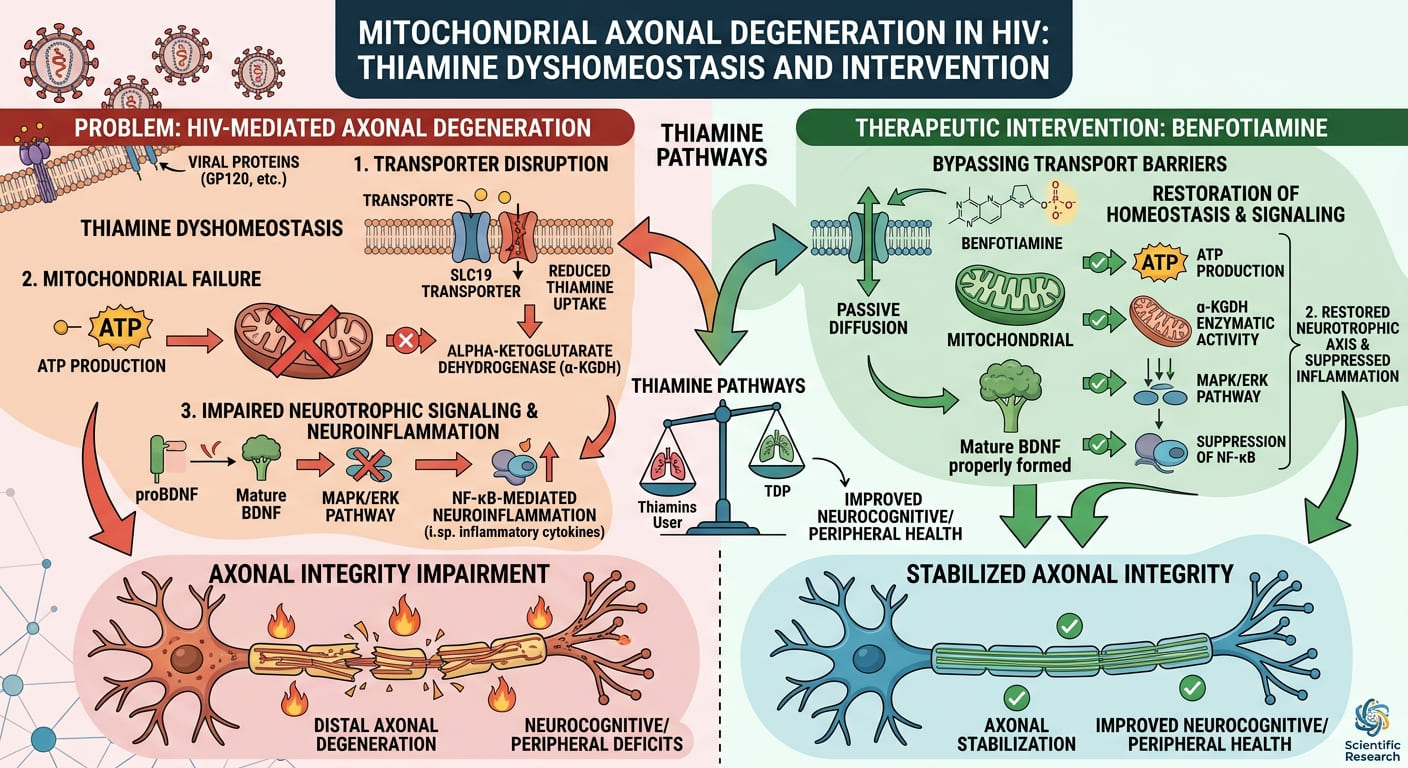
Human immunodeficiency virus-associated neurocognitive disorders and peripheral neuropathy remain persistent clinical challenges despite effective viral suppression through antiretroviral therapy. Recent evidence suggests that vitamin B1 dyshomeostasis serves as a critical metabolic bottleneck that accelerates axonal degeneration. This study aims to elucidate the molecular interplay between thiamine homeostasis and neurotrophic signaling in human immunodeficiency virus-associated neurodegeneration, specifically identifying metabolic drivers of axonal damage. Following the PRISMA 2020 guidelines, a comprehensive search was conducted across PubMed, Scopus, Web of Science, and Google Scholar for peer-reviewed studies published between 2018 and 2025. Quality assessment was performed using Joanna Briggs Institute tools to ensure high-quality evidence. The analysis revealed that viral proteins, particularly glycoprotein 120, disrupt solute carrier family 19 thiamine transporters, precipitating a mitochondrial adenosine triphosphate failure. This bioenergetic crisis fundamentally impairs the thiamine-neurotrophic axis by hindering the proteolytic cleavage of pro-brain-derived neurotrophic factor into its mature form and silencing the mitogen-activated protein kinase/extracellular signal-regulated kinase survival pathway, driving distal axonal degeneration. Conversely, interventions using high-dose thiamine and lipophilic derivatives, such as benfotiamine, effectively bypass transport barriers via passive diffusion, restore alpha-ketoglutarate dehydrogenase enzymatic activity, and suppress nuclear factor kappa B-mediated neuroinflammation, thereby stabilizing axonal integrity. In conclusion, thiamine dyshomeostasis represents a pivotal metabolic driver of neurodegeneration, and targeted supplementation with benfotiamine offers a promising therapeutic strategy to mitigate neurocognitive and peripheral deficits.
References
Abdou, E., & Hazell, A. S. (2015). Thiamine Deficiency: An Update of Pathophysiologic Mechanisms and Future Therapeutic Considerations. Neurochemical Research, 40(2), 353–361. https://doi.org/10.1007/s11064-014-1430-z
Allen, C. N. S., Arjona, S. P., Santerre, M., De Lucia, C., Koch, W. J., & Sawaya, B. E. (2022). Metabolic Reprogramming in HIV-Associated Neurocognitive Disorders. Frontiers in Cellular Neuroscience, 16, 812887. https://doi.org/10.3389/fncel.2022.812887
Avdoshina, V., Fields, J. A., Castellano, P., Dedoni, S., Palchik, G., Trejo, M., Adame, A., Rockenstein, E., Eugenin, E., Masliah, E., & Mocchetti, I. (2016). The HIV Protein gp120 Alters Mitochondrial Dynamics in Neurons. Neurotoxicity Research, 29(4), 583–593. https://doi.org/10.1007/s12640-016-9608-6
Bachis, A., Avdoshina, V., Zecca, L., Parsadanian, M., & Mocchetti, I. (2012). Human Immunodeficiency Virus Type 1 Alters Brain-Derived Neurotrophic Factor Processing in Neurons. Journal of Neuroscience, 32(28), 9477–9484. https://doi.org/10.1523/JNEUROSCI.0865-12.2012
Baltrusch, S. (2021). The Role of Neurotropic B Vitamins in Nerve Regeneration. BioMed Research International, 2021(1), 9968228. https://doi.org/10.1155/2021/9968228
Bolton, C., & Jones, A. (2012). Thiamine deficiency. BMJ, e8309. https://doi.org/10.1136/sbmj.e8309
Butterfield, T. R., Landay, A. L., & Anzinger, J. J. (2020a). Dysfunctional Immunometabolism in HIV Infection: Contributing Factors and Implications for Age-Related Comorbid Diseases. Current HIV/AIDS Reports, 17(2), 125–137. https://doi.org/10.1007/s11904-020-00484-4
Butterfield, T. R., Landay, A. L., & Anzinger, J. J. (2020b). Dysfunctional Immunometabolism in HIV Infection: Contributing Factors and Implications for Age-Related Comorbid Diseases. Current HIV/AIDS Reports, 17(2), 125–137. https://doi.org/10.1007/s11904-020-00484-4
Butterworth, R. F. (2003). Thiamin deficiency and brain disorders. Nutrition Research Reviews, 16(2), 277–284. https://doi.org/10.1079/NRR200367
Chen, Z., Wang, T., & Deng, K. (2022). Glucose Metabolism and Human Immunodeficiency Virus Type 1 Infection. Infectious Diseases & Immunity, 2(4), 242–247. https://doi.org/10.1097/ID9.0000000000000071
Crater, J. M., Nixon, D. F., & Furler O’Brien, R. L. (2022). HIV-1 replication and latency are balanced by mTOR-driven cell metabolism. Frontiers in Cellular and Infection Microbiology, 12, 1068436. https://doi.org/10.3389/fcimb.2022.1068436
De Freitas-Suarez, A., Espinosa-Ponce, N., Alvarez-Roger, N., Cabrera-Suarez, A. I., Jiménez-Jordán, G., Vega-Roman, R., Inyushin, M., & Alves, J. M. (2023). An Integrative Approach to the Current Treatment of HIV-Associated Neurocognitive Disorders and the Implementation of Leukemia Inhibitor Factor as a Mediator of Neurocognitive Preservation. Life, 13(11), 2194. https://doi.org/10.3390/life13112194
Deme, P., Rubin, L. H., Yu, D., Xu, Y., Nakigozi, G., Nakasujja, N., Anok, A., Kisakye, A., Quinn, T. C., Reynolds, S. J., Mayanja, R., Batte, J., Wawer, M. J., Sacktor, N. C., Saylor, D., & Haughey, N. J. (2022). Immunometabolic Reprogramming in Response to HIV Infection Is Not Fully Normalized by Suppressive Antiretroviral Therapy. Viruses, 14(6), 1313. https://doi.org/10.3390/v14061313
Guo, H., Wang, Q., Ghneim, K., Wang, L., Rampanelli, E., Holley-Guthrie, E., Cheng, L., Garrido, C., Margolis, D. M., Eller, L. A., Robb, M. L., Sekaly, R.-P., Chen, X., Su, L., & Ting, J. P.-Y. (2021). Multi-omics analyses reveal that HIV-1 alters CD4+ T cell immunometabolism to fuel virus replication. Nature Immunology, 22(4), 423–433. https://doi.org/10.1038/s41590-021-00898-1
Haddaway, N. R., Page, M. J., Pritchard, C. C., & McGuinness, L. A. (2022a). PRISMA2020: An R package and Shiny app for producing PRISMA 2020‐compliant flow diagrams, with interactivity for optimised digital transparency and Open Synthesis. Campbell Systematic Reviews, 18(2), e1230. https://doi.org/10.1002/cl2.1230
Haddaway, N. R., Page, M. J., Pritchard, C. C., & McGuinness, L. A. (2022b). PRISMA2020: An R package and Shiny app for producing PRISMA 2020‐compliant flow diagrams, with interactivity for optimised digital transparency and Open Synthesis. Campbell Systematic Reviews, 18(2), e1230. https://doi.org/10.1002/cl2.1230
Hao, S. (2013). The Molecular and Pharmacological Mechanisms of HIV-Related Neuropathic Pain. Current Neuropharmacology, 11(5), 499–512. https://doi.org/10.2174/1570159X11311050005
Ishibashi, S. (2003). Reversible acute axonal polyneuropathy associated with Wernicke-Korsakoff syndrome: Impaired physiological nerve conduction due to thiamine deficiency? Journal of Neurology, Neurosurgery & Psychiatry, 74(5), 674–676. https://doi.org/10.1136/jnnp.74.5.674
Jaman, M. S. (2025). A Review Potential Radioprotective Mechanism of Molecular Hydrogen via Regulation of Cellular Signaling Pathways. Radinka Journal Of Health Science, 3(2), 503–528. https://doi.org/10.56778/rjhs.v3i2.591
Kolson, D. L. (2022). Developments in Neuroprotection for HIV-Associated Neurocognitive Disorders (HAND). Current HIV/AIDS Reports, 19(5), 344–357. https://doi.org/10.1007/s11904-022-00612-2
Le Berre, A.-P., Fama, R., Sassoon, S. A., Pfefferbaum, A., Sullivan, E. V., & Zahr, N. M. (2019). Cognitive and Motor Impairment Severity Related to Signs of Subclinical Wernicke’s Encephalopathy in HIV Infection. JAIDS Journal of Acquired Immune Deficiency Syndromes, 81(3), 345–354. https://doi.org/10.1097/QAI.0000000000002043
Li, P., Zhu, Z., Wang, Y., Zhang, X., Yang, C., Zhu, Y., Zhou, Z., Chao, Y., Long, Y., Gao, Y., Liu, S., Zhang, L., Gao, P., & Qu, Q. (2024). Substrate transport and drug interaction of human thiamine transporters SLC19A2/A3. Nature Communications, 15(1), 10924. https://doi.org/10.1038/s41467-024-55359-8
Maagaard, A., & Kvale, D. (2009). Mitochondrial toxicity in HIV-infected patients both off and on antiretroviral treatment: A continuum or distinct underlying mechanisms? Journal of Antimicrobial Chemotherapy, 64(5), 901–909. https://doi.org/10.1093/jac/dkp316
Mangold, J. F., & Swartz, T. H. (2025). Redox regulation of HIV-1: The thioredoxin pathway, oxidative metabolism, and latency control. Frontiers in Physiology, 16, 1651148. https://doi.org/10.3389/fphys.2025.1651148
Michael, H., Mpofana, T., Ramlall, S., & Oosthuizen, F. (2020). The Role of Brain Derived Neurotrophic Factor in HIV-Associated Neurocognitive Disorder: From the Bench-Top to the Bedside. Neuropsychiatric Disease and Treatment, Volume 16, 355–367. https://doi.org/10.2147/NDT.S232836
Mohan, J., Ghazi, T., Sibiya, T., & Chuturgoon, A. A. (2023). Antiretrovirals Promote Metabolic Syndrome through Mitochondrial Stress and Dysfunction: An In Vitro Study. Biology, 12(4), 580. https://doi.org/10.3390/biology12040580
Muneer, P. M. A., Alikunju, S., Schuetz, H., Szlachetka, A. M., Ma, X., & Haorah, J. (2018). Impairment of Thiamine Transport at the GUT-BBB-AXIS Contributes to Wernicke’s Encephalopathy. Molecular Neurobiology, 55(7), 5937–5950. https://doi.org/10.1007/s12035-017-0811-0
Rakotoambinina, B., Hiffler, L., & Gomes, F. (2021). Pediatric thiamine deficiency disorders in high‐income countries between 2000 and 2020: A clinical reappraisal. Annals of the New York Academy of Sciences, 1498(1), 57–76. https://doi.org/10.1111/nyas.14669
Robinson-Papp, J., & Schütz, S. G. (2013). HIV-related neuropathy: Current perspectives. HIV/AIDS - Research and Palliative Care, 243. https://doi.org/10.2147/HIV.S36674
Rodriguez, N. R., Fortune, T., Hegde, E., Weinstein, M. P., Keane, A. M., Mangold, J. F., & Swartz, T. H. (2024). Oxidative phosphorylation in HIV-1 infection: Impacts on cellular metabolism and immune function. Frontiers in Immunology, 15, 1360342. https://doi.org/10.3389/fimmu.2024.1360342
Routy, J.-P., & Isnard, S. (2023). An army marches on its stomach: Immunometabolic dysregulation in persons with HIV. AIDS, 37(7), 1171–1173. https://doi.org/10.1097/QAD.0000000000003558
Ru, W., & Tang, S.-J. (2017). HIV-associated synaptic degeneration. Molecular Brain, 10(1), 40. https://doi.org/10.1186/s13041-017-0321-z
Sambon, M., Wins, P., & Bettendorff, L. (2021). Neuroprotective Effects of Thiamine and Precursors with Higher Bioavailability: Focus on Benfotiamine and Dibenzoylthiamine. International Journal of Molecular Sciences, 22(11), 5418. https://doi.org/10.3390/ijms22115418
Sénécal, V., Barat, C., & Tremblay, M. J. (2021). The delicate balance between neurotoxicity and neuroprotection in the context of HIV ‐1 infection. Glia, 69(2), 255–280. https://doi.org/10.1002/glia.23904
Shrestha, J., Santerre, M., Allen, C. N. S., Arjona, S. P., Merali, C., Mukerjee, R., Chitrala, K. N., Park, J., Bagashev, A., Bui, V., Eugenin, E. A., Merali, S., Kaul, M., Chin, J., & Sawaya, B. E. (2022). HIV-1 gp120 Impairs Spatial Memory Through Cyclic AMP Response Element-Binding Protein. Frontiers in Aging Neuroscience, 14, 811481. https://doi.org/10.3389/fnagi.2022.811481
Tapias, V., Jainuddin, S., Ahuja, M., Stack, C., Elipenahli, C., Vignisse, J., Gerges, M., Starkova, N., Xu, H., Starkov, A. A., Bettendorff, L., Hushpulian, D. M., Smirnova, N. A., Gazaryan, I. G., Kaidery, N. A., Wakade, S., Calingasan, N. Y., Thomas, B., Gibson, G. E., … Beal, M. F. (2018). Benfotiamine treatment activates the Nrf2/ARE pathway and is neuroprotective in a transgenic mouse model of tauopathy. Human Molecular Genetics, 27(16), 2874–2892. https://doi.org/10.1093/hmg/ddy201
Tyrberg, E., Hagberg, L., Andersson, L.-M., Nilsson, S., Yilmaz, A., Mellgren, Å., Blennow, K., Zetterberg, H., & Gisslén, M. (2022). The effect of vitamin B supplementation on neuronal injury in people living with HIV: A randomized controlled trial. Brain Communications, 4(6), fcac259. https://doi.org/10.1093/braincomms/fcac259
Wenzel, E. D., Avdoshina, V., & Mocchetti, I. (2019). HIV-associated neurodegeneration: Exploitation of the neuronal cytoskeleton. Journal of NeuroVirology, 25(3), 301–312. https://doi.org/10.1007/s13365-019-00737-y
Wenzel, E. D., Speidell, A., Flowers, S. A., Wu, C., Avdoshina, V., & Mocchetti, I. (2019). Histone deacetylase 6 inhibition rescues axonal transport impairments and prevents the neurotoxicity of HIV-1 envelope protein gp120. Cell Death & Disease, 10(9), 674. https://doi.org/10.1038/s41419-019-1920-7
Xu, Y., Zhao, L., Qiu, H., Qian, T., Sang, S., & Zhong, C. (2021). The impact of thiamine deficiency and benfotiamine treatment on Nod-like receptor protein-3 inflammasome in microglia. NeuroReport, 32(12), 1041–1048. https://doi.org/10.1097/WNR.0000000000001691
Downloads
Published
How to Cite
Issue
Section
License
Copyright (c) 2026 RADINKA JOURNAL OF HEALTH SCIENCE

This work is licensed under a Creative Commons Attribution 4.0 International License.
<meta name="google-site-verification" content="qBtkk8rnBm0ZRgy_14UYrahahLnkC844dKsDOFjzrn4" />